


Achievable logoAchievable logo
CMA Part 1
Sign in
Sign up
Purchase
Textbook
Practice exams
Support
How it works
Exam catalog
Mountain with a flag at the peak
Textbook
1. External financial reporting decisions
2. Planning, budgeting, and forecasting
3. Performance management
4. Cost management
5. Internal control
6. Technology and analytics
Achievable logoAchievable logo
3.1.4.5.1 VOH cost variance summary
Achievable CMA Part 1
3. Cost and variance measures
3.1. Management by exception and standard cost systems
3.1.4. Variable overhead (VOH) cost variance
Our CMA Part 1 course is currently in development and is a work-in-progress.

VOH cost variance summary

7 min read
Font
Discuss
Share
Feedback
Definitions
Variable overhead (VOH)
Indirect production costs that vary with the level of activity. These costs are not directly traceable to individual units of production but are essential to the manufacturing process.

Common examples of VOH include indirect materials (e.g., lubricants, cleaning supplies), indirect labor (e.g., wages of machine operators’ assistants), and utilities like electricity tied to production.

The cost drivers for VOH depend on the nature of the production process and the type of overhead incurred. For instance if VOH is closely tied to material usage, the cost driver might be the quantity of materials used. If VOH is more closely linked to indirect labor, the cost driver could be labor hours worked.

In practice, if the CMA exam problem does not explicitly state the cost driver, labor hours are often used as the default for VOH. For this discussion, we will refer to labor hours as the cost driver but it equally applies if the cost driver of the VOH is indirect materials.

The computation of VOH variances is identical to the method used for direct labor variances. Understanding these variances provides insight into cost control and production efficiency for overhead costs, which often represent a significant portion of total manufacturing costs.

The basic formula of the VOH cost variance is as follows:

Variable Overhead Cost Variance=(Standard Hours×Standard Rate)−(Actual Hours×Actual Rate)

Oftentimes the first step in solving overhead variance questions is calculating the standard VOH per unit or the Standard VOH Rate (referred above as the “Standard Rate”). When this is not provided, we need to calculate it manually by using inputs from the master budget:

Standard VOH Rate=Budgeted Hours in the Master BudgetTotal Budgeted VOH from Master Budget​

Same as with previous discussions, it should be noted that the Standard Hours (SH) used in this computation is not the same as the budgeted hours in the master budget. Explained simply, this is the standard hours expected to be used based on actual production volume. It will be explained further when we discuss the efficiency variance.

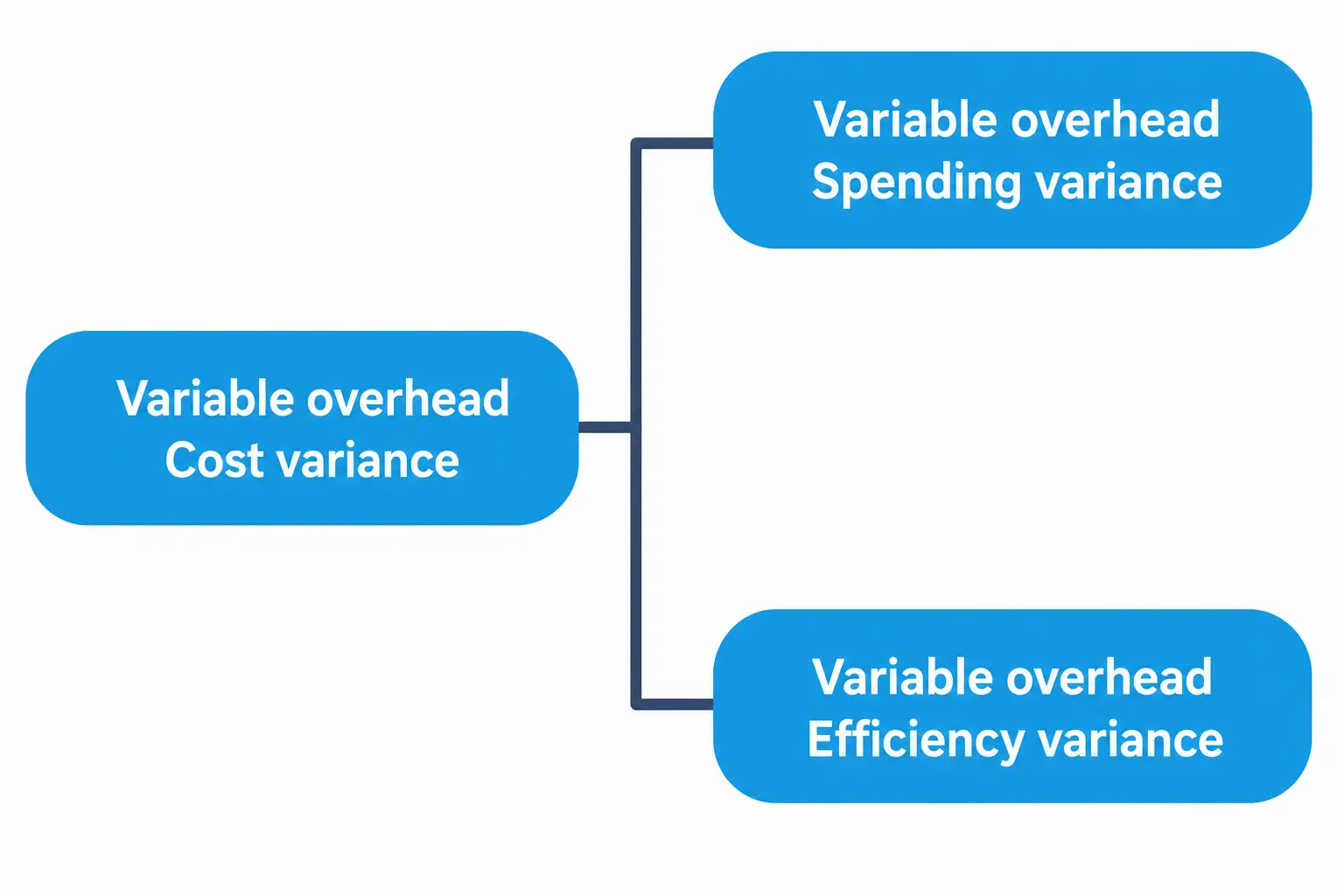
The variable overhead cost variance is broken down into different components to isolate the sources of deviations of actual VOH costs from standard VOH costs. The variance primarily arises from two sources:

  1. differences between the standard rate and the actual rate paid for VOH (Variable Overhead Spending Variance); and
  2. differences between the standard hours allowed and the actual hours worked (Variable Overhead Efficiency Variance).
Splitting variable overhead cost variance into spending and efficiency variance.
VOH Variance Breakdown

Overview of variance formula

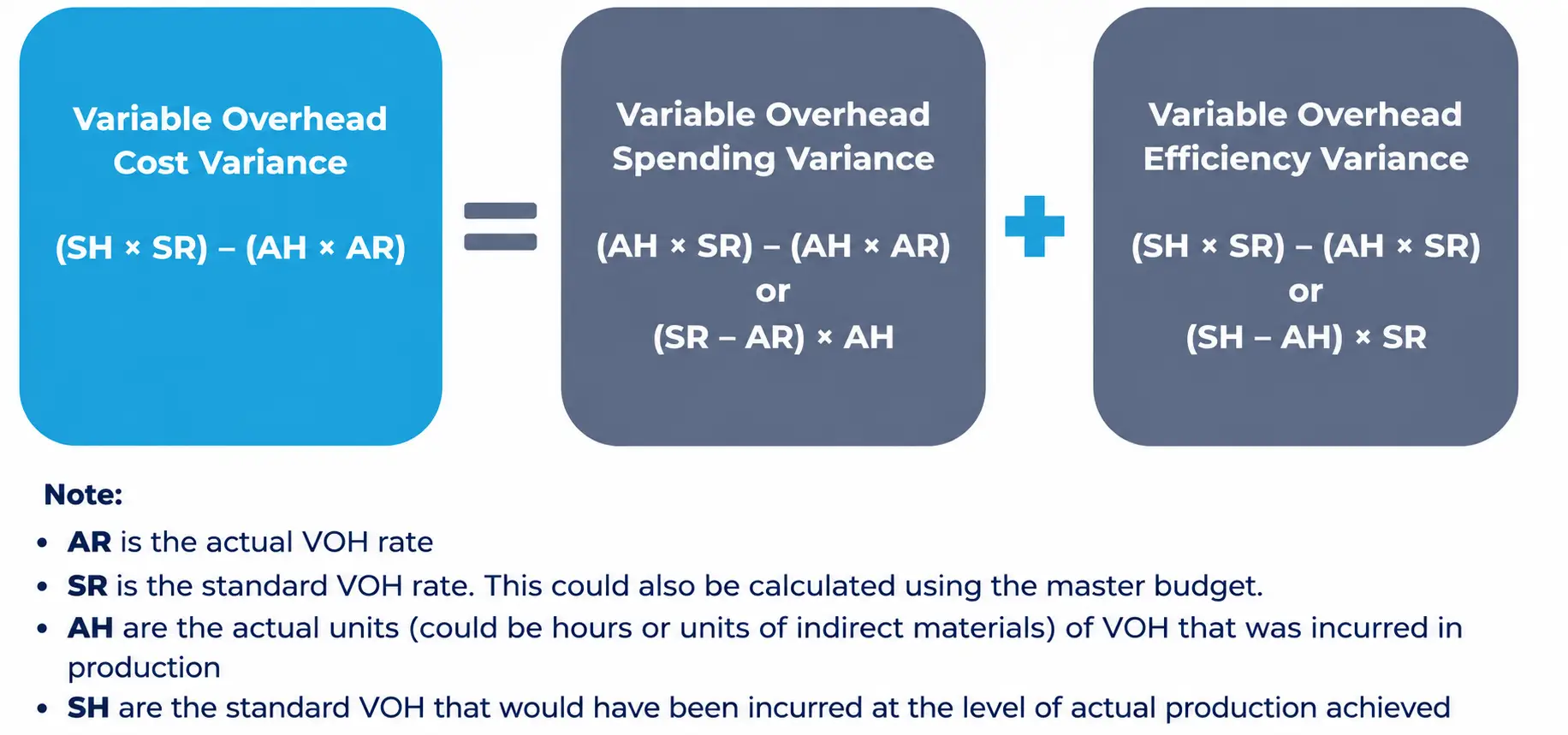
The total of all VOH variances should equal the variable overhead cost variance. This provides a useful way to verify the accuracy of your calculations by comparing the sum of the individual variances to the total VOH cost variance. You can revisit the illustration below once you have finished reading the different components of the VOH cost variance.

Formulas for variable overhead cost, spending, and efficiency variances with variable definitions.
VOH Variances Formulas

Variable overhead spending variance

The formula for calculating variable overhead spending variance is:

VOH Spending Variance=Standard Costs of Actual VOH−Actual Cost of VOH

It can also be expressed in terms of the formulas:

VOH Spending Variance​=(SR×AH)−(AR×AH)=(SR−AR)×AH​

Where:

  • AR is the actual VOH rate
  • SR is the standard VOH rate. As mentioned before, this could be required to be calculated using the master budget.
  • AH are the actual units (could be hours or units of indirect materials) of VOH that was incurred in production

The VOH Spending variance reflects the difference between the actual VOH rate paid per hour and the standard VOH rate established in the budget.

Understanding the reasons behind these variances is essential to avoid confusion. For instance, when the actual indirect labor rate exceeds the standard rate, it creates an unfavorable variance, as higher indirect labor costs negatively impact the company’s financial performance. By analyzing the root causes of these variances, organizations can interpret their implications more accurately and take appropriate corrective actions.

Variable overhead efficiency variance

The formula for calculating variable overhead efficiency variance is:

VOH Efficiency Variance=Standard Cost of Standard VOH for Actual Production−Standard Cost of Actual VOH

It can also be expressed in terms of the formulas:

VOH Efficiency Variance​=(SR×SH)−(SR×AH)=(SH−AH)×SR​

Where:

  • SR is the standard VOH rate. As mentioned before, this could be required to be calculated using the master budget.
  • AH are the actual units (could be hours or units of indirect materials) of VOH that was incurred in production
  • SH are the standard VOH that would have been incurred at the level of actual production achieved
Sidenote
Note on the difference with flexible budget variance

In variance analysis, the term Standard Cost of Standard VOH for Actual Production emphasizes that the actual production level, not the master budget production level, must be used to determine the standard hours (SH) applied to variable overhead. The SH represents the number of hours that should have been incurred for the actual output achieved, based on the standard rate per unit.

For example, if the master budget planned for 100 units and each unit required 3 standard indirect labor hours, the budgeted standard hours would be 300. If actual production was 150 units and only 400 hours of indirect labor were used, the correct SH for variance purposes is 450 hours (150 units × 3 hours), not the 300 hours based on budgeted output.

When applying inputs into the formula, a positive variance indicates a favorable variance, while a negative variance signifies an unfavorable variance. However, to avoid getting confused with the mathematical signs, it is essential to understand the reasons behind these variances to interpret them correctly.

For instance, if the standard VOH hours allowed for production exceed the actual VOH hours worked, this reflects VOH efficiency. Such a scenario is considered favorable for the company, as it indicates that less indirect labor time was required than anticipated, leading to cost savings and improved operational performance.

Variable Overhead (VOH) Basics

  • Indirect production costs varying with activity level
  • Examples: indirect materials, indirect labor, production-related utilities
  • Cost drivers: typically labor hours (default if unspecified), but could be material usage

VOH Variance Formulas

  • Variable Overhead Cost Variance = (Standard Hours × Standard Rate) − (Actual Hours × Actual Rate)
  • Standard VOH Rate = Total Budgeted VOH / Budgeted Hours (from master budget)
  • Standard Hours (SH): based on actual production, not master budget hours

Components of VOH Variance

  • Total VOH variance = sum of spending variance and efficiency variance
  • Variances isolate rate (spending) and usage (efficiency) deviations

Variable Overhead Spending Variance

  • Formula: (Standard Rate × Actual Hours) − (Actual Rate × Actual Hours)
    • Or: (Standard Rate − Actual Rate) × Actual Hours
  • Measures difference between standard and actual VOH rates
  • Unfavorable if actual rate > standard rate

Variable Overhead Efficiency Variance

  • Formula: (Standard Rate × Standard Hours) − (Standard Rate × Actual Hours)
    • Or: (Standard Hours − Actual Hours) × Standard Rate
  • Measures difference between standard hours allowed for actual production and actual hours worked
  • Favorable if standard hours > actual hours (greater efficiency)

Key Calculation Notes

  • Use actual production to determine standard hours for variance analysis
  • Positive variance = favorable; negative variance = unfavorable
  • Analyze root causes for meaningful interpretation and corrective action

Sign up for free to take 18 quiz questions on this topic

Previous
Next  | 3.1.4.5.2 VOH cost variance scenario
All rights reserved ©2016 - 2026 Achievable, Inc.

VOH cost variance summary

Definitions
Variable overhead (VOH)
Indirect production costs that vary with the level of activity. These costs are not directly traceable to individual units of production but are essential to the manufacturing process.

Common examples of VOH include indirect materials (e.g., lubricants, cleaning supplies), indirect labor (e.g., wages of machine operators’ assistants), and utilities like electricity tied to production.

The cost drivers for VOH depend on the nature of the production process and the type of overhead incurred. For instance if VOH is closely tied to material usage, the cost driver might be the quantity of materials used. If VOH is more closely linked to indirect labor, the cost driver could be labor hours worked.

In practice, if the CMA exam problem does not explicitly state the cost driver, labor hours are often used as the default for VOH. For this discussion, we will refer to labor hours as the cost driver but it equally applies if the cost driver of the VOH is indirect materials.

The computation of VOH variances is identical to the method used for direct labor variances. Understanding these variances provides insight into cost control and production efficiency for overhead costs, which often represent a significant portion of total manufacturing costs.

The basic formula of the VOH cost variance is as follows:

Variable Overhead Cost Variance=(Standard Hours×Standard Rate)−(Actual Hours×Actual Rate)

Oftentimes the first step in solving overhead variance questions is calculating the standard VOH per unit or the Standard VOH Rate (referred above as the “Standard Rate”). When this is not provided, we need to calculate it manually by using inputs from the master budget:

Standard VOH Rate=Budgeted Hours in the Master BudgetTotal Budgeted VOH from Master Budget​

Same as with previous discussions, it should be noted that the Standard Hours (SH) used in this computation is not the same as the budgeted hours in the master budget. Explained simply, this is the standard hours expected to be used based on actual production volume. It will be explained further when we discuss the efficiency variance.

The variable overhead cost variance is broken down into different components to isolate the sources of deviations of actual VOH costs from standard VOH costs. The variance primarily arises from two sources:

  1. differences between the standard rate and the actual rate paid for VOH (Variable Overhead Spending Variance); and
  2. differences between the standard hours allowed and the actual hours worked (Variable Overhead Efficiency Variance).

Overview of variance formula

The total of all VOH variances should equal the variable overhead cost variance. This provides a useful way to verify the accuracy of your calculations by comparing the sum of the individual variances to the total VOH cost variance. You can revisit the illustration below once you have finished reading the different components of the VOH cost variance.

Variable overhead spending variance

The formula for calculating variable overhead spending variance is:

VOH Spending Variance=Standard Costs of Actual VOH−Actual Cost of VOH

It can also be expressed in terms of the formulas:

VOH Spending Variance​=(SR×AH)−(AR×AH)=(SR−AR)×AH​

Where:

  • AR is the actual VOH rate
  • SR is the standard VOH rate. As mentioned before, this could be required to be calculated using the master budget.
  • AH are the actual units (could be hours or units of indirect materials) of VOH that was incurred in production

The VOH Spending variance reflects the difference between the actual VOH rate paid per hour and the standard VOH rate established in the budget.

Understanding the reasons behind these variances is essential to avoid confusion. For instance, when the actual indirect labor rate exceeds the standard rate, it creates an unfavorable variance, as higher indirect labor costs negatively impact the company’s financial performance. By analyzing the root causes of these variances, organizations can interpret their implications more accurately and take appropriate corrective actions.

Variable overhead efficiency variance

The formula for calculating variable overhead efficiency variance is:

VOH Efficiency Variance=Standard Cost of Standard VOH for Actual Production−Standard Cost of Actual VOH

It can also be expressed in terms of the formulas:

VOH Efficiency Variance​=(SR×SH)−(SR×AH)=(SH−AH)×SR​

Where:

  • SR is the standard VOH rate. As mentioned before, this could be required to be calculated using the master budget.
  • AH are the actual units (could be hours or units of indirect materials) of VOH that was incurred in production
  • SH are the standard VOH that would have been incurred at the level of actual production achieved
Sidenote
Note on the difference with flexible budget variance

In variance analysis, the term Standard Cost of Standard VOH for Actual Production emphasizes that the actual production level, not the master budget production level, must be used to determine the standard hours (SH) applied to variable overhead. The SH represents the number of hours that should have been incurred for the actual output achieved, based on the standard rate per unit.

For example, if the master budget planned for 100 units and each unit required 3 standard indirect labor hours, the budgeted standard hours would be 300. If actual production was 150 units and only 400 hours of indirect labor were used, the correct SH for variance purposes is 450 hours (150 units × 3 hours), not the 300 hours based on budgeted output.

When applying inputs into the formula, a positive variance indicates a favorable variance, while a negative variance signifies an unfavorable variance. However, to avoid getting confused with the mathematical signs, it is essential to understand the reasons behind these variances to interpret them correctly.

For instance, if the standard VOH hours allowed for production exceed the actual VOH hours worked, this reflects VOH efficiency. Such a scenario is considered favorable for the company, as it indicates that less indirect labor time was required than anticipated, leading to cost savings and improved operational performance.

Key points

Variable Overhead (VOH) Basics

  • Indirect production costs varying with activity level
  • Examples: indirect materials, indirect labor, production-related utilities
  • Cost drivers: typically labor hours (default if unspecified), but could be material usage

VOH Variance Formulas

  • Variable Overhead Cost Variance = (Standard Hours × Standard Rate) − (Actual Hours × Actual Rate)
  • Standard VOH Rate = Total Budgeted VOH / Budgeted Hours (from master budget)
  • Standard Hours (SH): based on actual production, not master budget hours

Components of VOH Variance

  • Total VOH variance = sum of spending variance and efficiency variance
  • Variances isolate rate (spending) and usage (efficiency) deviations

Variable Overhead Spending Variance

  • Formula: (Standard Rate × Actual Hours) − (Actual Rate × Actual Hours)
    • Or: (Standard Rate − Actual Rate) × Actual Hours
  • Measures difference between standard and actual VOH rates
  • Unfavorable if actual rate > standard rate

Variable Overhead Efficiency Variance

  • Formula: (Standard Rate × Standard Hours) − (Standard Rate × Actual Hours)
    • Or: (Standard Hours − Actual Hours) × Standard Rate
  • Measures difference between standard hours allowed for actual production and actual hours worked
  • Favorable if standard hours > actual hours (greater efficiency)

Key Calculation Notes

  • Use actual production to determine standard hours for variance analysis
  • Positive variance = favorable; negative variance = unfavorable
  • Analyze root causes for meaningful interpretation and corrective action

More from Variable overhead (VOH) cost variance

  • VOH cost variance scenario