



Warranty introduction
The learning outcome statements mention two main topics that will be covered:
- Assurance warranty approach
- Service warranty approach
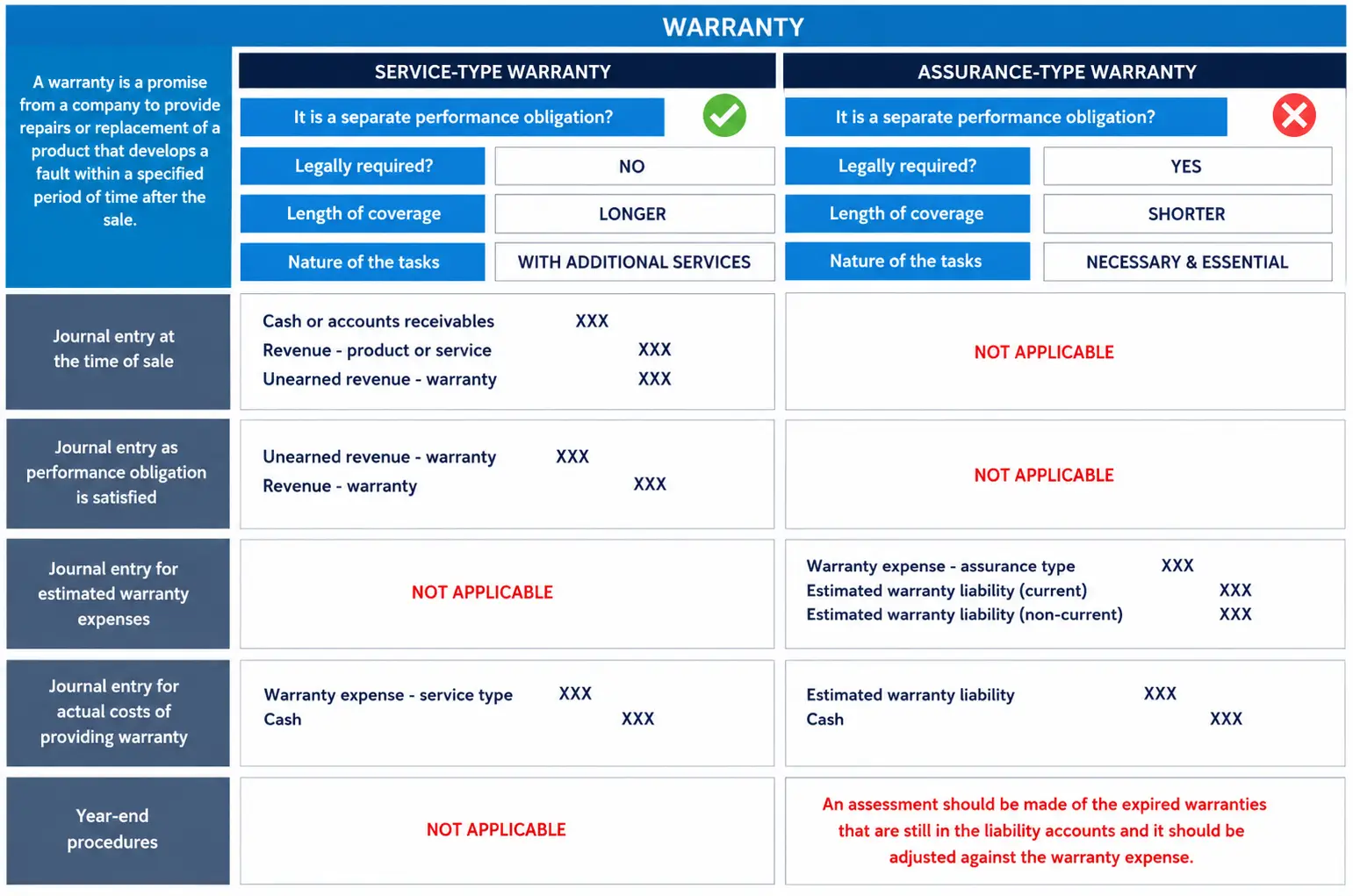
The following concept map provides a summary of the key concepts related to warranty accounting:
Warranties may be explicitly stated in the sales agreement or may arise implicitly due to legal requirements or customary business practices. Under US GAAP, there are two approaches to accounting for warranties, depending on whether the warranty represents a separate performance obligation or not:
- Service type warranties: If the warranty is a separate performance obligation
- Assurance type warranties: If the warranty is not a separate performance obligation.
Because warranty accounting often intersects with revenue recognition principles, it is helpful to revisit the chapter on revenue recognition when studying this section, as many concepts are directly connected.
Judgment should be applied by the company in determining if a warranty is a service type or assurance type.
If the company cannot reasonably separate (distinguish) the assurance element from the service element, the entire warranty is accounted for as a single separate performance obligation, following service-type warranty accounting.
When a warranty cannot be purchased separately, there can be more judgment in determining if it is a separate performance obligation or not. In this case, US GAAP has provided the following factors that companies can consider:
| Service type | Assurance type | |
| Legally required warranties | When warranty is not legally required by law, it can be an indication that it is a service type warranty. | When a warranty is legally required by law, the warranty is generally an assurance type because such laws exist to protect (i.e., assure) customers from purchasing defective products. |
| Length of warranty coverage | The longer the covered period of the warranty, the more likely it is that it is a separate performance obligation and that an additional service is being offered to the customer on top of the assurance element. | When the warranty period is relatively short, it could be an indication that it is only placed for assurance and is not a separate performance obligation. |
| Nature of the tasks the company promises to perform | If additional services are being required in order to comply with the warranty obligation, they could be an indication of a separate performance obligation. | When the nature of tasks being promised are necessary and essential in nature, for example providing return shipping for defective products, they typically do not give rise to separate performance obligations. |
Example: Classifying a warranty
A furniture manufacturer includes a standard one-year warranty against manufacturing defects with every sale. The warranty isn’t legally required, but it’s standard industry practice, it’s short in duration, and it only requires the company to repair or replace defective units - a task that’s necessary and essential to fulfilling the original sale.
Applying the three factors: the short coverage period and the “necessary and essential” nature of the repair task both point toward assurance-type coverage. Because the warranty simply assures the customer the furniture meets basic quality expectations - and isn’t sold separately or bundled with any extra service - it’s accounted for as an assurance-type warranty under ASC 460.
The mechanics of recognizing and recording each approach - including the journal entries for accruing assurance-type warranty expense and for deferring revenue under a service-type warranty - are covered in the following chapters, Service warranty approach and Assurance warranty approach.