


Achievable logoAchievable logo
CMA Part 1
Sign in
Sign up
Purchase
Textbook
Practice exams
Support
How it works
Exam catalog
Mountain with a flag at the peak
Textbook
1. External financial reporting decisions
2. Planning, budgeting, and forecasting
3. Performance management
4. Cost management
5. Internal control
6. Technology and analytics
Achievable logoAchievable logo
1.2.9.3 Types of leases
Achievable CMA Part 1
1. External financial reporting decisions
1.2. Financial transactions
1.2.9. Leases
Our CMA Part 1 course is currently in development and is a work-in-progress.

Types of leases

4 min read
Font
Discuss
Share
Feedback

Short term lease exception

Before we discuss finance and operating leases, we should know about the practical expedient provided by US GAAP for short term leases.

Definitions
Short term leases
Short term leases are leases that have
  • a lease term of 12 months or less at the time of commencement date; and
  • do not include a purchase option that the lessee is reasonably certain to take.

A lease can have a purchase option but still qualify as short-term if the lessee is reasonably certain not to exercise it.

If a lease qualifies as short-term, the lessee may elect, as a practical expedient not to recognize a right-of-use (ROU) asset or a lease liability. Instead, lease payments are recorded as lease expense on a straight-line basis over the lease term.

This simplified treatment reduces complexity when the lease is not expected to extend beyond one year. Any variable lease payments are recognized in the period in which they are incurred.

When applying the straight-line method, the lease expense recognized in the income statement may not always equal the cash paid in a given period (e.g., due to rent-free periods or uneven payments). Any difference is typically recorded in a lease payable (if cash paid < expense) or lease receivable (if cash paid > expense) account.

To calculate the straight-line lease expense:

  1. Add up all lease payments over the contract term.
  2. Divide the total by the number of months in the lease term.

The resulting amount is recorded as the periodic lease expense. If the cash paid in a given period is less than the straight-line expense, the difference is recorded as a lease payable. If the cash paid is greater, the difference reduces the payable balance. Below is the sample journal entry.

Account Debit Credit Financial statement element
Lease expense XXX Expense
Lease payable XXX Liability
Cash XXX Asset
To record payment of lease expense for the period (short-term)

Although short-term leases are not specifically addressed in the CMA learning outcome statements, having a basic understanding of their treatment is valuable background knowledge in case a related question appears.

Two types of leases

If the lease contract does not qualify as a short term lease or if the option has not been taken to account for the lease as a short term lease, there are two possible classifications of leases under US GAAP:

  • Operating lease
  • Finance lease

For both types of leases, it is required to recognize two balance sheet items:

  1. the right of use (ROU) asset; and
  2. the lease liability.
Definitions
Right of use (ROU) asset
This is an asset that represents the lessee’s right to use the asset for the term of the lease.

It is important to note that the ROU asset is not the asset itself but the right to use it.

Lease liability
This represents the obligation of the lessee to pay the lessor the agreed lease payments throughout the lease term.

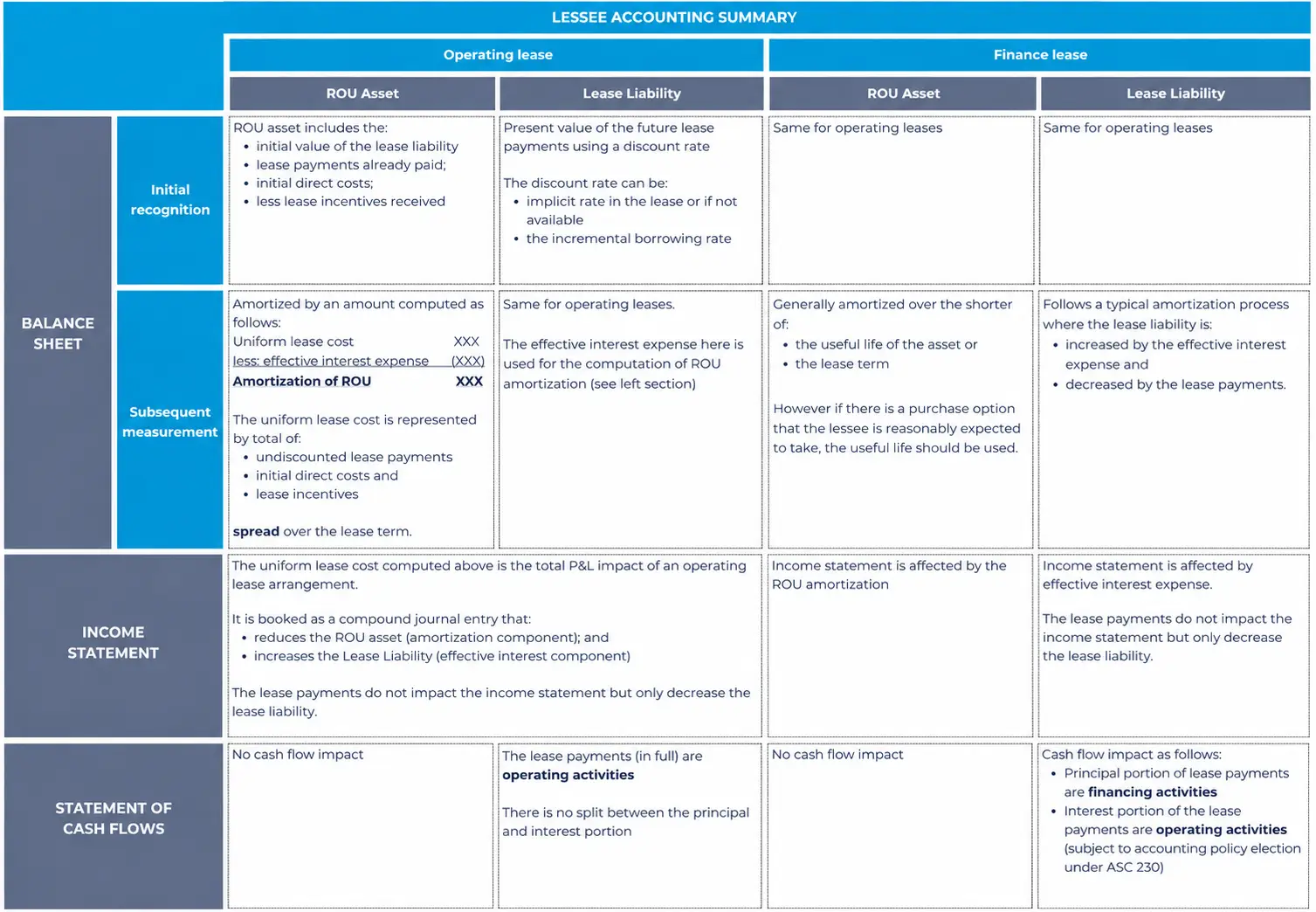
Each type of lease (operating or finance) will result in a different accounting method for the ROU asset and the lease liability. The following is a summary of the differences between the operating and finance leases under US GAAP. Detailed discussions are in the subsequent sections.

We recommend to revisit the table after going through the detailed discussions about operating and finance leases.

Comparing operating and finance lease accounting impacts on balance sheet, income statement, and cash flows.
Lessee Accounting Summary

Short term lease exception

  • Lease term ≤ 12 months and no likely purchase option exercise
  • Lessee may elect not to recognize ROU asset or lease liability
  • Lease expense recognized straight-line over lease term
    • Variable payments expensed as incurred
    • Differences between expense and cash paid recorded as lease payable/receivable

Two types of leases

  • Leases not qualifying as short-term are classified as:
    • Operating lease
    • Finance lease
  • Both require recognition of:
    • Right of use (ROU) asset (intangible right to use asset)
    • Lease liability (obligation for lease payments)
  • Accounting treatment for ROU asset and lease liability differs between operating and finance leases

Sign up for free to take 7 quiz questions on this topic

Previous
Next  | 1.2.9.4 Finance lease
All rights reserved ©2016 - 2026 Achievable, Inc.

Types of leases

Short term lease exception

Before we discuss finance and operating leases, we should know about the practical expedient provided by US GAAP for short term leases.

Definitions
Short term leases
Short term leases are leases that have
  • a lease term of 12 months or less at the time of commencement date; and
  • do not include a purchase option that the lessee is reasonably certain to take.

A lease can have a purchase option but still qualify as short-term if the lessee is reasonably certain not to exercise it.

If a lease qualifies as short-term, the lessee may elect, as a practical expedient not to recognize a right-of-use (ROU) asset or a lease liability. Instead, lease payments are recorded as lease expense on a straight-line basis over the lease term.

This simplified treatment reduces complexity when the lease is not expected to extend beyond one year. Any variable lease payments are recognized in the period in which they are incurred.

When applying the straight-line method, the lease expense recognized in the income statement may not always equal the cash paid in a given period (e.g., due to rent-free periods or uneven payments). Any difference is typically recorded in a lease payable (if cash paid < expense) or lease receivable (if cash paid > expense) account.

To calculate the straight-line lease expense:

  1. Add up all lease payments over the contract term.
  2. Divide the total by the number of months in the lease term.

The resulting amount is recorded as the periodic lease expense. If the cash paid in a given period is less than the straight-line expense, the difference is recorded as a lease payable. If the cash paid is greater, the difference reduces the payable balance. Below is the sample journal entry.

Account Debit Credit Financial statement element
Lease expense XXX Expense
Lease payable XXX Liability
Cash XXX Asset
To record payment of lease expense for the period (short-term)

Although short-term leases are not specifically addressed in the CMA learning outcome statements, having a basic understanding of their treatment is valuable background knowledge in case a related question appears.

Two types of leases

If the lease contract does not qualify as a short term lease or if the option has not been taken to account for the lease as a short term lease, there are two possible classifications of leases under US GAAP:

  • Operating lease
  • Finance lease

For both types of leases, it is required to recognize two balance sheet items:

  1. the right of use (ROU) asset; and
  2. the lease liability.
Definitions
Right of use (ROU) asset
This is an asset that represents the lessee’s right to use the asset for the term of the lease.

It is important to note that the ROU asset is not the asset itself but the right to use it.

Lease liability
This represents the obligation of the lessee to pay the lessor the agreed lease payments throughout the lease term.

Each type of lease (operating or finance) will result in a different accounting method for the ROU asset and the lease liability. The following is a summary of the differences between the operating and finance leases under US GAAP. Detailed discussions are in the subsequent sections.

We recommend to revisit the table after going through the detailed discussions about operating and finance leases.

Key points

Short term lease exception

  • Lease term ≤ 12 months and no likely purchase option exercise
  • Lessee may elect not to recognize ROU asset or lease liability
  • Lease expense recognized straight-line over lease term
    • Variable payments expensed as incurred
    • Differences between expense and cash paid recorded as lease payable/receivable

Two types of leases

  • Leases not qualifying as short-term are classified as:
    • Operating lease
    • Finance lease
  • Both require recognition of:
    • Right of use (ROU) asset (intangible right to use asset)
    • Lease liability (obligation for lease payments)
  • Accounting treatment for ROU asset and lease liability differs between operating and finance leases

More from Leases

  • Learning outcomes
  • Definitions
  • Finance lease
  • Operating lease