


Achievable logoAchievable logo
CMA Part 1
Sign in
Sign up
Purchase
Textbook
Practice exams
Support
How it works
Exam catalog
Mountain with a flag at the peak
Textbook
1. External financial reporting decisions
2. Planning, budgeting, and forecasting
3. Performance management
4. Cost management
5. Internal control
6. Technology and analytics
Achievable logoAchievable logo
1.2.9.2 Definitions
Achievable CMA Part 1
1. External financial reporting decisions
1.2. Financial transactions
1.2.9. Leases
Our CMA Part 1 course is currently in development and is a work-in-progress.

Definitions

4 min read
Font
Discuss
Share
Feedback

A lease is an agreement that conveys to the lessee the right to control the use of an identified asset for a period of time in exchange for consideration.

The agreement should convey the transfer to the lessee of the right to control the asset by:

  1. obtaining substantially all economic benefits from the use of the asset
  2. directing its use.

There are two perspectives of accounting for leases, the one for lessor and the one for the lessee.

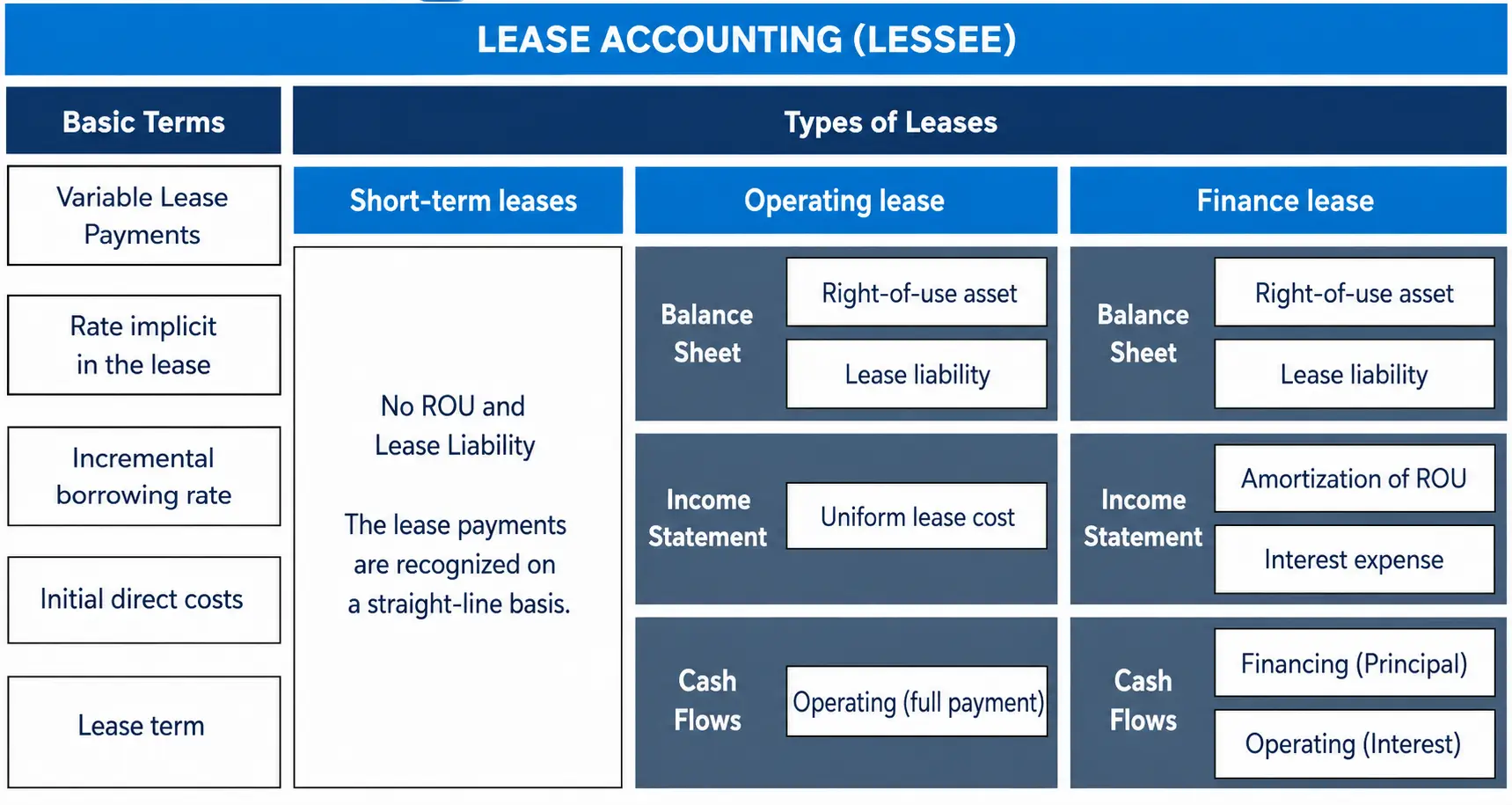
We note that for CMA exams, the scope only covers accounting by lessees. This is the case when the company is the party using the property subject to the lease. The following concept map includes a summary of the necessary topics to be familiar with in this section:

Comparing short-term, operating, and finance lease accounting treatment on the balance sheet, income statement, and cash flows.
Lessee Lease Accounting Overview

Basic definitions

The following basic definitions on leases can be helpful in understanding the subsequent discussions. You may skip this section and come back to them while reading the sections that mention them.

Lease payments

These are the payments a lessee includes when measuring the lease liability. They consist of:

  • fixed payments over the lease term
  • variable payments that depend on an index or rate (measured using the index or rate at lease commencement)
  • amounts the lessee is probable of owing under a residual value guarantee
  • the exercise price of a purchase option, if the lessee is reasonably certain to exercise it
  • termination penalties, if the lease term reflects the lessee exercising an option to terminate the lease.

Variable lease payments

These are lease payments that do not have a fixed amount. These generally have two types:

  • included in lease liability: variable lease payments that depend on an index or rate (i.e., LIBOR, CPI etc.). These are measured using the index or rate at the lease commencement date.
  • expensed as incurred: variable lease payments that do not depend on an index.

Rate implicit in the lease

The discount rate that makes the present value of the lease payments equal to the fair value of the asset. This is a simplified statement of the definition: more precisely, it’s the rate that equates the present value of the lease payments plus the residual value the lessor expects, to the fair value of the asset plus the lessor’s deferred initial direct costs. Although this is the first preferred rate to be used, computation of the rate implicit in the lease is not covered by the CMA exams.

Incremental borrowing rate

This is the discount rate to be used if the rate implicit in the lease is not available. The incremental borrowing rate is the rate of interest that the lessee would have to pay if they proceed to borrow an amount equal to the lease payments in a collateralized arrangement over a term similar to the lease term. This is essentially the market rate of interest should the lessee just decide to borrow money over the same period to finance the acquisition of a similar asset.

Initial direct costs

These are costs directly related to originating the lease that would not have been incurred if the lease did not exist. Typical costs included are costs in negotiating the lease, preparing the contract, and commissions to real estate brokers.

Lease term

This is the period in which the lessee has the right to use the asset.

This includes:

  • the non-cancellable period of the lease agreement
  • periods covered by a renewal option that is reasonably certain to be taken by the lessee
  • periods covered by a termination option that the lessee is reasonably certain not to exercise
  • periods covered by an option to extend or not terminate the lease controlled by the lessor

Lease definition and control

  • Lease: right to control use of identified asset for a period in exchange for consideration
  • Lessee controls asset by:
    • Obtaining substantially all economic benefits
    • Directing asset’s use

Accounting perspectives

  • Two perspectives: lessor and lessee
  • CMA exams focus only on lessee accounting

Variable lease payments

  • Payments not fixed in amount
  • Two types:
    • Included in lease liability: depend on index/rate (measured at commencement date)
    • Expensed as incurred: do not depend on index/rate

Rate implicit in the lease

  • Discount rate equating present value of lease payments to asset’s fair value
  • Preferred rate, but calculation not covered for CMA exams

Incremental borrowing rate

  • Used if rate implicit in lease unavailable
  • Rate lessee would pay to borrow equivalent amount over similar term, collateralized

Initial direct costs

  • Costs directly related to originating the lease
  • Examples: negotiation, contract preparation, broker commissions

Lease term

  • Period lessee has right to use asset
  • Includes:
    • Non-cancellable lease period
    • Renewal periods reasonably certain to be exercised
    • Periods with termination option unlikely to be exercised
    • Periods with extension/non-termination option controlled by lessor

Sign up for free to take 9 quiz questions on this topic

Previous
Next  | 1.2.9.3 Types of leases
All rights reserved ©2016 - 2026 Achievable, Inc.

Definitions

A lease is an agreement that conveys to the lessee the right to control the use of an identified asset for a period of time in exchange for consideration.

The agreement should convey the transfer to the lessee of the right to control the asset by:

  1. obtaining substantially all economic benefits from the use of the asset
  2. directing its use.

There are two perspectives of accounting for leases, the one for lessor and the one for the lessee.

We note that for CMA exams, the scope only covers accounting by lessees. This is the case when the company is the party using the property subject to the lease. The following concept map includes a summary of the necessary topics to be familiar with in this section:

Basic definitions

The following basic definitions on leases can be helpful in understanding the subsequent discussions. You may skip this section and come back to them while reading the sections that mention them.

Lease payments

These are the payments a lessee includes when measuring the lease liability. They consist of:

  • fixed payments over the lease term
  • variable payments that depend on an index or rate (measured using the index or rate at lease commencement)
  • amounts the lessee is probable of owing under a residual value guarantee
  • the exercise price of a purchase option, if the lessee is reasonably certain to exercise it
  • termination penalties, if the lease term reflects the lessee exercising an option to terminate the lease.

Variable lease payments

These are lease payments that do not have a fixed amount. These generally have two types:

  • included in lease liability: variable lease payments that depend on an index or rate (i.e., LIBOR, CPI etc.). These are measured using the index or rate at the lease commencement date.
  • expensed as incurred: variable lease payments that do not depend on an index.

Rate implicit in the lease

The discount rate that makes the present value of the lease payments equal to the fair value of the asset. This is a simplified statement of the definition: more precisely, it’s the rate that equates the present value of the lease payments plus the residual value the lessor expects, to the fair value of the asset plus the lessor’s deferred initial direct costs. Although this is the first preferred rate to be used, computation of the rate implicit in the lease is not covered by the CMA exams.

Incremental borrowing rate

This is the discount rate to be used if the rate implicit in the lease is not available. The incremental borrowing rate is the rate of interest that the lessee would have to pay if they proceed to borrow an amount equal to the lease payments in a collateralized arrangement over a term similar to the lease term. This is essentially the market rate of interest should the lessee just decide to borrow money over the same period to finance the acquisition of a similar asset.

Initial direct costs

These are costs directly related to originating the lease that would not have been incurred if the lease did not exist. Typical costs included are costs in negotiating the lease, preparing the contract, and commissions to real estate brokers.

Lease term

This is the period in which the lessee has the right to use the asset.

This includes:

  • the non-cancellable period of the lease agreement
  • periods covered by a renewal option that is reasonably certain to be taken by the lessee
  • periods covered by a termination option that the lessee is reasonably certain not to exercise
  • periods covered by an option to extend or not terminate the lease controlled by the lessor
Key points

Lease definition and control

  • Lease: right to control use of identified asset for a period in exchange for consideration
  • Lessee controls asset by:
    • Obtaining substantially all economic benefits
    • Directing asset’s use

Accounting perspectives

  • Two perspectives: lessor and lessee
  • CMA exams focus only on lessee accounting

Variable lease payments

  • Payments not fixed in amount
  • Two types:
    • Included in lease liability: depend on index/rate (measured at commencement date)
    • Expensed as incurred: do not depend on index/rate

Rate implicit in the lease

  • Discount rate equating present value of lease payments to asset’s fair value
  • Preferred rate, but calculation not covered for CMA exams

Incremental borrowing rate

  • Used if rate implicit in lease unavailable
  • Rate lessee would pay to borrow equivalent amount over similar term, collateralized

Initial direct costs

  • Costs directly related to originating the lease
  • Examples: negotiation, contract preparation, broker commissions

Lease term

  • Period lessee has right to use asset
  • Includes:
    • Non-cancellable lease period
    • Renewal periods reasonably certain to be exercised
    • Periods with termination option unlikely to be exercised
    • Periods with extension/non-termination option controlled by lessor

More from Leases

  • Learning outcomes
  • Types of leases
  • Finance lease
  • Operating lease