


Achievable logoAchievable logo
CMA Part 1
Sign in
Sign up
Purchase
Textbook
Practice exams
Support
How it works
Exam catalog
Mountain with a flag at the peak
Textbook
1. External financial reporting decisions
2. Planning, budgeting, and forecasting
3. Performance management
4. Cost management
5. Internal control
6. Technology and analytics
Achievable logoAchievable logo
1.2.2.2 Inventory ownership and capitalization
Achievable CMA Part 1
1. External financial reporting decisions
1.2. Financial transactions
1.2.2. Inventory
Our CMA Part 1 course is currently in development and is a work-in-progress.

Inventory ownership and capitalization

9 min read
Font
Discuss
Share
Feedback

Inventories are assets in the balance sheet because:

  • they are resources owned by an entity; and
  • they are expected to provide future economic benefits from its sale or use (in the case of a manufacturing entity) in the ordinary course of business.
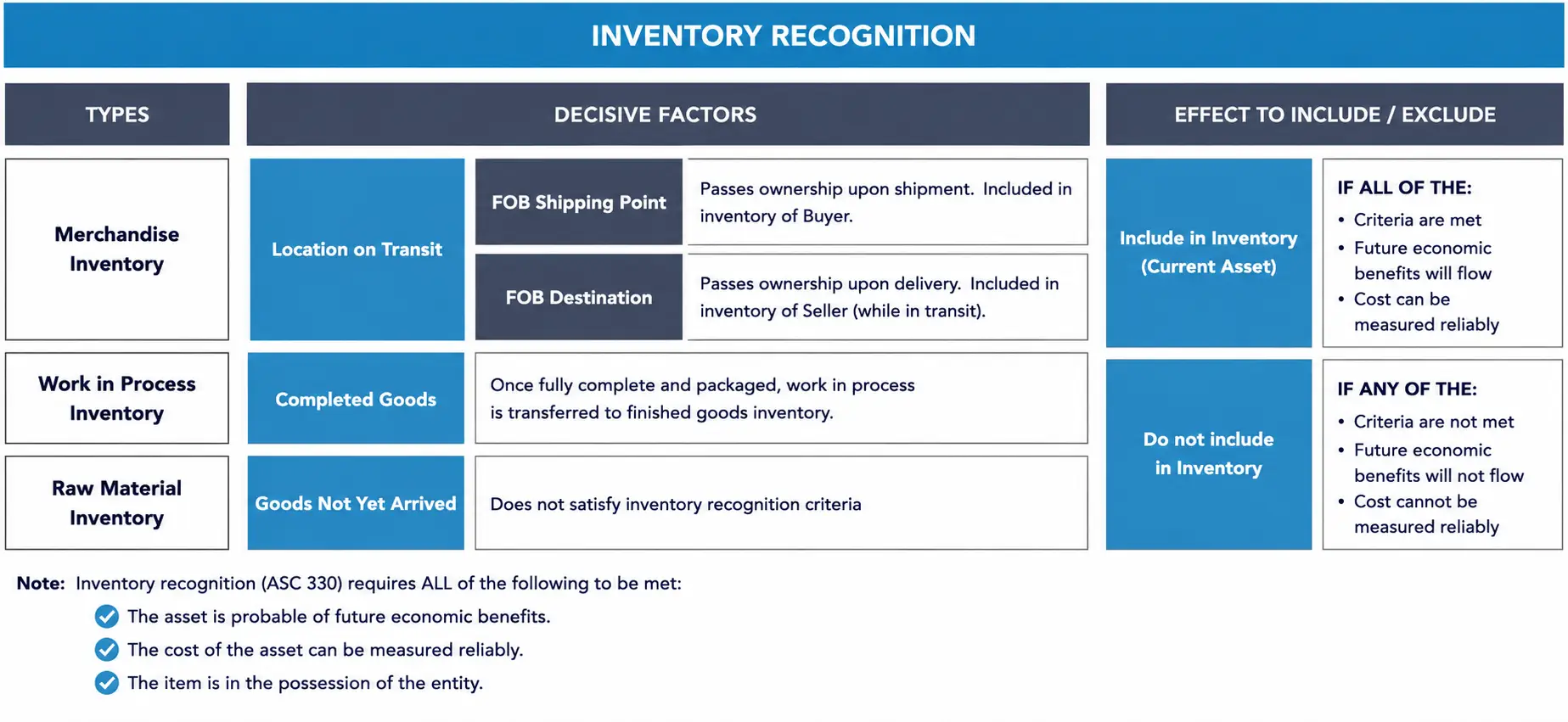
Covering inventory types, goods to include based on shipping terms, and which costs are included or excluded from inventory.
Inventory Costs Concept Map

Inventories are a unique type of asset because they appear as an asset in the balance sheet, but also as an input to determine the cost of goods sold in the income statement. This is why the major objective in the accounting for inventories is the proper determination of income by matching the revenues to the costs related to those items sold. If the inventory amounts are misstated, it has a corresponding impact to the cost of goods sold and eventually to the net income.

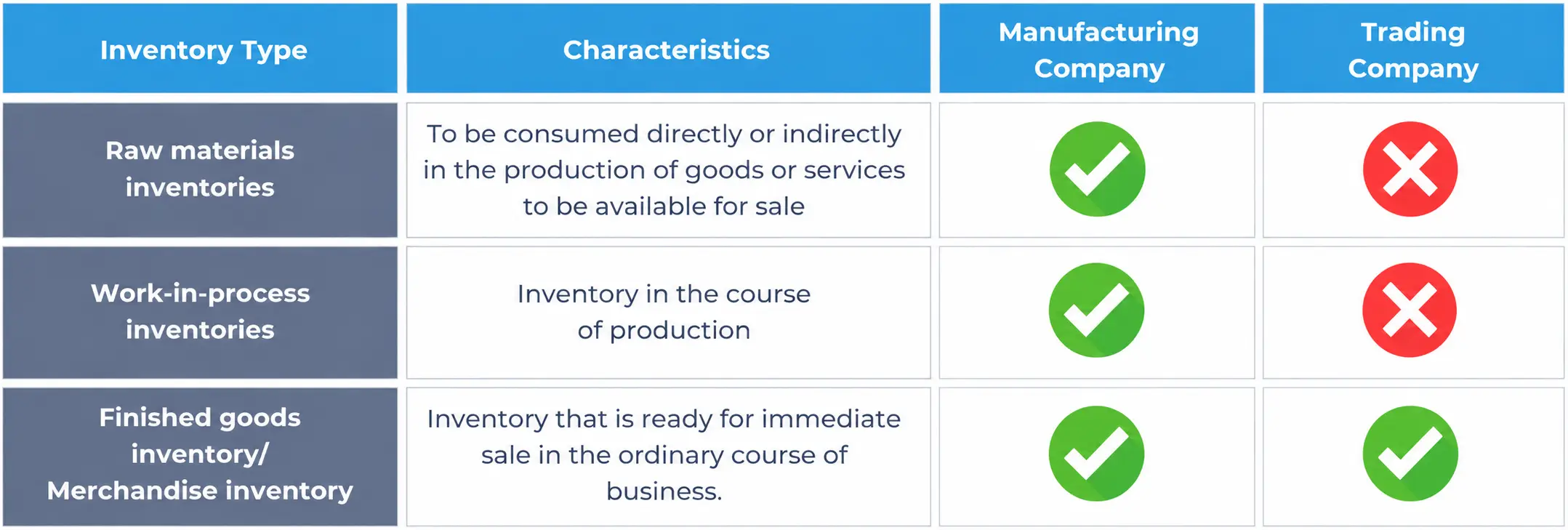
Below is a summary of the characteristics of inventories as per ASC 330, summarized by the nature of the operations. This chapter follows US GAAP; differences between US GAAP and IFRS inventory accounting are covered in a later chapter, US GAAP versus IFRS.

Comparing raw materials, work-in-process, and finished goods inventory types across manufacturing and trading companies.
Types Of Inventories

This section covers only the accounting for finished goods inventories of a trading company. The accounting for other types of inventories are covered in a later chapter of CMA Part 1.

What goods to include in inventory

As defined in the previous section, assets are resources owned by the company that are expected to generate future returns. Therefore, it is understandable that the main criteria of what goods to include in a company’s inventories is ownership.

In particular, a company needs to include inside the “inventories” line item in the balance sheet all inventory items that the company owns or has title to, as at the date of the balance sheet date. This may sound pretty straight-forward for unsold inventories at the company’s physical warehouse, but there are certain cases that need to be considered as per below:

Inventories in transit

There are inventories that are either sold to a customer or purchased from a supplier but still did not arrive at their intended destination as at the end of the year. This needs to be considered in the assessment because the ownership of the inventories may pass on at different times depending on the terms of shipping:

  • FOB shipping point; or
  • FOB destination
Definitions
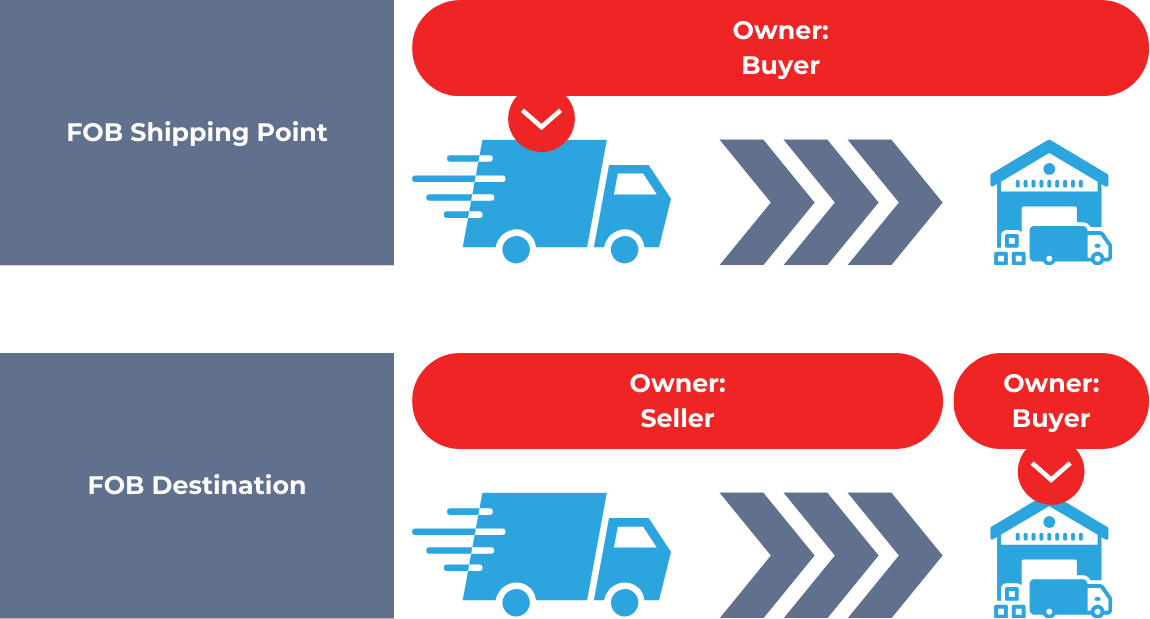
FOB shipping point
This means that the ownership passes to the buyer when the goods are delivered to the shipping company.
FOB destination
This means that the ownership passes to the buyer when the goods are received by the customer.
Explanation of the different shipping terms

Since a trading company can either be a buyer or a seller, you need to consider both points of view in assessing inventory ownership. Below is a summary of the impacts to the inventory balance on an in transit inventory during year-end depending if the company is a buyer or the seller of the merchandise:

Terms of shipping Company is:
Buyer Seller
FOB shipping point Included in inventory Excluded in inventory
FOB destination Excluded in inventory Included in inventory

For all items above, you just need to determine if, as at year-end, the company has ownership over the inventory items that were bought or sold, taking into account the terms of shipping.

Example: FOB destination shipment in transit

A trading company ships $2,000 of goods to a customer under FOB destination terms on December 29. The goods are still in transit on December 31, the balance sheet date, and arrive at the customer’s location on January 3.

Because ownership under FOB destination doesn’t transfer until the customer receives the goods, the seller still owns the goods on December 31. The seller includes the $2,000 in its own ending inventory, even though the goods have already left its warehouse.

Consigned goods

Consignment is an arrangement whereby a company (the consignor) delivers goods to another company (the consignee) but the title is retained by the consignor until the goods are finally sold to the end customer. The consignee becomes responsible to sell the goods as an agent and has the ability to return unsold goods, thereby bearing no risk in the arrangement.

In a consignment arrangement, the goods are included in the inventory of the consignor because the title has not passed during the delivery. It is accounted for only as a reclassification of the inventory cost plus any shipping cost paid to deliver the goods to the consignee:

Account Debit Credit Financial statement element
Inventories on consignment $10,500 Asset
Inventories $10,000 Asset
Cash $500 Asset
To record delivery of inventories out on consignment

The credit in cash is the cost paid to deliver inventories to the consignee. These are capitalizable costs and should not be expensed.

If the company is a consignee, even if physically in the consignee’s warehouse, the consigned goods (also called as goods held on consignment) are not included in its balance sheet as inventories.

Obsolete inventories

When for whatever reason an inventory item cannot be sold anymore, it is deemed as obsolete. These items are not expected to bring future benefits to the company and should not be a part of a company’s assets anymore. The cost of the obsolete inventories should be written off in the period when they are determined to be obsolete. A sample journal entry is as follows:

Account Debit Credit Financial statement element
Loss on inventory obsolescence $500 Loss
Inventories $500 Asset
To record write-off of obsolete inventories

When inventories have salvage values, it means a portion of their costs can be recovered through sale. This topic is covered by “inventory valuation” in a subsequent section.

What costs to include in inventory

Another issue related to inventory accounting is the determination of what constitutes the capitalizable costs of an inventory. A company routinely pays for costs of different nature and we need to determine if such payments should go to the income statement (as expenses) or to the balance sheet (as inventories).

Definitions
Inventoriable costs
These are those costs that are capitalized in the balance sheet as inventory.

Inventoriable costs include:

  • Costs to purchase the inventory which include the purchase price, transport costs, handling costs and other costs directly attributable to the purchase of raw materials or finished goods. These amounts are recorded net of any trade discounts and rebates.
  • Costs of conversion include costs required to directly or indirectly convert raw materials or work-in-progress inventories into finished goods. Examples are direct labor costs, variable and fixed overheads. This is common only for manufacturing companies.
  • Other costs incurred in bringing the inventories to their present location and condition.

The following items are expensed in the income statement and are therefore not included as inventoriable costs:

  • Abnormal costs related to freight, handling, and wasted materials (spoilage). Only the abnormal, unexpected portion of these costs is expensed - normal (routine) freight-in and expected spoilage are still inventoriable costs.
  • Storage costs except when the storage costs are required for the production process (i.e., inventory handling costs related to the raw materials of a manufacturing company)
  • Administrative overhead costs. These costs are not directly or indirectly related to the production of goods so they are excluded from inventory costs
  • Selling costs
  • Costs to transport goods to the customer or freight-out (note that costs to transport inventories to a consignee are inventoriable costs)

When goods are unsold, the costs of the goods are in the balance sheet as inventories and in the period when they are sold, they will be on the income statement as cost of goods sold along with the corresponding revenue. This is an application of the matching principle where costs are matched to the revenues in the same period the sales transaction occurred.

Inventories as Assets

  • Resources owned, expected to provide future economic benefits
  • Appear on balance sheet and as input for cost of goods sold (income statement)
  • Accurate inventory accounting crucial for proper income determination

Criteria for Inventory Inclusion

  • Main criterion: ownership as of balance sheet date
  • Include all inventory items company owns or has title to

Inventories in Transit

  • Ownership determined by shipping terms:
    • FOB shipping point: buyer owns once shipped
    • FOB destination: buyer owns upon receipt
  • Year-end inclusion:
    • Buyer includes if FOB shipping point
    • Seller includes if FOB destination

Consigned Goods

  • Consignor retains title; goods included in consignor’s inventory
    • Costs to deliver to consignee are capitalizable
  • Consignee does not include consigned goods in inventory

Obsolete Inventories

  • Not expected to bring future benefits; written off as loss
  • Write-off recorded when determined obsolete

Inventoriable Costs

  • Capitalized in inventory:
    • Purchase costs (price, transport, handling, net of discounts)
    • Conversion costs (direct labor, variable/fixed overheads for manufacturers)
    • Other costs to bring inventory to present location/condition
  • Not inventoriable (expensed):
    • Abnormal costs (freight, spoilage)
    • Storage costs (unless required for production)
    • Administrative overhead
    • Selling costs
    • Freight-out (to customer)
  • Matching principle: costs recognized as expense when related revenue is recognized

Sign up for free to take 12 quiz questions on this topic

Previous
Next  | 1.2.2.3 Inventory cost flow assumptions
All rights reserved ©2016 - 2026 Achievable, Inc.

Inventory ownership and capitalization

Inventories are assets in the balance sheet because:

  • they are resources owned by an entity; and
  • they are expected to provide future economic benefits from its sale or use (in the case of a manufacturing entity) in the ordinary course of business.

Inventories are a unique type of asset because they appear as an asset in the balance sheet, but also as an input to determine the cost of goods sold in the income statement. This is why the major objective in the accounting for inventories is the proper determination of income by matching the revenues to the costs related to those items sold. If the inventory amounts are misstated, it has a corresponding impact to the cost of goods sold and eventually to the net income.

Below is a summary of the characteristics of inventories as per ASC 330, summarized by the nature of the operations. This chapter follows US GAAP; differences between US GAAP and IFRS inventory accounting are covered in a later chapter, US GAAP versus IFRS.

This section covers only the accounting for finished goods inventories of a trading company. The accounting for other types of inventories are covered in a later chapter of CMA Part 1.

What goods to include in inventory

As defined in the previous section, assets are resources owned by the company that are expected to generate future returns. Therefore, it is understandable that the main criteria of what goods to include in a company’s inventories is ownership.

In particular, a company needs to include inside the “inventories” line item in the balance sheet all inventory items that the company owns or has title to, as at the date of the balance sheet date. This may sound pretty straight-forward for unsold inventories at the company’s physical warehouse, but there are certain cases that need to be considered as per below:

Inventories in transit

There are inventories that are either sold to a customer or purchased from a supplier but still did not arrive at their intended destination as at the end of the year. This needs to be considered in the assessment because the ownership of the inventories may pass on at different times depending on the terms of shipping:

  • FOB shipping point; or
  • FOB destination
Definitions
FOB shipping point
This means that the ownership passes to the buyer when the goods are delivered to the shipping company.
FOB destination
This means that the ownership passes to the buyer when the goods are received by the customer.

Since a trading company can either be a buyer or a seller, you need to consider both points of view in assessing inventory ownership. Below is a summary of the impacts to the inventory balance on an in transit inventory during year-end depending if the company is a buyer or the seller of the merchandise:

Terms of shipping Company is:
Buyer Seller
FOB shipping point Included in inventory Excluded in inventory
FOB destination Excluded in inventory Included in inventory

For all items above, you just need to determine if, as at year-end, the company has ownership over the inventory items that were bought or sold, taking into account the terms of shipping.

Example: FOB destination shipment in transit

A trading company ships $2,000 of goods to a customer under FOB destination terms on December 29. The goods are still in transit on December 31, the balance sheet date, and arrive at the customer’s location on January 3.

Because ownership under FOB destination doesn’t transfer until the customer receives the goods, the seller still owns the goods on December 31. The seller includes the $2,000 in its own ending inventory, even though the goods have already left its warehouse.

Consigned goods

Consignment is an arrangement whereby a company (the consignor) delivers goods to another company (the consignee) but the title is retained by the consignor until the goods are finally sold to the end customer. The consignee becomes responsible to sell the goods as an agent and has the ability to return unsold goods, thereby bearing no risk in the arrangement.

In a consignment arrangement, the goods are included in the inventory of the consignor because the title has not passed during the delivery. It is accounted for only as a reclassification of the inventory cost plus any shipping cost paid to deliver the goods to the consignee:

Account Debit Credit Financial statement element
Inventories on consignment $10,500 Asset
Inventories $10,000 Asset
Cash $500 Asset
To record delivery of inventories out on consignment

The credit in cash is the cost paid to deliver inventories to the consignee. These are capitalizable costs and should not be expensed.

If the company is a consignee, even if physically in the consignee’s warehouse, the consigned goods (also called as goods held on consignment) are not included in its balance sheet as inventories.

Obsolete inventories

When for whatever reason an inventory item cannot be sold anymore, it is deemed as obsolete. These items are not expected to bring future benefits to the company and should not be a part of a company’s assets anymore. The cost of the obsolete inventories should be written off in the period when they are determined to be obsolete. A sample journal entry is as follows:

Account Debit Credit Financial statement element
Loss on inventory obsolescence $500 Loss
Inventories $500 Asset
To record write-off of obsolete inventories

When inventories have salvage values, it means a portion of their costs can be recovered through sale. This topic is covered by “inventory valuation” in a subsequent section.

What costs to include in inventory

Another issue related to inventory accounting is the determination of what constitutes the capitalizable costs of an inventory. A company routinely pays for costs of different nature and we need to determine if such payments should go to the income statement (as expenses) or to the balance sheet (as inventories).

Definitions
Inventoriable costs
These are those costs that are capitalized in the balance sheet as inventory.

Inventoriable costs include:

  • Costs to purchase the inventory which include the purchase price, transport costs, handling costs and other costs directly attributable to the purchase of raw materials or finished goods. These amounts are recorded net of any trade discounts and rebates.
  • Costs of conversion include costs required to directly or indirectly convert raw materials or work-in-progress inventories into finished goods. Examples are direct labor costs, variable and fixed overheads. This is common only for manufacturing companies.
  • Other costs incurred in bringing the inventories to their present location and condition.

The following items are expensed in the income statement and are therefore not included as inventoriable costs:

  • Abnormal costs related to freight, handling, and wasted materials (spoilage). Only the abnormal, unexpected portion of these costs is expensed - normal (routine) freight-in and expected spoilage are still inventoriable costs.
  • Storage costs except when the storage costs are required for the production process (i.e., inventory handling costs related to the raw materials of a manufacturing company)
  • Administrative overhead costs. These costs are not directly or indirectly related to the production of goods so they are excluded from inventory costs
  • Selling costs
  • Costs to transport goods to the customer or freight-out (note that costs to transport inventories to a consignee are inventoriable costs)

When goods are unsold, the costs of the goods are in the balance sheet as inventories and in the period when they are sold, they will be on the income statement as cost of goods sold along with the corresponding revenue. This is an application of the matching principle where costs are matched to the revenues in the same period the sales transaction occurred.

Key points

Inventories as Assets

  • Resources owned, expected to provide future economic benefits
  • Appear on balance sheet and as input for cost of goods sold (income statement)
  • Accurate inventory accounting crucial for proper income determination

Criteria for Inventory Inclusion

  • Main criterion: ownership as of balance sheet date
  • Include all inventory items company owns or has title to

Inventories in Transit

  • Ownership determined by shipping terms:
    • FOB shipping point: buyer owns once shipped
    • FOB destination: buyer owns upon receipt
  • Year-end inclusion:
    • Buyer includes if FOB shipping point
    • Seller includes if FOB destination

Consigned Goods

  • Consignor retains title; goods included in consignor’s inventory
    • Costs to deliver to consignee are capitalizable
  • Consignee does not include consigned goods in inventory

Obsolete Inventories

  • Not expected to bring future benefits; written off as loss
  • Write-off recorded when determined obsolete

Inventoriable Costs

  • Capitalized in inventory:
    • Purchase costs (price, transport, handling, net of discounts)
    • Conversion costs (direct labor, variable/fixed overheads for manufacturers)
    • Other costs to bring inventory to present location/condition
  • Not inventoriable (expensed):
    • Abnormal costs (freight, spoilage)
    • Storage costs (unless required for production)
    • Administrative overhead
    • Selling costs
    • Freight-out (to customer)
  • Matching principle: costs recognized as expense when related revenue is recognized

More from Inventory

  • Learning outcomes
  • Inventory cost flow assumptions
  • Inventory systems: periodic
  • Inventory systems: perpetual
  • Inventory valuation