



Allowance for credit losses: Estimation Process
The estimation process
The following steps are followed when estimating bad debts:
Step 1: Estimate the ending balance of the allowance for credit losses
When faced with a problem involving the estimation of bad debts, there are commonly two unknown items:
- The bad debts expense, and
- The ending balance of the allowance account.
All other variables can normally be derived from the inputs provided.
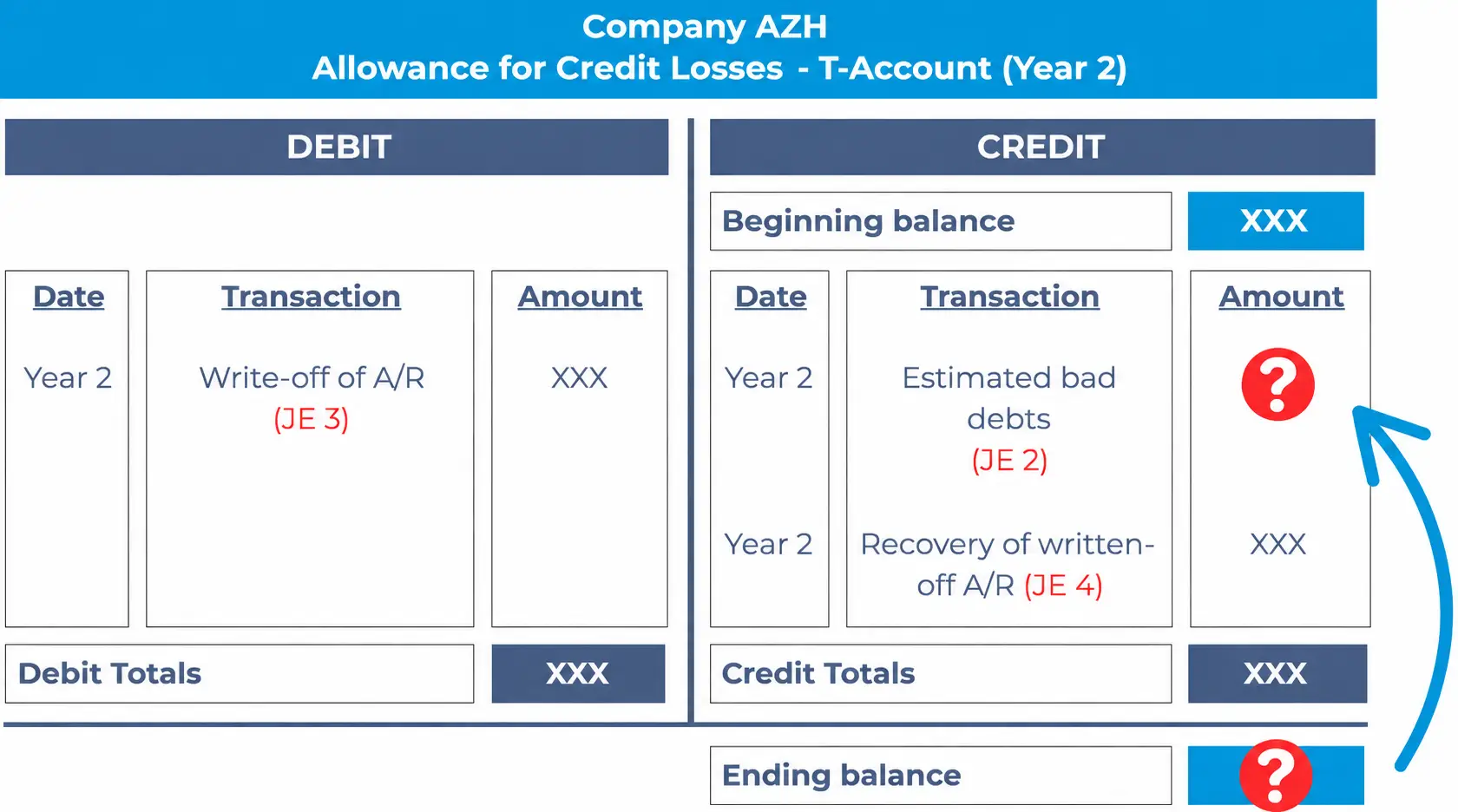
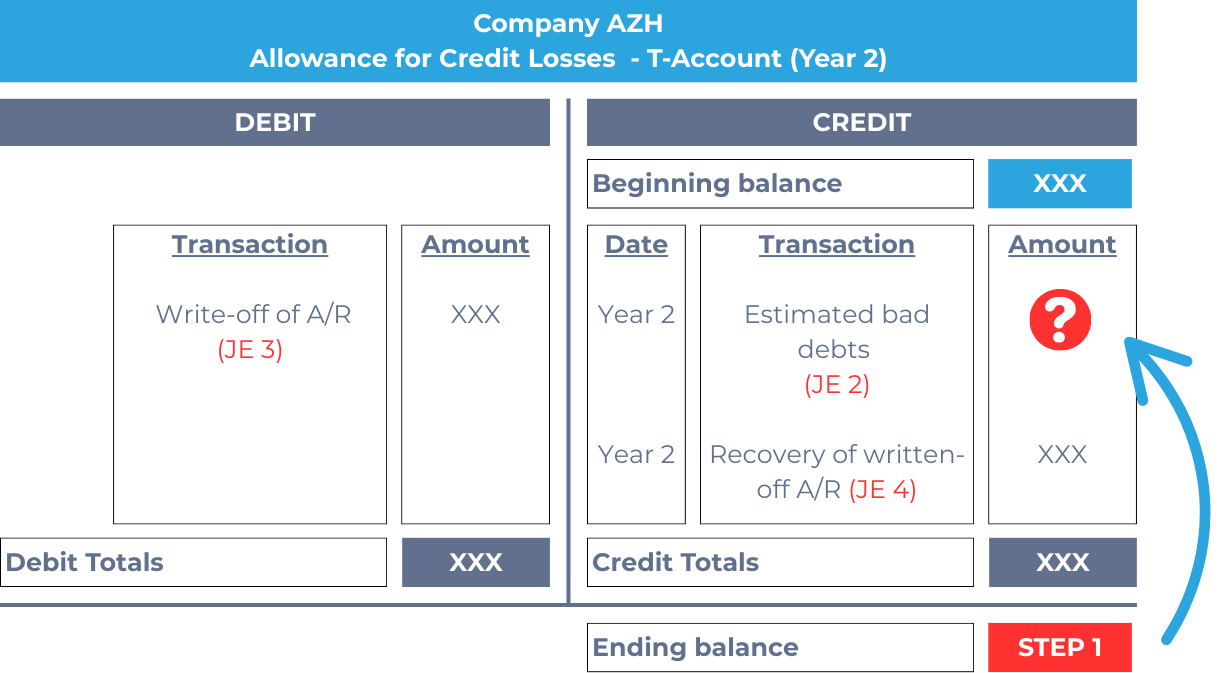
The normal process is to determine the ending balance of the allowance account, and then use this input to work back the estimated bad debts using the T-account presented below. However, when problems are presented in a different way (i.e., providing bad debts expense instead of the ending balance) you can still use the T-account to determine the missing item.
There are two common ways of calculating the ending balance of the allowance account:
1. Percentage of accounts receivable methodThis is the simpler method where a single percentage of uncollectible accounts is applied to the whole ending balance of the accounts receivable. In practice, this percentage is estimated by the company using any of the acceptable methods that reflect all available and relevant information about collectibility of the balances, including current and historical information and supportable forecasts.
The resulting amount from applying the uncollectible percentage to the ending balance of the accounts receivable is considered to be the ending balance of the allowance account. This means that the company is estimating that this much accounts receivable has a risk of not being collected in the future.
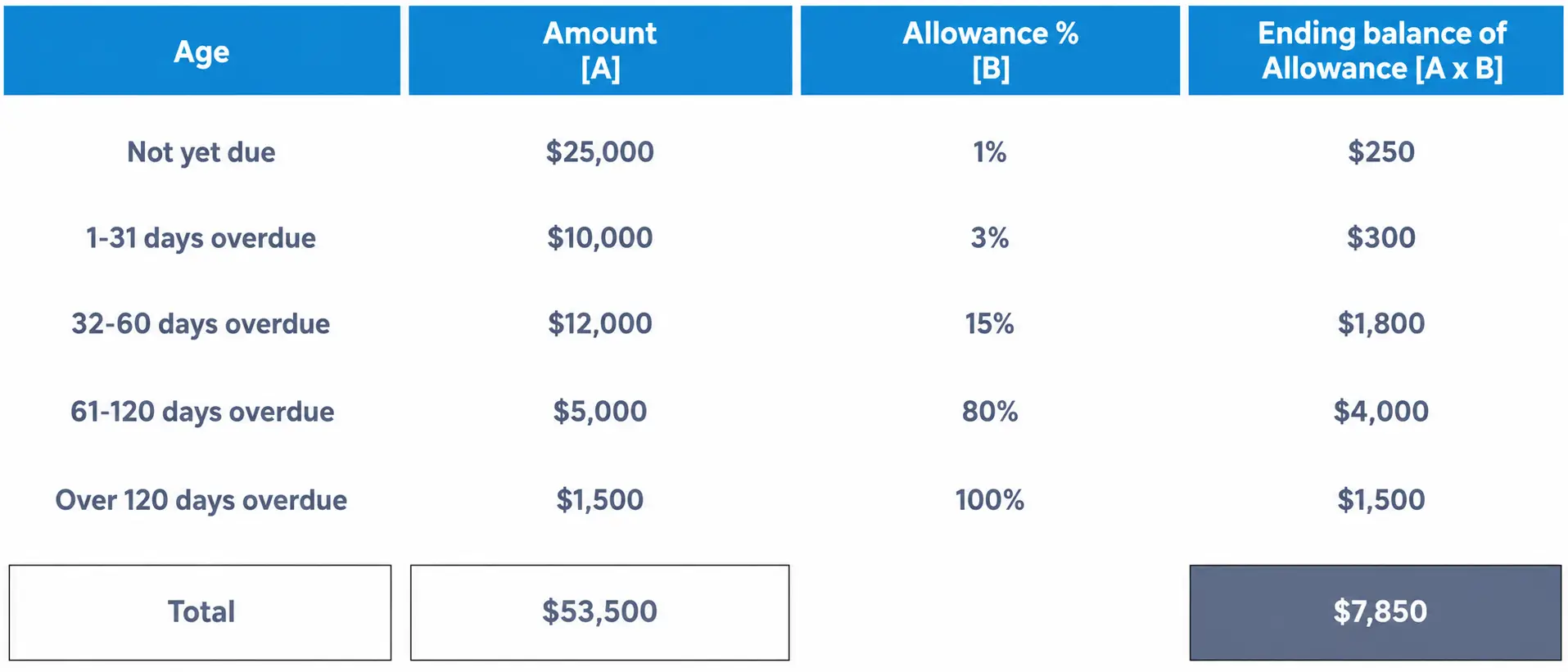
2. Aging analysisThis is a method where a series of percentages of uncollectible accounts is applied to the aged balance of the accounts receivable. The aged balances of the accounts receivable is shown through an aging analysis which shows how many days each accounts receivable is past due. The company then determined the appropriate uncollectible percentage for each age bucket. You will notice that the uncollectible percentages typically increase as the accounts receivable is getting older.
In practice, these percentages are estimated by the company by examining the aging report and using any of the acceptable methods that reflect all available and relevant information about collectibility of the balances for each age bucket, including current and historical information and supportable forecasts. A sample aging schedule and computation of the allowance through the uncollectible percentages are shown below (the schedule breaks the $53,500 total accounts receivable into age buckets, applies an uncollectible percentage to each bucket, and sums to the $7,850 allowance discussed next):
Step 2: Calculate the bad debts expense
Calculation of the bad debt expense is done through the T-account of the allowance account. Since the ending balance of the allowance account was already determined from step 1 above, we can use all other inputs to determine the bad debts expense. The following shows a recap of the inputs:
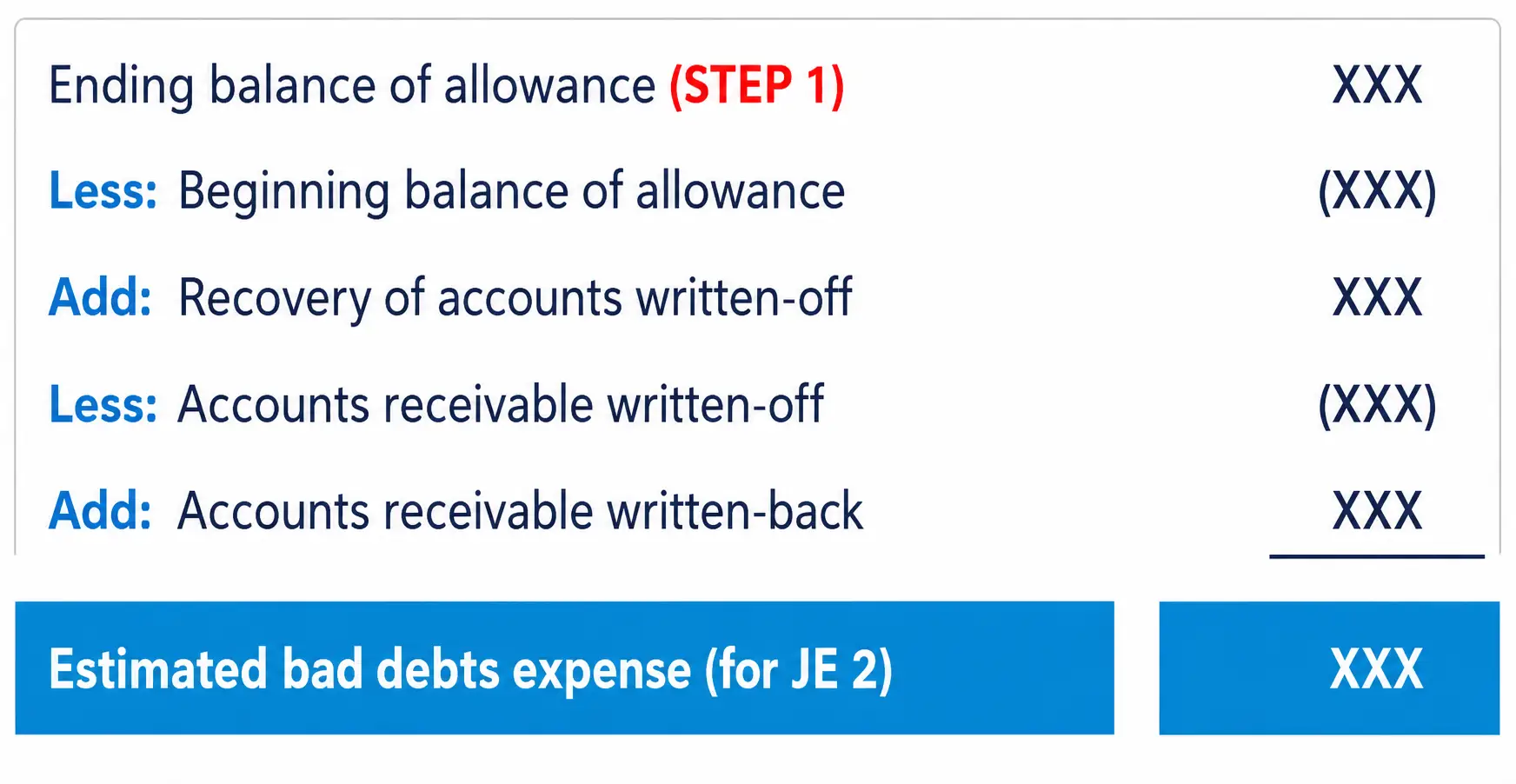
Alternatively, the bad debts expense can be derived from the following formula:
In words, the allowance account rolls forward from its beginning balance, is reduced by write-offs, increased by recoveries of previously written-off accounts, and increased by the current period’s bad debt expense, to arrive at the ending balance:
Since the ending balance is the target found in Step 1, you can rearrange this same relationship to solve for the bad debt expense directly:
In the CMA exam questions, most of the items above would be provided or would be available for computation. The student needs to know how to plot inputs into the T-account in order to solve for what is missing.
The amount derived from above is the estimated bad debts for the period. Technically it is the amount that the allowance account needs to be adjusted with to arrive at the ending balance calculated in step 1. In essence, this amount is the amount of expense recognized to account for additional uncollectible accounts in the balance sheet since the last period.
It is possible that the balance calculated is negative (i.e., estimated bad debt is in the debit side of the T-account. In this case, it is recorded as a reversal of bad debts expense in the income statement using the same account.
Presentation in the financial statements
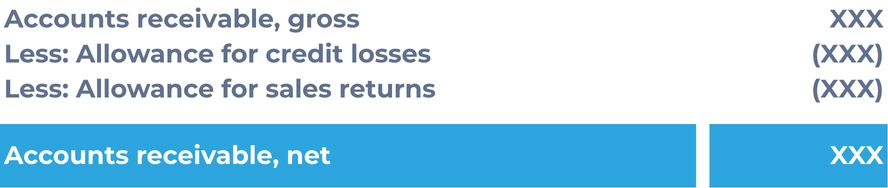
The accounts receivable are presented as a current asset in the balance sheet, net of the allowances. This allows companies to show the accounts receivable at net amounts expected to be collected.
The direct write-off method
An alternative to the accounting for credit losses is the direct write-off method.
In this method, the company does not estimate the uncollectible accounts but would record bad debts when there is certainty that accounts receivables are uncollectible. This method is not accepted under GAAP and only used for tax purposes. Below are sample journal entries under the direct write-off method:
JE 1: Record the sale
| Account | Debit | Credit | Financial statement element |
| Accounts receivable | $10,000 | Asset | |
| Sales | $10,000 | Revenue | |
| To record sales of $10,000 with term 2/10, n/60 | |||
JE 2: Record estimated credit losses
There is no journal entry to estimate bad debts under the direct write-off method.
JE 3: Record write-off of receivables
| Account | Debit | Credit | Financial statement element |
| Bad debts written-off | $10,000 | Expense | |
| Accounts receivable | $10,000 | Asset | |
| To record write-off of accounts receivable | |||
JE 4: Record recovery of previously written-off receivables
| Account | Debit | Credit | Financial statement element |
| Cash | $10,000 | Asset | |
| Bad debts recovered | $10,000 | Revenue | |
| To record collection of previously written-off accounts receivable | |||
This recovery entry is specific to the direct write-off method shown in this section. Under the allowance method used in Steps 1-2 above, a recovery instead reinstates the receivable and credits the allowance account (debit accounts receivable, credit allowance for credit losses; then debit cash, credit accounts receivable) rather than being recorded as revenue - this is the treatment reflected in the Step 2 roll-forward formula.