


Achievable logoAchievable logo
CMA Part 1
Sign in
Sign up
Purchase
Textbook
Practice exams
Support
How it works
Exam catalog
Mountain with a flag at the peak
Textbook
1. External financial reporting decisions
2. Planning, budgeting, and forecasting
3. Performance management
4. Cost management
5. Internal control
6. Technology and analytics
Achievable logoAchievable logo
1.2.1.3.2 Allowance for credit losses: Journal Entries
Achievable CMA Part 1
1. Financial transactions
1.2. Accounts receivable
1.2.1. Subsequent measurement of accounts receivables
Our CMA Part 1 course is currently in development and is a work-in-progress.

Allowance for credit losses: Journal Entries

8 min read
Font
Discuss
Share
Feedback

The topic of the allowance for credit losses is included in subsequent measurement of accounts receivable. However, it is separated here since it requires a broader discussion to accomplish the learning outcome statements.

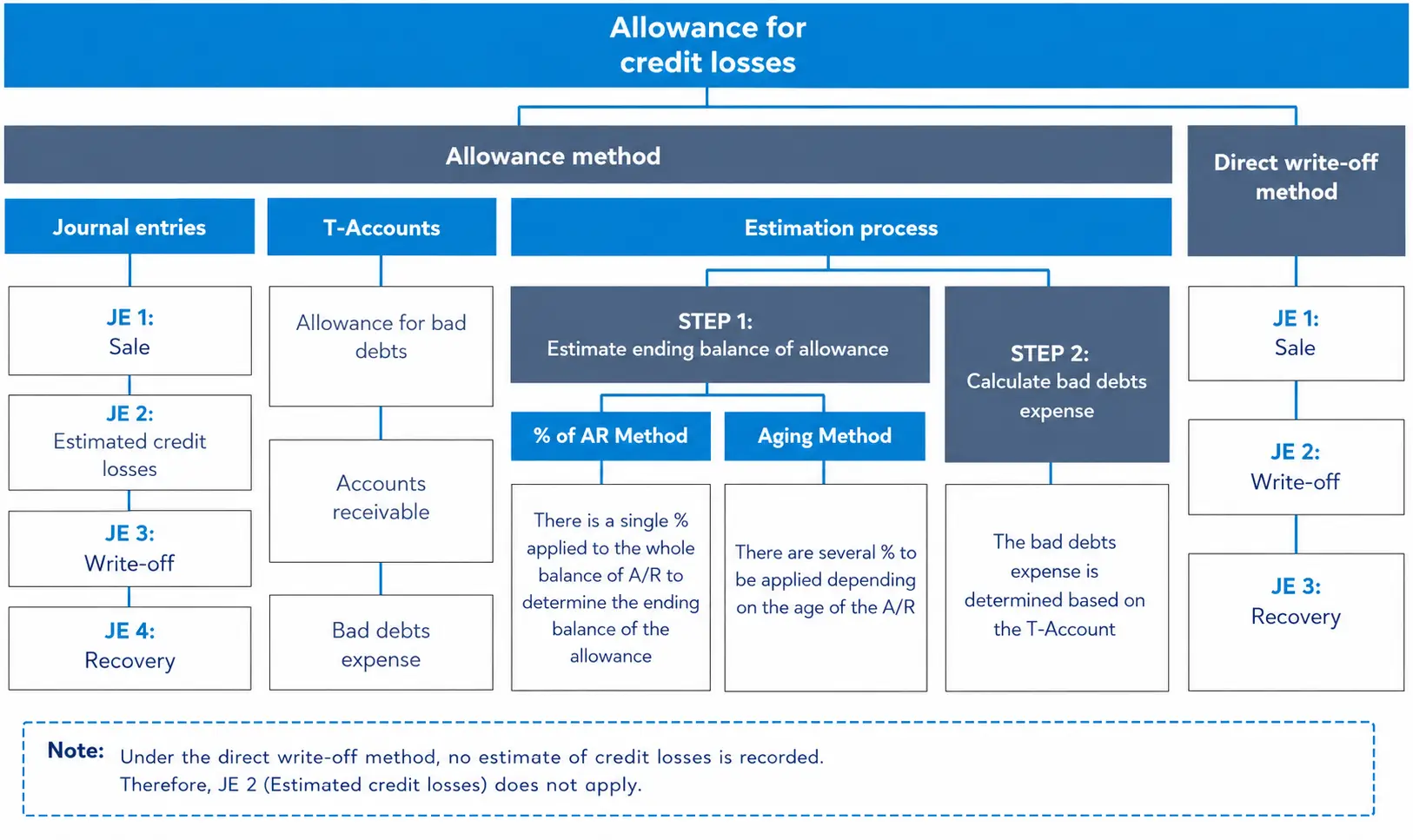
The below concept map is a continuation from the last page detailing the concepts that you need to learn related to the allowance for credit losses.

Comparing the allowance method and direct write-off method for accounting for credit losses on receivables.
Allowance Estimation Concept Map

Journal entries

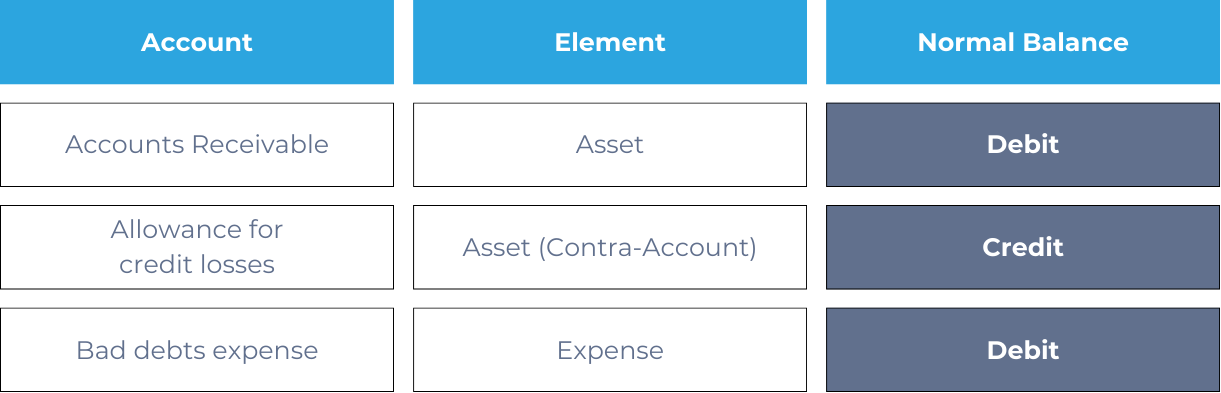
The accounting for credit losses for accounts receivable are best learned by understanding the journal entries and T-accounts of all the relevant accounts affected. It is also important to know what are the relationships among these accounts to be able to analyze exam problems properly. Three accounts are generally used for this process:

Normal balances of accounts receivable accounts

We find that getting familiar with their normal balances and the nature of the accounts help with better understanding of the journal entries. Get familiar with the following journal entries (JEs) and then we will use them to discuss the estimation process in the next section.

JE 1: Record the sale

This has already been covered in previous sections but only included here to show the full picture of the estimation process.

Account Debit Credit Financial statement element
Accounts receivable $10,000 Asset
Sales $10,000 Revenue
To record sales of $10,000 with term 2/10, n/60

JE 2: Record estimated credit losses

A discussion on how this journal entry is prepared is in the next section about the estimation process. When we book bad debts expense, the accounts receivable is not directly affected because this is only an estimate of future credit losses. Instead companies should include this estimate in a contra-asset account called “allowance for credit losses” which effectively decreases the amount of accounts receivable in the balance sheet.

Account Debit Credit Financial statement element
Bad debts expense $500 Expense
Allowance for credit losses $500 Asset (contra)
To record estimated bad debts for the period

The balance of the “allowance for credit losses” account at the end of the period, represents the total amount of accounts receivable that the company does not expect to collect in the future.

JE 3: Record write-off of receivables

When a company determines with certainty that an accounts receivables is uncollectible, the company needs to record a write-off using the following journal entry:

Account Debit Credit Financial statement element
Allowance for credit losses $10,000 Asset (contra)
Accounts receivable $10,000 Asset
To record write-off of accounts receivable

Notice that the journal entry above does not have an impact on the bad debts expense. This is because the impact on the income statement (i.e., expense) has already been previously recorded through the estimation process in JE 2 above.

In effect, a write-off of an accounts receivable does not impact the net accounts receivable since we are just removing the uncollectible balance from both the allowance account and the accounts receivable account. (Note that JE 1 through JE 4 on this page are independent, illustrative entries rather than a single continuous period - that’s why the write-off here is larger than the single estimate in JE 2. In practice, a write-off can never exceed the allowance’s accumulated credit balance.)

JE 4: Record recovery of previously written-off receivables

It is also common that companies recover previously written off accounts receivables. When this happens, we first re-establish the receivable that was previously written off by reversing JE 3 - debiting accounts receivable and crediting allowance for credit losses - and then record the normal collection of that cash. Because accounts receivable is debited and credited by the same amount across those two steps, they net out, so companies typically record the recovery directly as a single compound entry:

Account Debit Credit Financial statement element
Cash $10,000 Asset
Allowance for credit losses $10,000 Asset (contra)
To record recovery of previously written-off accounts receivable

Note that collections of previously written-off accounts receivable are not recorded as income but are reflected as an adjustment to the allowance for credit losses. The only time when the income statement is affected is during the estimation of bad debts (JE 2).

T-accounts related to allowance

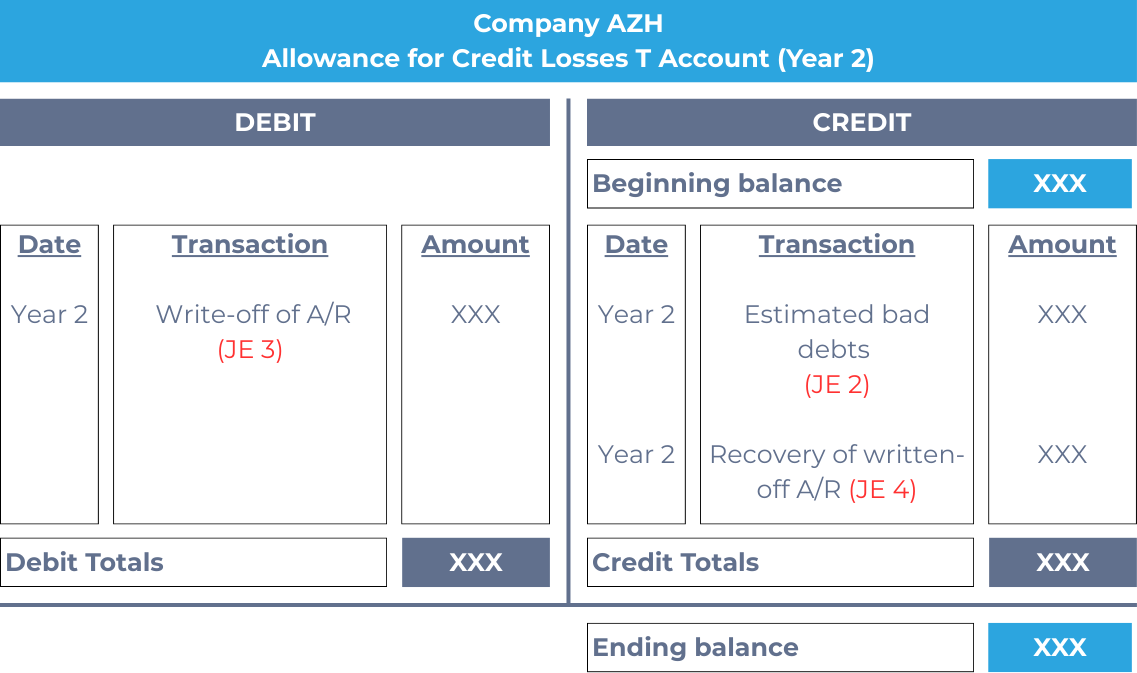
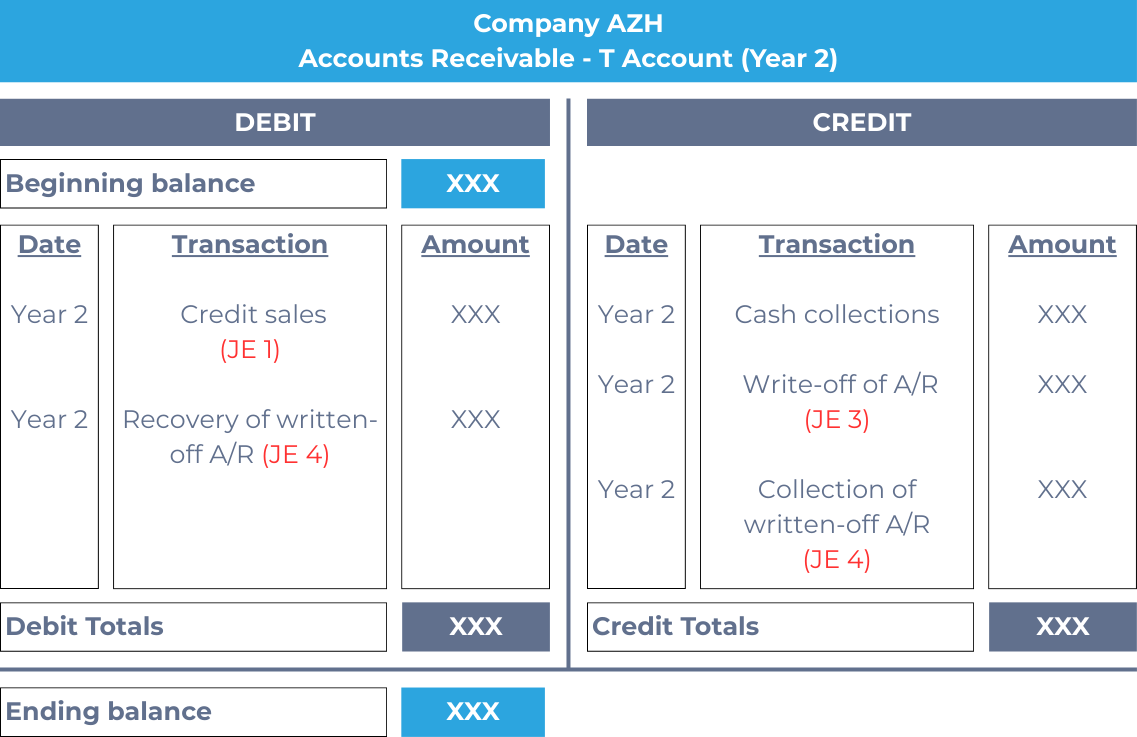
A lot of the problems in the exam related to the allowance can be solved by an in-depth understanding of the T-accounts. Below is an example which references the journal entries from the previous section.

Allowance for credit losses T-account

T-Account for AR allowance

Accounts receivable T-account

Accounts receivable T-Account

Quick trace: beginning balance $200 + estimate (JE 2) $500 − write-off (JE 3) $300 = ending balance $400. Exam questions on the allowance account typically give you a beginning balance plus some combination of estimates, write-offs, and recoveries, and ask you to solve for the missing piece.

The image below previews the aging-of-receivables method used to estimate the allowance balance - a technique covered in full on the next page, Allowance for credit losses: Estimation process.

Accounts receivable aging table listing amounts and allowance percentages by overdue category, totaling a$7,850 allowance.
Aging Analysis Example

Journal entries for credit losses

  • Four key journal entries:
    • Record sale (increase A/R, increase sales)
    • Record estimated credit losses (bad debts expense, allowance for credit losses)
    • Write-off uncollectible receivables (reduce A/R, reduce allowance)
    • Recover previously written-off receivables (reverse write-off, then record cash collection)
  • Allowance for credit losses is a contra-asset account
  • Only estimation of bad debts affects income statement

Normal balances and account relationships

  • Accounts receivable: normal debit balance (asset)
  • Allowance for credit losses: normal credit balance (contra-asset)
  • Bad debts expense: normal debit balance (expense)
  • Write-offs do not affect bad debts expense

Allowance for credit losses T-Account

  • Credited when estimating bad debts (JE 2)
  • Debited when receivables are written off (JE 3)
  • Balance represents expected uncollectible A/R

Accounts receivable T-Account

  • Debited for sales and recoveries
  • Credited for collections and write-offs
  • Net accounts receivable = gross A/R – allowance for credit losses

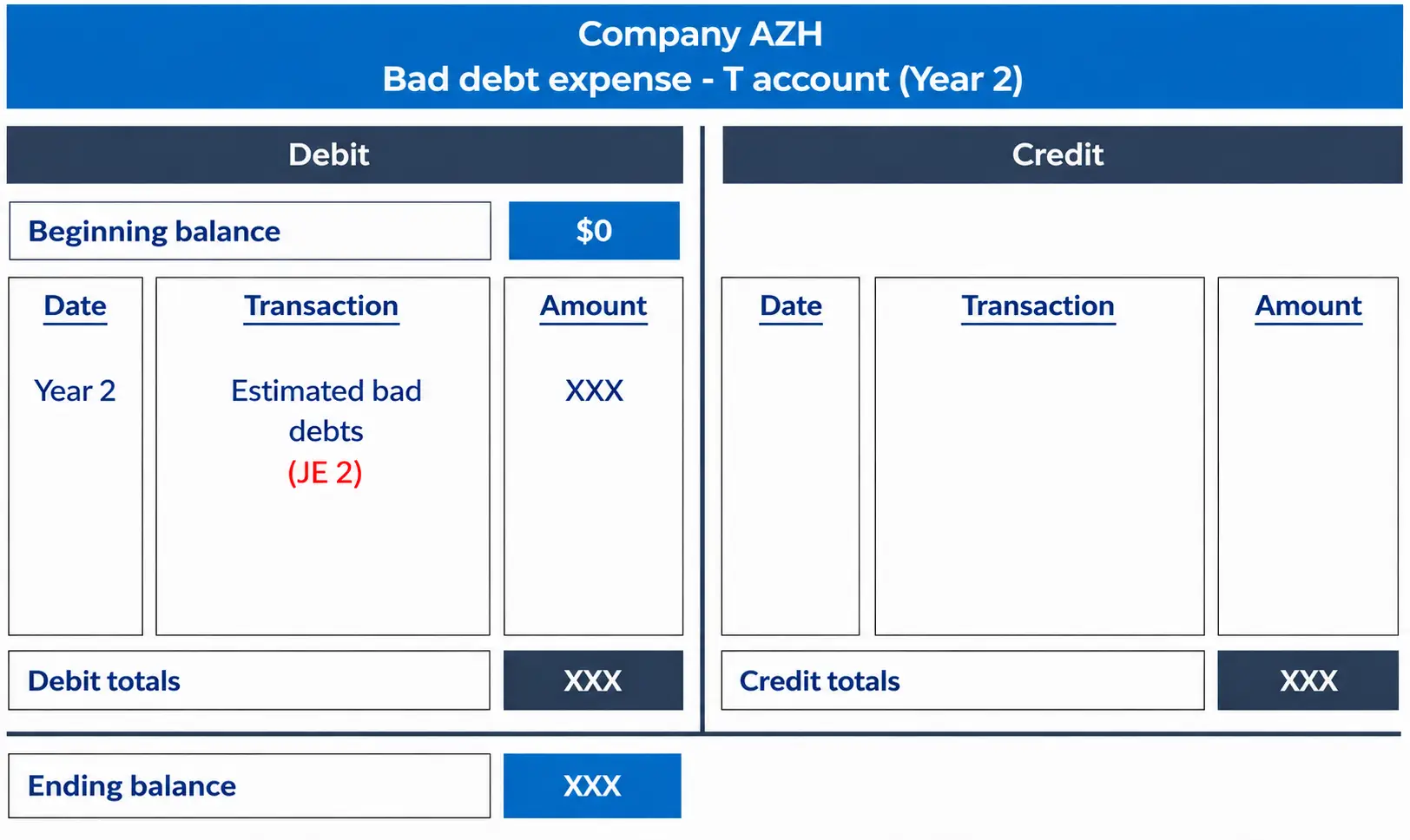
Bad debts expense T-Account

  • Debited only when estimating credit losses
  • No entry for write-offs or recoveries
  • Affects income statement only at estimation stage

Sign up for free to take 11 quiz questions on this topic

Previous
Next  | 1.2.1.3.3 Allowance for credit losses: Estimation Process
All rights reserved ©2016 - 2026 Achievable, Inc.

Allowance for credit losses: Journal Entries

The topic of the allowance for credit losses is included in subsequent measurement of accounts receivable. However, it is separated here since it requires a broader discussion to accomplish the learning outcome statements.

The below concept map is a continuation from the last page detailing the concepts that you need to learn related to the allowance for credit losses.

Journal entries

The accounting for credit losses for accounts receivable are best learned by understanding the journal entries and T-accounts of all the relevant accounts affected. It is also important to know what are the relationships among these accounts to be able to analyze exam problems properly. Three accounts are generally used for this process:

We find that getting familiar with their normal balances and the nature of the accounts help with better understanding of the journal entries. Get familiar with the following journal entries (JEs) and then we will use them to discuss the estimation process in the next section.

JE 1: Record the sale

This has already been covered in previous sections but only included here to show the full picture of the estimation process.

Account Debit Credit Financial statement element
Accounts receivable $10,000 Asset
Sales $10,000 Revenue
To record sales of $10,000 with term 2/10, n/60

JE 2: Record estimated credit losses

A discussion on how this journal entry is prepared is in the next section about the estimation process. When we book bad debts expense, the accounts receivable is not directly affected because this is only an estimate of future credit losses. Instead companies should include this estimate in a contra-asset account called “allowance for credit losses” which effectively decreases the amount of accounts receivable in the balance sheet.

Account Debit Credit Financial statement element
Bad debts expense $500 Expense
Allowance for credit losses $500 Asset (contra)
To record estimated bad debts for the period

The balance of the “allowance for credit losses” account at the end of the period, represents the total amount of accounts receivable that the company does not expect to collect in the future.

JE 3: Record write-off of receivables

When a company determines with certainty that an accounts receivables is uncollectible, the company needs to record a write-off using the following journal entry:

Account Debit Credit Financial statement element
Allowance for credit losses $10,000 Asset (contra)
Accounts receivable $10,000 Asset
To record write-off of accounts receivable

Notice that the journal entry above does not have an impact on the bad debts expense. This is because the impact on the income statement (i.e., expense) has already been previously recorded through the estimation process in JE 2 above.

In effect, a write-off of an accounts receivable does not impact the net accounts receivable since we are just removing the uncollectible balance from both the allowance account and the accounts receivable account. (Note that JE 1 through JE 4 on this page are independent, illustrative entries rather than a single continuous period - that’s why the write-off here is larger than the single estimate in JE 2. In practice, a write-off can never exceed the allowance’s accumulated credit balance.)

JE 4: Record recovery of previously written-off receivables

It is also common that companies recover previously written off accounts receivables. When this happens, we first re-establish the receivable that was previously written off by reversing JE 3 - debiting accounts receivable and crediting allowance for credit losses - and then record the normal collection of that cash. Because accounts receivable is debited and credited by the same amount across those two steps, they net out, so companies typically record the recovery directly as a single compound entry:

Account Debit Credit Financial statement element
Cash $10,000 Asset
Allowance for credit losses $10,000 Asset (contra)
To record recovery of previously written-off accounts receivable

Note that collections of previously written-off accounts receivable are not recorded as income but are reflected as an adjustment to the allowance for credit losses. The only time when the income statement is affected is during the estimation of bad debts (JE 2).

T-accounts related to allowance

A lot of the problems in the exam related to the allowance can be solved by an in-depth understanding of the T-accounts. Below is an example which references the journal entries from the previous section.

Allowance for credit losses T-account

Accounts receivable T-account

Quick trace: beginning balance $200 + estimate (JE 2) $500 − write-off (JE 3) $300 = ending balance $400. Exam questions on the allowance account typically give you a beginning balance plus some combination of estimates, write-offs, and recoveries, and ask you to solve for the missing piece.

The image below previews the aging-of-receivables method used to estimate the allowance balance - a technique covered in full on the next page, Allowance for credit losses: Estimation process.

Key points

Journal entries for credit losses

  • Four key journal entries:
    • Record sale (increase A/R, increase sales)
    • Record estimated credit losses (bad debts expense, allowance for credit losses)
    • Write-off uncollectible receivables (reduce A/R, reduce allowance)
    • Recover previously written-off receivables (reverse write-off, then record cash collection)
  • Allowance for credit losses is a contra-asset account
  • Only estimation of bad debts affects income statement

Normal balances and account relationships

  • Accounts receivable: normal debit balance (asset)
  • Allowance for credit losses: normal credit balance (contra-asset)
  • Bad debts expense: normal debit balance (expense)
  • Write-offs do not affect bad debts expense

Allowance for credit losses T-Account

  • Credited when estimating bad debts (JE 2)
  • Debited when receivables are written off (JE 3)
  • Balance represents expected uncollectible A/R

Accounts receivable T-Account

  • Debited for sales and recoveries
  • Credited for collections and write-offs
  • Net accounts receivable = gross A/R – allowance for credit losses

Bad debts expense T-Account

  • Debited only when estimating credit losses
  • No entry for write-offs or recoveries
  • Affects income statement only at estimation stage

More from Subsequent measurement of accounts receivables

  • Discounts and sales returns
  • Allowance for credit losses: Estimation Process