



Types of leases
Short term lease exception
Before we discuss finance and operating leases, we should know about the practical expedient provided by US GAAP for short term leases.
If a lease qualifies as short-term, the lessee may elect, as a practical expedient not to recognize a right-of-use (ROU) asset or a lease liability. Instead, lease payments are recorded as lease expense on a straight-line basis over the lease term.
This simplified treatment reduces complexity when the lease is not expected to extend beyond one year. Any variable lease payments are recognized in the period in which they are incurred.
When applying the straight-line method, the lease expense recognized in the income statement may not always equal the cash paid in a given period (e.g., due to rent-free periods or uneven payments). Any difference is typically recorded in a lease payable (if cash paid < expense), or as prepaid lease (prepaid rent), an asset (if cash paid > expense, after any existing payable is reduced to zero).
To calculate the straight-line lease expense:
- Add up all lease payments over the contract term.
- Divide the total by the number of months in the lease term.
The resulting amount is recorded as the periodic lease expense. If the cash paid in a given period is less than the straight-line expense, the difference is recorded as a lease payable. If the cash paid is greater, the difference first reduces any payable balance, with any excess recorded as a prepaid lease asset. Below is the sample journal entry.
| Account | Debit | Credit | Financial statement element |
| Lease expense | XXX | Expense | |
| Lease payable | XXX | Liability | |
| Cash | XXX | Asset | |
| To record payment of lease expense for the period (short-term) | |||
Example: Straight-line expense with a rent-free period
A 10-month lease is rent-free for months 1-2, then $1,000/month for months 3-10. Total: $8,000, so expense = $8,000 ÷ 10 = $800/month.
- Months 1-2: debit lease expense $800, credit lease payable $800.
- Months 3-10: debit lease expense $800, debit lease payable $200, credit cash $1,000.
Answer: the payable rises to $1,600, then unwinds $200/month over 8 months back to zero.
Short-term leases aren’t specifically tested in the CMA learning outcomes, but this background is useful if a related question appears.
Two types of leases
If the lease contract does not qualify as a short term lease or if the option has not been taken to account for the lease as a short term lease, there are two possible classifications of leases under US GAAP:
- Operating lease
- Finance lease
A lease is a finance lease if it meets any of these criteria; otherwise it’s an operating lease:
- ownership transfers to the lessee at lease end;
- there’s a purchase option the lessee is reasonably certain to exercise;
- the lease term covers most of the asset’s remaining economic life;
- the present value of payments is substantially all of the asset’s fair value; or
- the asset is too specialized for the lessor to use otherwise.
Each type’s accounting follows in the next two chapters.
For both types of leases, it is required to recognize two balance sheet items:
- the right of use (ROU) asset; and
- the lease liability.
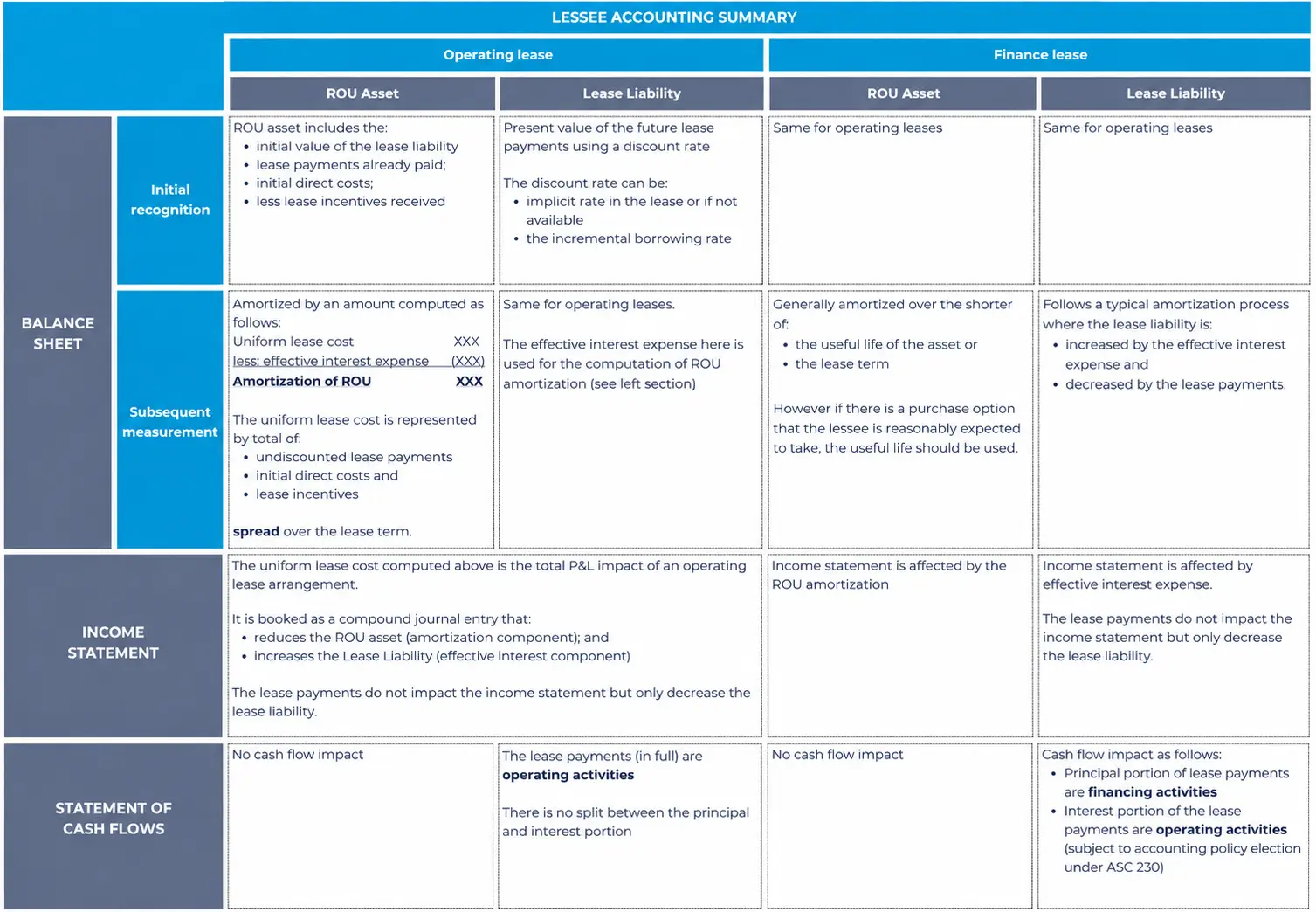
Each type of lease (operating or finance) will result in a different accounting method for the ROU asset and the lease liability. The following is a summary of the differences between the operating and finance leases under US GAAP. Detailed discussions are in the subsequent sections.
An operating lease produces one straight-line lease cost, an operating cash outflow. A finance lease produces separate ROU amortization and interest expense, with principal as a financing outflow and interest typically operating.
Revisit this table after working through the operating and finance lease sections that follow.