



Prescriptions, regulatory requirements, and patient care
Prescriptions
A prescription is a written order by a provider to the pharmacist. It tells the pharmacist what medication and how much should be dispensed to the patient. There are four parts to a prescription: superscription, inscription, signature, and subscription.
Medical assistant’s role
In some ambulatory care facilities, there are scenarios in which medical assistants prepare prescriptions for providers to sign:
- A patient may request refills while the medical assistant is rooming the patient. The medical assistant may prepare the prescriptions, so the provider just needs to sign for the refills.
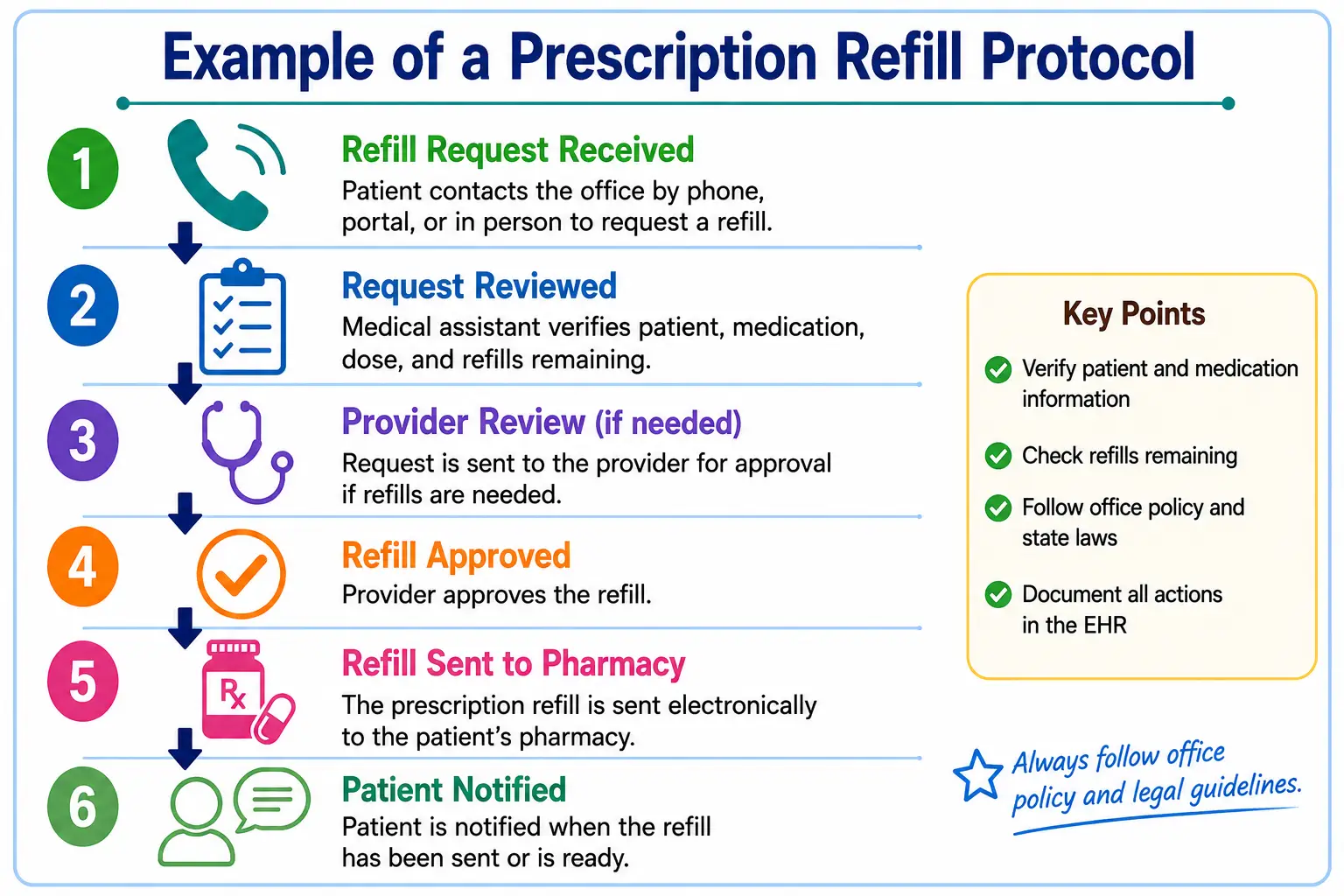
- A patient may call the department and request a refill on a medication. Using a medication refill protocol, the medical assistant needs to see if the patient can get a refill. If the patient can, then the medical assistant prepares the prescription and has the provider sign it.
The prescription must be written in ink or be computer generated. A medical assistant can prepare prescriptions for the provider to sign. The provider is responsible for ensuring the prescription meets federal and state laws and regulations. All prescriptions need to include this information:
- Date of issue (when it was written)
- Patient information (name and address are required, date of birth is helpful)
- Provider’s full name and address
- Drug name (e.g., amoxicillin)
- Drug strength (e.g., 500 mg)
- Dosage form (e.g., tablets)
- Quantity prescribed (e.g., 14 [fourteen]); writing out the number prevents people from altering the prescription, which is especially important with controlled substances
- Directions for use (e.g., Take 1 tablet q12h)
- Number of refills (e.g., Refills 0)
- National Provider Identifier (NPI) and signature of provider (a manual signature is required for controlled substances)
- Must indicate if a generic is acceptable
If an electronic prescription is sent to the pharmacy and a paper copy is given to the patient, the copy should indicate that it is a copy (“Copy only - not valid for dispensing”).
Only facility-approved abbreviations should be used when preparing prescriptions and documenting the patients’ health records. Once the prescriptions are prepared, they need to be given to the provider to sign. Either the provider or the medical assistant needs to document the refills in the patient’s health record. The facility’s policy will indicate who is responsible for the documentation.
Controlled substance prescriptions
For security reasons, the provider’s DEA number should be used only on controlled substance prescriptions. It is not appropriate for the number to appear on non-narcotic prescriptions. The NPI is a national number that is unique to the provider. This number is found on prescriptions and may be used for tracking or treatment identification purposes.
The medical assistant needs to be aware of the special requirements for controlled substances. It is important for the medical assistant to stay updated on which frequently prescribed medications are controlled substances.
Patient coaching
OTC medications and herbal supplements can affect medication treatment. It is important for the medical assistant to obtain a list of the patient’s current prescription and OTC medications, in addition to herbal supplements. Some patients may hesitate or may not want to share this information. They may not realize that OTC medications and herbal supplements can interfere with prescription medications. It is important for medical assistants to be professional and respectful when dealing with these situations. If they coach patients that sometimes the OTC medications and herbal supplements react with prescription medications, patients may be more willing to share information on what they take.
Legal and ethical issues
The magnitude of opioid abuse has increased dramatically, and it is currently considered a crisis. According to the Centers for Disease Control and Prevention (CDC) (www.cdc.gov), 91,799 drug overdose deaths occurred in the United States in 2020. This equates to about 250 deaths daily from drug overdoses. Synthetic opioid overdoses increased during this period compared to the prior year. With the frequency of opioid abuse, prescribing guidelines are changing. Many ambulatory care facilities have adopted procedures for specific controlled substance prescriptions. Before patients can get these prescriptions, they need to have a urine drug test. The urine drug test helps providers assess what drugs patients have taken. Providers expect the results to show the drug prescribed, but they check for other prescribed controlled substances and illicit drugs. In many cases, if the drug test shows evidence of illicit drug use or prescription-controlled substances not prescribed by the provider, the patient is referred for substance abuse counseling and treatment.
The CDC has published the document Guidelines for Prescribing Opioids for Chronic Pain (available at www.cdc.gov/drugoverdose/pdf/Guidelines_Factsheet-a.pdf). These guidelines help support providers who are working with patients with chronic pain. The provider may have the medical assistant coach patients on home care treatments. Opioids are not first-line or routine therapy for chronic pain. The medical assistant may need to coach the patient on the importance of using nonpharmacologic therapy and nonopioid pharmacologic therapy for chronic pain. For patients who receive opioid prescriptions, frequent follow-up is needed for the provider to evaluate the benefit and risks of the drug.
Patient-centered care
Most healthcare facilities require that patients receive a printout of their current medications at the end of each visit. When patients are taking several medications, it is important for the medical assistant to encourage these patients to carry a current medications list in their wallet or purse. This can be helpful in an emergency or when the patient needs to see a different provider.
Professional behaviors
When working with prescription refills, it is important for the medical assistant to process the refill in a timely fashion. If the medical assistant procrastinates and does not process refills, then patients may not have their medications when they need them. Some medications need to be taken daily. If a dose is skipped, the patient may have serious consequences.
It is also important for the medical assistant to honor what that patient was told. If the patient is told the medication will be sent to a pharmacy by a specific time, it is important for the medical assistant to ensure this is done. If the medication is held up for some reason, the medical assistant should notify the patient about the delay.