


Achievable logoAchievable logo
CCMA
Sign in
Sign up
Purchase
Textbook
Practice exams
Support
How it works
Exam catalog
Mountain with a flag at the peak
Textbook
1. Medical assistant
2. Electronic records
3. Medical terminology and anatomy
4. The fundamentals of infection control
5. Introduction to vital signs
6. The patient interview and history
7. The physical examination
8. Appointment scheduling
9. Insurance billing
10. Diagnostic coding and the ICD-10-CM System
11. Procedural coding
12. Medical billing and reimbursement essentials
13. Assisting with medical specialties
14. Assisting with the musculoskeletal system
15. Assisting with the cardiovascular system
16. Assisting with the respiratory system
17. Assisting with the nervous system
18. Anatomy and physiology of the urinary system
19. Assisting in obstetrics and gynecology
20. Assisting in endocrinology
21. Assisting in ophthalmology & otolaryngology
22. Assisting in gastroenterology
23. Assisting in the immune & lymphatic systems
24. Assisting in pediatrics: the developmental stages and care
25. The medical assistant’s role in caring for the older patient
26. The role of the medical assistant in physical therapy examination and assessment
27. Preparing for minor surgery: room, solutions, and supplies
28. Introduction to the clinical laboratory
29. Urinalysis
30. Blood collection
31. Analysis of blood
32. Electrocardiography and heart structure
33. The principles of pharmacology
33.1 The principles of pharmacology
33.2 Drug metabolism, action, and effects
33.3 Drug legislation and the ambulatory care setting
33.4 Prescriptions, regulatory requirements, and patient care
33.5 Drug naming, reference, and classification
33.6 Medication forms and types of orders
34. Essential calculations and measurement systems
35. Solid, liquid, & solutions medication doses
36. Administering medications
37. Metabolism and core nutrient roles
38. Medical emergencies in the healthcare setting
Achievable logoAchievable logo
33.3 Drug legislation and the ambulatory care setting
Achievable CCMA
33. The principles of pharmacology
Our CCMA course is currently in development and is a work-in-progress.

Drug legislation and the ambulatory care setting

9 min read
Font
Discuss
Share
Feedback

In the ambulatory care environment, medications can be prescribed, administered, and dispensed.

Prescribe means to order medication as a treatment for a condition. Doctors (MDs [including psychiatrists], doctors of osteopathic medicine [DOs], and dentists) and advanced practice professionals, including physician assistants (PAs), nurse practitioners (NPs), and certified nurse-midwives (CNMs), can prescribe medications. State prescribing laws can vary for advanced practice professionals.

Administer means to give a prescribed dose of medication to a patient. Medical assistants, nurses, and providers can administer medications. State laws related to medication administration by medical assistants can vary.

Dispense means to give a supply of medication that the patient will take later. In most scenarios, pharmacists dispense medications.

Federal and state legislation governs these three activities. The following sections will discuss these laws, the agencies responsible for overseeing the laws, and the laws’ effect on medical assistants.

Food, drug, and cosmetic act

The Food, Drug, and Cosmetic Act of 1938 is enforced by the Food and Drug Administration (FDA). The FDA is a federal agency in the Department of Health and Human Services (HHS). The FDA is responsible for the safety, effectiveness, security, and quality of drugs, cosmetics, and food. The FDA oversees a number of areas:

  • Foods: Dietary supplements, bottled water, food additives, infant formula, and other food products
  • Drugs: Prescription drugs (brand name and generic) and nonprescription (over-the-counter [OTC]) drugs
  • Biologics: Vaccines, blood, and blood products
  • Medical devices: Medical equipment (from simple [tongue depressor] to complex [heart pacemaker]), dental devices, and surgical implants

Manufacturers must submit applications for new products to the FDA. Manufacturers must provide adequate data to show the safety and effectiveness of the product. The FDA must determine if drugs, devices, and products are safe and effective. Once this is determined, then the product is released to the general public.

FDA adverse event reporting system

The FDA monitors the safety of products released to the market. The FDA Adverse Event Reporting System (FAERS) is a computerized database that helps the FDA monitor drugs. It contains reports of adverse events reported to the FDA. MedWatch is the FDA’s reporting program. It provides information on products overseen by the FDA. MedWatch is available to healthcare professionals (www.fda.gov/safety/medwatch-fda-safety-information-and-adverse-event-reporting-program).

If the FDA determines a medication is unsafe, it will recall the medication. The medical assistant should remove any recalled medications from the stock and sample cabinets. (Sample medications come from pharmaceutical companies and are used for patients.) Concerned patients may contact their providers. The provider will determine what action to take for each patient.

Controlled substances act

The Controlled Substances Act (CSA), Title II of the Comprehensive Drug Abuse Prevention and Control Act of 1970, is a federal law. The Drug Enforcement Agency (DEA) is a federal law enforcement agency under the US Department of Justice. The DEA enforces the CSA. The DEA oversees the manufacturing, importation, possession, use, and distribution of legal (or prescription) controlled substances. The DEA also handles illegal controlled substances, which cannot legally be manufactured, purchased, or sold in the United States.

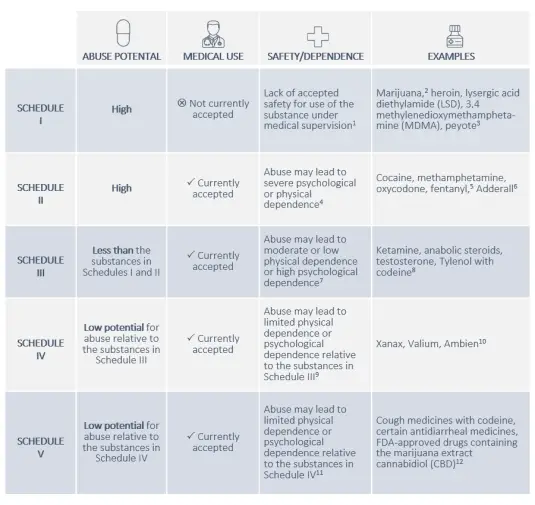
Under the CSA, controlled substances are divided into five schedules. These schedules are arranged from the greatest to the least abuse potential. State statutes also address procedures related to scheduled medications. It is important for the medical assistant to know the schedule of commonly ordered medications. Some controlled substance prescriptions are handled differently. This is discussed later in the chapter.

Compliance with the controlled substance act

Providers prescribing controlled substances need a DEA registration number. Each provider has a unique number. The DEA number is good for 3 years. The medical assistant may need to assist the provider in renewing or obtaining a DEA number. This can be done at the DEA website at www.deadiversion.usdoj.gov. Additional state requirements may need to be met before a provider can prescribe controlled substances.

DEA schedule of controlled substances shown
Schedule of controlled substances
Wikimedia Commons
/
U.S. Government Work (Public Domain)

Controlled substances have a paper trail. This record starts with the manufacturer and ends when the medication is dispensed or administered. In some healthcare facilities, the in-house pharmacy handles the controlled substances that are administered. The provider gives the medical assistant a prescription for a patient. The medical assistant gives the pharmacist the prescription and, in return, gets the medication. (Please note that some state laws do not allow medical assistants to administer controlled substances.) In this scenario, the pharmacist is responsible for managing the paperwork for the controlled substances.

In healthcare facilities without pharmacies, providers must take the responsibility of ordering controlled substances from the manufacturer. The medical assistant must help the provider comply with the Controlled Substance Act. The following sections discuss common compliance activities.

Storage

All controlled substances must be adequately safeguarded. They need to be kept in a locked cabinet or safe of substantial construction. Keys should be placed in a locked area accessible only to authorized persons. Store controlled substances in a different location than non-narcotic medications. Additional storage guidelines apply to all medications:

  • Make sure all medications are kept in their original containers.
  • Store medications in a cool, dry location. Keep medications away from light, heat, or moisture. Refer to package inserts for specific storage information.
  • Do not combine or repackage medications with different lot numbers or expiration dates.
  • Keep stock medications (purchased by department) separated from sample medications (given by pharmaceutical manufacturers for patients).
  • Keep medications out of exam rooms. Lock medication cabinets at the end of the day.

Inventory records

It is important to keep an ongoing log of controlled substances received from manufacturers and administered to patients. Medications are tracked by the manufacturer, lot number, and expiration date. This information is found on the package. When a patient needs a controlled substance, the medical assistant must complete the log. The log typically requires the following data:

  • The medication information (name, dose, lot number, and expiration date)
  • The ordering provider’s name
  • Information on the patient receiving the medication (name, date of birth, address, health record number, and so on)
  • The name or initials of the healthcare professional administering the medication

The log must be kept separate from the patient’s health record. The medication must also be documented in the patient’s health record after it is administered.

Periodic reconciling of the log with the actual inventory count is important to identify missing medications. An inventory of all controlled substances must be done at least annually unless required more often by law. Some states have special requirements for the inventory. It is important for the medical assistant to be knowledgeable about the special state requirements. The controlled substance inventory and log records need to be kept for 2 years. The records may be inspected by individuals authorized by the state attorney general.

Drug destruction

Expired controlled substances are returned to the place from where they were received. For example, controlled substances that were sent by the manufacturer must be returned to the manufacturer, along with the required paperwork.

Sometimes a controlled substance must be destroyed in the healthcare facility, such as in the following situations:

  • Only part of the medication is used for the patient; the extra amount must be destroyed.
  • The patient refuses the medication after it has been opened and prepared.
  • The medication is accidentally contaminated before it can be administered.

In these situations, the controlled substance must be destroyed in the presence of two authorized persons (e.g., medical assistants, nurses). An entry on the waste log must be made. This information must include the date; the drug’s name, strength, and quantity; the reason for destruction; and the signatures of both persons.

Discarding medications in the healthcare facility

Discard medication that is expired, contaminated, unlabeled, or opened and not used. Some healthcare facilities have medication discarding programs to prevent medications from entering the city’s water supply. Remember, if the medication is a controlled substance, two authorized employees must sign a waste log before the medication is discarded. Both employees must witness the disposal.

To discard medication, follow these steps if the facility has no other procedures in place:

  • Return expired controlled substances to the place they were received from (e.g., manufacturer), accompanied by the proper paperwork.
  • Flush liquids down the sink.
  • Flush pills down the toilet.
  • Mix powdered medications with water and flush them down the toilet.
  • Flush fluid from syringes down the sink and discard the syringe in a biohazardous sharps container.

Theft and diversion reporting

Diversion of controlled substances means using the medication for personal reasons. If a medical assistant identifies that controlled substances are missing, it is important to notify the provider and supervisor. Many states and the DEA require any theft or loss to be reported to them within a given period. A report must be completed and filed by the deadline.

Medical assistant’s role in preventing drug abuse

By following these guidelines, the medical assistant can help prevent drug abuse:

  • Carefully monitor patients who repeatedly call for prescription refills of controlled substances. Be aware that some patients will give aliases (false names).
  • Request health records from other facilities for patients who report previous prescriptions for scheduled drugs.
  • If the facility uses paper prescription pads, keep blank pads in a locked cabinet. They should be stored away from patient treatment areas.
  • Never use prescription pads for notepads. Never use preprinted or presigned forms.
  • Secure computers used for electronic health record (EHR) documentation to prevent patient access to prescription generation.
  • Keep only a limited supply of controlled substances on hand.
  • Keep accurate, complete records of controlled substances administered. Patients’ records should contain information on prescribed and administered controlled substances.

Prescribing, Administering, and Dispensing in Ambulatory Care

  • Prescribing: ordering medication by authorized providers (MDs, DOs, dentists, PAs, NPs, CNMs; varies by state)
  • Administering: giving prescribed dose to patient (medical assistants, nurses, providers; state laws vary)
  • Dispensing: providing medication supply for later use (primarily pharmacists)
  • Governed by federal and state laws

Food, Drug, and Cosmetic Act

  • Enforced by FDA (part of HHS)
  • FDA ensures safety, effectiveness, quality of drugs, foods, cosmetics, biologics, medical devices
  • Manufacturers must submit data for FDA approval before public release

FDA Adverse Event Reporting System (FAERS)

  • FDA monitors post-market drug safety via FAERS database
  • MedWatch: reporting program for adverse events (open to healthcare professionals)
  • FDA can recall unsafe medications; medical assistants must remove recalled drugs from stock

Controlled Substances Act (CSA)

  • Federal law enforced by DEA (Dept. of Justice)
  • Regulates manufacturing, distribution, use of controlled substances (legal and illegal)
  • Controlled substances classified into five schedules (I-V) by abuse potential

Compliance with the Controlled Substances Act

  • Providers need DEA registration number (valid 3 years) to prescribe controlled substances
  • Controlled substances require a documented paper trail from manufacturer to administration/dispensing
  • State laws may restrict medical assistants from administering controlled substances

Storage of Controlled Substances

  • Store in locked, secure cabinet/safe, separate from non-narcotics
  • Keep medications in original containers, away from light, heat, moisture
  • Separate stock from sample medications; lock cabinets at end of day

Inventory Records

  • Maintain ongoing log: medication details, provider, patient info, administering staff
  • Log kept separate from patient health record; must reconcile with inventory regularly
  • Annual inventory required (or more often per state law); records kept for 2 years

Drug Destruction

  • Return expired controlled substances to source with paperwork
  • Destroy unused portions in facility with two authorized witnesses; document in waste log (date, drug info, reason, signatures)

Discarding Medications in Healthcare Facility

  • Discard expired, contaminated, unlabeled, or unused medications per facility protocol
  • Controlled substances: two authorized employees must witness and sign waste log
  • Common disposal: flush liquids/pills, mix powders with water and flush, sharps in biohazard container

Theft and Diversion Reporting

  • Diversion: unauthorized personal use of controlled substances
  • Report missing controlled substances to provider, supervisor, and authorities (DEA, state) promptly
  • File required theft/loss reports by deadline

Medical Assistant’s Role in Preventing Drug Abuse

  • Monitor for frequent refill requests, aliases
  • Request prior health records for patients with scheduled drug history
  • Secure prescription pads and EHR systems
  • Limit on-hand controlled substances; keep accurate records of administration and prescriptions

Sign up for free to take 14 quiz questions on this topic

Previous
Next  | 33.4 Prescriptions, regulatory requirements, and patient care
All rights reserved ©2016 - 2026 Achievable, Inc.

Drug legislation and the ambulatory care setting

In the ambulatory care environment, medications can be prescribed, administered, and dispensed.

Prescribe means to order medication as a treatment for a condition. Doctors (MDs [including psychiatrists], doctors of osteopathic medicine [DOs], and dentists) and advanced practice professionals, including physician assistants (PAs), nurse practitioners (NPs), and certified nurse-midwives (CNMs), can prescribe medications. State prescribing laws can vary for advanced practice professionals.

Administer means to give a prescribed dose of medication to a patient. Medical assistants, nurses, and providers can administer medications. State laws related to medication administration by medical assistants can vary.

Dispense means to give a supply of medication that the patient will take later. In most scenarios, pharmacists dispense medications.

Federal and state legislation governs these three activities. The following sections will discuss these laws, the agencies responsible for overseeing the laws, and the laws’ effect on medical assistants.

Food, drug, and cosmetic act

The Food, Drug, and Cosmetic Act of 1938 is enforced by the Food and Drug Administration (FDA). The FDA is a federal agency in the Department of Health and Human Services (HHS). The FDA is responsible for the safety, effectiveness, security, and quality of drugs, cosmetics, and food. The FDA oversees a number of areas:

  • Foods: Dietary supplements, bottled water, food additives, infant formula, and other food products
  • Drugs: Prescription drugs (brand name and generic) and nonprescription (over-the-counter [OTC]) drugs
  • Biologics: Vaccines, blood, and blood products
  • Medical devices: Medical equipment (from simple [tongue depressor] to complex [heart pacemaker]), dental devices, and surgical implants

Manufacturers must submit applications for new products to the FDA. Manufacturers must provide adequate data to show the safety and effectiveness of the product. The FDA must determine if drugs, devices, and products are safe and effective. Once this is determined, then the product is released to the general public.

FDA adverse event reporting system

The FDA monitors the safety of products released to the market. The FDA Adverse Event Reporting System (FAERS) is a computerized database that helps the FDA monitor drugs. It contains reports of adverse events reported to the FDA. MedWatch is the FDA’s reporting program. It provides information on products overseen by the FDA. MedWatch is available to healthcare professionals (www.fda.gov/safety/medwatch-fda-safety-information-and-adverse-event-reporting-program).

If the FDA determines a medication is unsafe, it will recall the medication. The medical assistant should remove any recalled medications from the stock and sample cabinets. (Sample medications come from pharmaceutical companies and are used for patients.) Concerned patients may contact their providers. The provider will determine what action to take for each patient.

Controlled substances act

The Controlled Substances Act (CSA), Title II of the Comprehensive Drug Abuse Prevention and Control Act of 1970, is a federal law. The Drug Enforcement Agency (DEA) is a federal law enforcement agency under the US Department of Justice. The DEA enforces the CSA. The DEA oversees the manufacturing, importation, possession, use, and distribution of legal (or prescription) controlled substances. The DEA also handles illegal controlled substances, which cannot legally be manufactured, purchased, or sold in the United States.

Under the CSA, controlled substances are divided into five schedules. These schedules are arranged from the greatest to the least abuse potential. State statutes also address procedures related to scheduled medications. It is important for the medical assistant to know the schedule of commonly ordered medications. Some controlled substance prescriptions are handled differently. This is discussed later in the chapter.

Compliance with the controlled substance act

Providers prescribing controlled substances need a DEA registration number. Each provider has a unique number. The DEA number is good for 3 years. The medical assistant may need to assist the provider in renewing or obtaining a DEA number. This can be done at the DEA website at www.deadiversion.usdoj.gov. Additional state requirements may need to be met before a provider can prescribe controlled substances.

Controlled substances have a paper trail. This record starts with the manufacturer and ends when the medication is dispensed or administered. In some healthcare facilities, the in-house pharmacy handles the controlled substances that are administered. The provider gives the medical assistant a prescription for a patient. The medical assistant gives the pharmacist the prescription and, in return, gets the medication. (Please note that some state laws do not allow medical assistants to administer controlled substances.) In this scenario, the pharmacist is responsible for managing the paperwork for the controlled substances.

In healthcare facilities without pharmacies, providers must take the responsibility of ordering controlled substances from the manufacturer. The medical assistant must help the provider comply with the Controlled Substance Act. The following sections discuss common compliance activities.

Storage

All controlled substances must be adequately safeguarded. They need to be kept in a locked cabinet or safe of substantial construction. Keys should be placed in a locked area accessible only to authorized persons. Store controlled substances in a different location than non-narcotic medications. Additional storage guidelines apply to all medications:

  • Make sure all medications are kept in their original containers.
  • Store medications in a cool, dry location. Keep medications away from light, heat, or moisture. Refer to package inserts for specific storage information.
  • Do not combine or repackage medications with different lot numbers or expiration dates.
  • Keep stock medications (purchased by department) separated from sample medications (given by pharmaceutical manufacturers for patients).
  • Keep medications out of exam rooms. Lock medication cabinets at the end of the day.

Inventory records

It is important to keep an ongoing log of controlled substances received from manufacturers and administered to patients. Medications are tracked by the manufacturer, lot number, and expiration date. This information is found on the package. When a patient needs a controlled substance, the medical assistant must complete the log. The log typically requires the following data:

  • The medication information (name, dose, lot number, and expiration date)
  • The ordering provider’s name
  • Information on the patient receiving the medication (name, date of birth, address, health record number, and so on)
  • The name or initials of the healthcare professional administering the medication

The log must be kept separate from the patient’s health record. The medication must also be documented in the patient’s health record after it is administered.

Periodic reconciling of the log with the actual inventory count is important to identify missing medications. An inventory of all controlled substances must be done at least annually unless required more often by law. Some states have special requirements for the inventory. It is important for the medical assistant to be knowledgeable about the special state requirements. The controlled substance inventory and log records need to be kept for 2 years. The records may be inspected by individuals authorized by the state attorney general.

Drug destruction

Expired controlled substances are returned to the place from where they were received. For example, controlled substances that were sent by the manufacturer must be returned to the manufacturer, along with the required paperwork.

Sometimes a controlled substance must be destroyed in the healthcare facility, such as in the following situations:

  • Only part of the medication is used for the patient; the extra amount must be destroyed.
  • The patient refuses the medication after it has been opened and prepared.
  • The medication is accidentally contaminated before it can be administered.

In these situations, the controlled substance must be destroyed in the presence of two authorized persons (e.g., medical assistants, nurses). An entry on the waste log must be made. This information must include the date; the drug’s name, strength, and quantity; the reason for destruction; and the signatures of both persons.

Discarding medications in the healthcare facility

Discard medication that is expired, contaminated, unlabeled, or opened and not used. Some healthcare facilities have medication discarding programs to prevent medications from entering the city’s water supply. Remember, if the medication is a controlled substance, two authorized employees must sign a waste log before the medication is discarded. Both employees must witness the disposal.

To discard medication, follow these steps if the facility has no other procedures in place:

  • Return expired controlled substances to the place they were received from (e.g., manufacturer), accompanied by the proper paperwork.
  • Flush liquids down the sink.
  • Flush pills down the toilet.
  • Mix powdered medications with water and flush them down the toilet.
  • Flush fluid from syringes down the sink and discard the syringe in a biohazardous sharps container.

Theft and diversion reporting

Diversion of controlled substances means using the medication for personal reasons. If a medical assistant identifies that controlled substances are missing, it is important to notify the provider and supervisor. Many states and the DEA require any theft or loss to be reported to them within a given period. A report must be completed and filed by the deadline.

Medical assistant’s role in preventing drug abuse

By following these guidelines, the medical assistant can help prevent drug abuse:

  • Carefully monitor patients who repeatedly call for prescription refills of controlled substances. Be aware that some patients will give aliases (false names).
  • Request health records from other facilities for patients who report previous prescriptions for scheduled drugs.
  • If the facility uses paper prescription pads, keep blank pads in a locked cabinet. They should be stored away from patient treatment areas.
  • Never use prescription pads for notepads. Never use preprinted or presigned forms.
  • Secure computers used for electronic health record (EHR) documentation to prevent patient access to prescription generation.
  • Keep only a limited supply of controlled substances on hand.
  • Keep accurate, complete records of controlled substances administered. Patients’ records should contain information on prescribed and administered controlled substances.
Key points

Prescribing, Administering, and Dispensing in Ambulatory Care

  • Prescribing: ordering medication by authorized providers (MDs, DOs, dentists, PAs, NPs, CNMs; varies by state)
  • Administering: giving prescribed dose to patient (medical assistants, nurses, providers; state laws vary)
  • Dispensing: providing medication supply for later use (primarily pharmacists)
  • Governed by federal and state laws

Food, Drug, and Cosmetic Act

  • Enforced by FDA (part of HHS)
  • FDA ensures safety, effectiveness, quality of drugs, foods, cosmetics, biologics, medical devices
  • Manufacturers must submit data for FDA approval before public release

FDA Adverse Event Reporting System (FAERS)

  • FDA monitors post-market drug safety via FAERS database
  • MedWatch: reporting program for adverse events (open to healthcare professionals)
  • FDA can recall unsafe medications; medical assistants must remove recalled drugs from stock

Controlled Substances Act (CSA)

  • Federal law enforced by DEA (Dept. of Justice)
  • Regulates manufacturing, distribution, use of controlled substances (legal and illegal)
  • Controlled substances classified into five schedules (I-V) by abuse potential

Compliance with the Controlled Substances Act

  • Providers need DEA registration number (valid 3 years) to prescribe controlled substances
  • Controlled substances require a documented paper trail from manufacturer to administration/dispensing
  • State laws may restrict medical assistants from administering controlled substances

Storage of Controlled Substances

  • Store in locked, secure cabinet/safe, separate from non-narcotics
  • Keep medications in original containers, away from light, heat, moisture
  • Separate stock from sample medications; lock cabinets at end of day

Inventory Records

  • Maintain ongoing log: medication details, provider, patient info, administering staff
  • Log kept separate from patient health record; must reconcile with inventory regularly
  • Annual inventory required (or more often per state law); records kept for 2 years

Drug Destruction

  • Return expired controlled substances to source with paperwork
  • Destroy unused portions in facility with two authorized witnesses; document in waste log (date, drug info, reason, signatures)

Discarding Medications in Healthcare Facility

  • Discard expired, contaminated, unlabeled, or unused medications per facility protocol
  • Controlled substances: two authorized employees must witness and sign waste log
  • Common disposal: flush liquids/pills, mix powders with water and flush, sharps in biohazard container

Theft and Diversion Reporting

  • Diversion: unauthorized personal use of controlled substances
  • Report missing controlled substances to provider, supervisor, and authorities (DEA, state) promptly
  • File required theft/loss reports by deadline

Medical Assistant’s Role in Preventing Drug Abuse

  • Monitor for frequent refill requests, aliases
  • Request prior health records for patients with scheduled drug history
  • Secure prescription pads and EHR systems
  • Limit on-hand controlled substances; keep accurate records of administration and prescriptions

More from The principles of pharmacology

  • The principles of pharmacology
  • Drug metabolism, action, and effects
  • Prescriptions, regulatory requirements, and patient care
  • Drug naming, reference, and classification
  • Medication forms and types of orders