


Achievable logoAchievable logo
CCMA
Sign in
Sign up
Purchase
Textbook
Practice exams
Support
How it works
Resources
Exam catalog
Mountain with a flag at the peak
Textbook
Introduction
1. Medical assistant
2. Electronic records
3. Medical terminology and anatomy
4. The fundamentals of infection control
4.1 The cycle of infection
4.2 The body’s defense mechanisms and types of infection
4.3 Infection control
4.3.1 The role of the medical assistant
4.3.2 Workplace safety and protective measures
4.3.3 Infection control and OSHA standards in healthcare
4.3.4 Waste disposal, vaccination, and exposure protocols
5. Introduction to vital signs
6. The patient interview and history
7. The physical examination
8. Appointment scheduling
9. Insurance billing
10. Diagnostic coding and the ICD-10-CM System
11. Procedural coding
12. Medical billing and reimbursement essentials
13. Assisting with medical specialties
14. Assisting with the musculoskeletal system
15. Assisting with the cardiovascular system
16. Assisting with the respiratory system
17. Assisting with the nervous system
18. Anatomy and physiology of the urinary system
19. Assisting in obstetrics and gynecology
20. Assisting in endocrinology
21. Assisting in ophthalmology & otolaryngology
22. Assisting in gastroenterology
23. Assisting in the immune & lymphatic systems
24. Assisting in pediatrics: the developmental stages and care
25. The medical assistant’s role in caring for the older patient
26. The role of the medical assistant in physical therapy examination and assessment
27. Preparing for minor surgery: room, solutions, and supplies
28. Introduction to the clinical laboratory
29. Urinalysis
30. Blood collection
31. Analysis of blood
32. Electrocardiography and heart structure
33. The principles of pharmacology
34. Essential calculations and measurement systems
35. Solid, liquid, & solutions medication doses
36. Administering medications
37. Metabolism and core nutrient roles
38. Medical emergencies in the healthcare setting
Achievable logoAchievable logo
4.3.3 Infection control and OSHA standards in healthcare
Achievable CCMA
4. The fundamentals of infection control
4.3. Infection control

Infection control and OSHA standards in healthcare

11 min read
Font
Discuss
Share
Feedback

Occupational Safety and Health Administration (OSHA) standards

In 1987, in response to concern about the increasing prevalence of HIV and hepatitis B virus (HBV), the CDC recommended a new approach to potentially infectious materials called universal precautions.

Universal precautions assume that all blood and certain body fluids may contain infectious bloodborne pathogens. Therefore, precautions must be used with every patient, regardless of diagnosis or health history.

In 1991, OSHA issued the bloodborne pathogens standard, which incorporates universal precautions. The goal of the bloodborne pathogens standard is to safeguard all healthcare employees and their patients who are at risk of exposure to blood and other potentially infectious materials (OPIM).

Items contaminated with any of the following potentially infectious materials require special handling:

  • Body fluids
  • Semen
  • Vaginal secretions
  • Cerebrospinal fluid (CSF)
  • Synovial fluid
  • Pleural fluid
  • Pericardial fluid
  • Peritoneal fluid
  • Amniotic fluid
  • Saliva in dental procedures
  • Any body fluid that is visibly contaminated with blood
  • All body fluids that are present in situations in which it is difficult or impossible to differentiate between body fluids
  • Any unfixed tissue
  • Any pathogenic microorganism

Bloodborne pathogens standard

In 2000, Congress passed the needlestick safety and prevention act. This was in response to the CDC’s concern about employees’ risk when working with sharps. OSHA then amended the bloodborne pathogens standard in 2001 to implement the act’s requirements.

Employers are required to keep a sharps injury log that describes the device involved in the incident and the details of how and where the incident occurred. Employers must also make available to employees effective sharps management devices, such as these:

  • Syringes with self-sheathing needles
  • Needles that retract after use
  • Needleless intravenous (IV) systems

Parenteral exposure includes accidental needlesticks, occupation-related human bites, and exposure of nonintact skin (e.g., cuts and abrasions on the employee’s hands) to OPIM.

OSHA’s civil penalties are adjusted annually for inflation. As of 2024, an employer who fails to comply with the bloodborne pathogens standard can face a maximum penalty of $16,131 per serious violation and up to $161,323 per willful or repeated violation.

The bloodborne pathogens standard also clarifies the use of washing or flushing any exposed body area or mucous membrane immediately or as soon as possible after exposure to OPIM. This includes hand washing after the removal of gloves or other personal protective equipment.

CDC recommendations for hand hygiene

The CDC’s recommendations for adequate hand hygiene are as follows:

  • Visibly soiled hands should be washed with soap and running water for at least 15 to 20 seconds. The CDC’s guidance for healthcare personnel gives 15 seconds as the minimum and notes that others recommend 20. Avoid hot water, which dries the skin.
  • Alcohol-based hand sanitizers that contain at least 60% alcohol should be used before and after contact with each patient and also after removing gloves to prevent cross-contamination among patients and healthcare workers. When running water isn’t available, alcohol-based hand sanitizers can be used instead, and they take less time and cause less skin irritation than traditional hand washing.
  • Use an alcohol-based hand sanitizer properly, applying the label-recommended amount to the palm of one hand and rubbing the hands together, covering all surfaces until the hands are dry.
  • Artificial nails should not be worn; studies show that even after careful hand hygiene, healthcare workers with artificial nails have more pathogenic microbes under their nails and on their fingertips than workers with natural nails.
  • Natural nail tips should be no longer than one-fourth of an inch to prevent microbial growth under the nail.

Proper hand hygiene remains the single most effective method of reducing the spread of infection in healthcare settings.

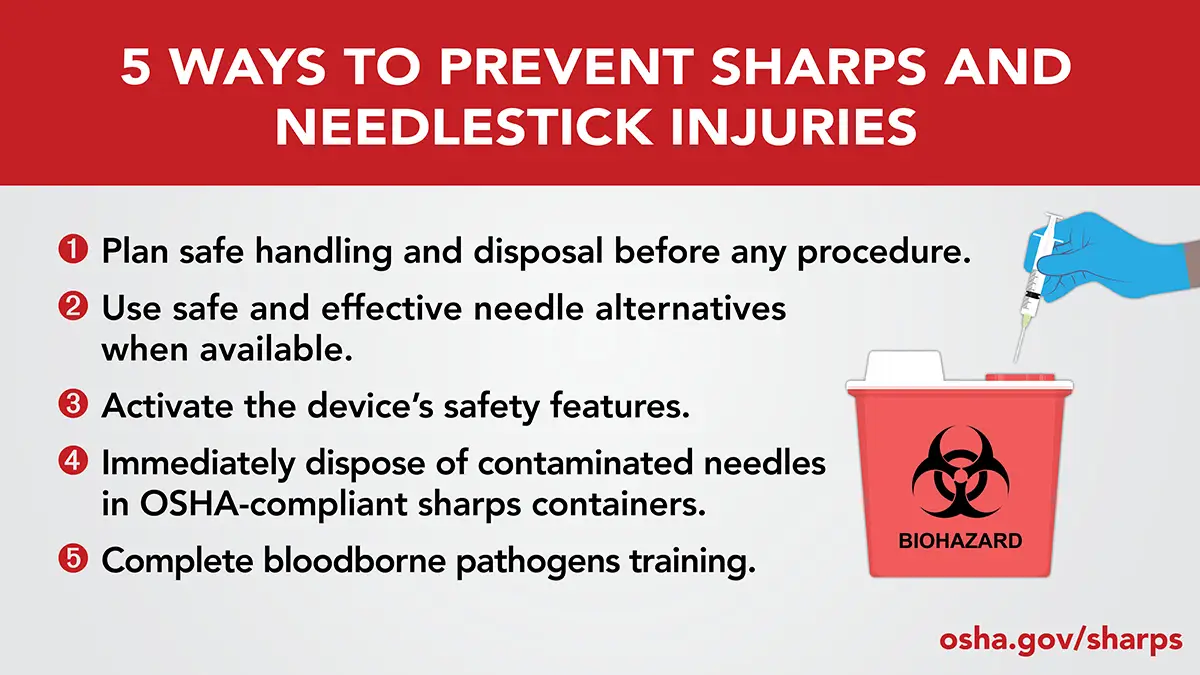
The best way to reduce the risk of infection is to follow the bloodborne pathogens standard. Healthcare workers must take adequate and consistent precautions to protect themselves and their patients. Healthcare facilities must establish specific policies and procedures for the management of an exposure incident (e.g., accidental needlestick) and the exposed employee.

OSHA bloodborne pathogen standards and guidelines summarized
OSHA Bloodborne pathogen standards
OSHA
/
Public Domain

Compliance guidelines

The bloodborne pathogens standard is for anyone working in the healthcare field. Only some of the regulations apply to the ambulatory care setting. Safety and infection control go beyond hand washing and knowledge of the disease cycle. The information presented here applies to the medical assisting profession.

As a medical assistant, your role in helping to create and maintain a safe and healthy environment for both patients and employees is key. This role includes understanding how infections occur and are transmitted in the population and practicing all necessary infection-control precautions.

Before you can understand the elements of an infection control plan, you first must understand how infections are transmitted.

The cycle of infection

Disease is defined as a specific illness with a recognizable group of signs and symptoms and a clear cause (e.g., infection, environment). We recognize and categorize many types of diseases, including hereditary (genetic), drug-induced, autoimmune, degenerative, communicable, and infectious diseases.

Any disease caused by the growth of pathogenic microorganisms in the body falls into the category of infectious diseases. The entrance of a living microbe into the body is not a disease until the infected cell or individual shows harmful changes in structure, function, or biochemistry.

A person can carry and transmit a pathogen without showing symptoms. Such an individual is called a carrier.

Microorganisms are almost everywhere. We carry them on our skin, in our bodies, and on our clothing. They can be found in ice, boiling water, soil, and air. The only places normally free of microorganisms are certain internal body organs and tissues and sterilized medical equipment and supplies.

Certain factors are required for an infectious disease to spread. These factors, or links, make up the chain of infection. Break the chain, and you break the infection process.

The chain of infection starts with the infectious agent, the first link. Infection cannot occur without the presence of an infectious microorganism.

The best way for healthcare workers to prevent the spread of disease is to use infection-control procedures such as:

  • Consistent hand washing
  • Proper use of antiseptics
  • Effective disinfection and sterilization methods
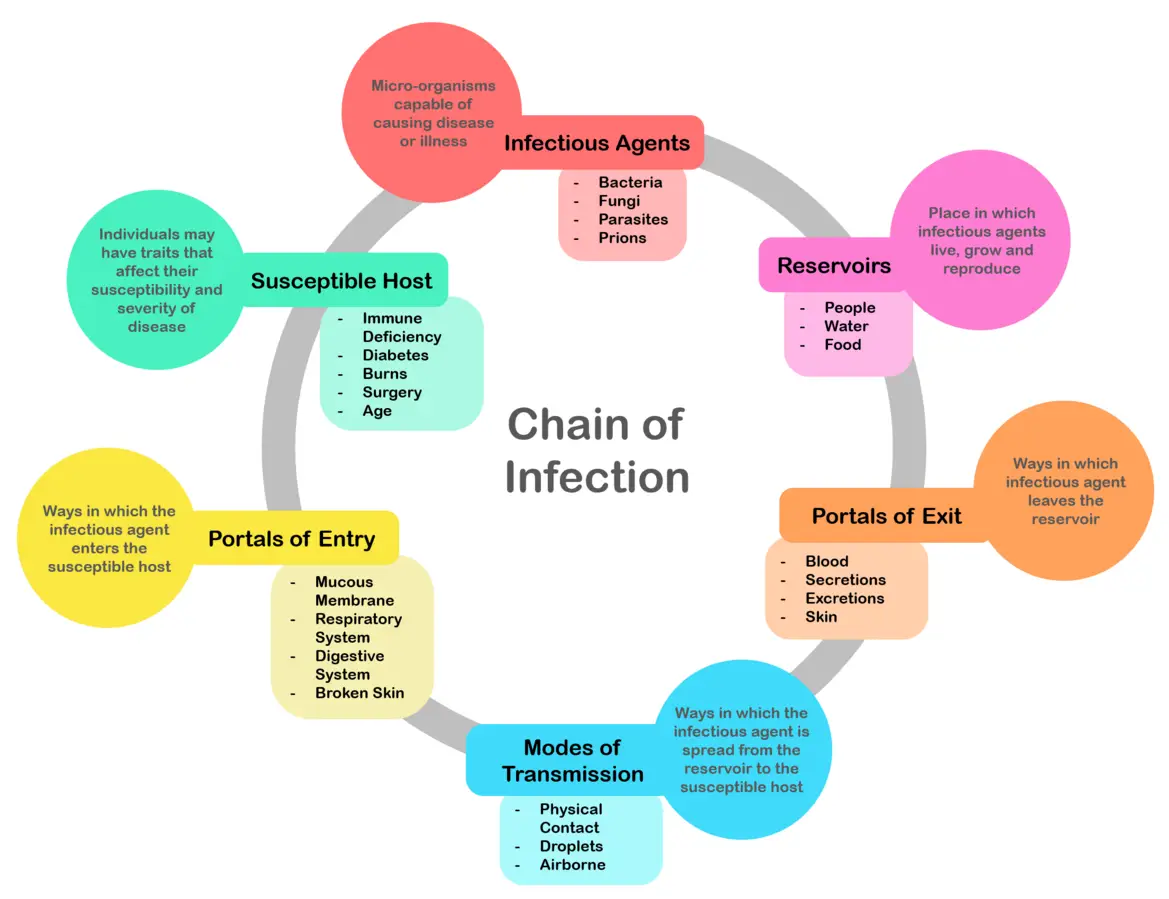
Six links in the chain of infection labeled
Chain of infection
Wikimedia Commons
/
CC BY-SA 4.0

The chain of infection has six links, all of which must be present for infection to occur:

  • Infectious agent
  • Reservoir host
  • Means of exit
  • Means of transmission
  • Means of entry
  • Susceptible host

Reservoir host

The second link in the chain of infection is the reservoir. Common reservoirs include people, insects, animals, water, food, and contaminated instruments and equipment.

The reservoir host supplies the conditions needed for microbial growth, allowing microbes to multiply. The pathogen either causes infection in the host or exits the host in sufficient numbers to infect another host.

Sanitization, disinfection, sterilization, and pest control help break the chain of infection at the reservoir stage.

Means of exit

The chain of infection continues with the third link, the portal of exit, which is how the pathogen leaves the reservoir host through the mouth, eyes, intestines, reproductive tract, nose, ears, urinary tract, or open wounds.

The use of standard precautions (e.g., gloves, masks, proper wound care, correct disposal of contaminated products, and hand hygiene) helps control the spread of infectious material from one host to another.

It is important to use proper hand hygiene and personal protective equipment to break the chain of infection at the portal of exit. Controlling splatter from coughs, sneezes, or procedures is another important strategy.

Means of transmission

After exiting the reservoir host, the organism needs a mode of transmission - the fourth link in the chain.

Direct transmission occurs through contact with an infected person, infected discharges, or infected soil. This includes droplet transmission, which occurs through droplets produced during coughing, sneezing, or talking.

Indirect transmission occurs through suspended particles in the air, contaminated objects, food, water, animals, or insects.

Definitions
Fomites
Contaminated objects that can transmit pathogens.

Proper sanitation of food and water, along with sanitization, disinfection, sterilization, and germicides (e.g., Wavicide and Cidex), help control transmission.

To break the chain of infection at this stage, hand hygiene, PPE, food safety, sanitization, disinfection, and sterilization are essential.

Transmission-based precautions

Standard precautions are used with every patient, every time. When a patient is known or suspected to be infected with an organism that standard precautions alone will not contain, transmission-based precautions are added on top of them - never instead of them. There are three categories, and a patient can be placed in more than one at the same time.

Category Used for What is added
Contact Organisms spread by touching the patient or the patient’s surroundings: Clostridioides difficile, norovirus, scabies, impetigo, draining wounds, respiratory syncytial virus (RSV), and multidrug-resistant organisms such as MRSA and VRE Gown and gloves before entering the room. A single-patient room when one is available.
Droplet Organisms carried in large respiratory droplets produced by coughing, sneezing, or talking, which fall to the ground within a few feet: influenza, pertussis, mumps, rubella, diphtheria, and meningococcal disease A surgical mask before entering the room. A single-patient room when one is available. A mask on the patient during transport.
Airborne Organisms carried in particles small enough to stay suspended and travel on air currents: tuberculosis, measles, varicella (chickenpox), and disseminated herpes zoster A fit-tested N95 or higher-level respirator before entering. An airborne infection isolation room kept under negative pressure with the door closed. A mask on the patient during transport.

In an ambulatory care setting, the practical step is the same in all three cases: as soon as the need is recognized, the patient is moved out of the waiting room and into an examination room rather than left sitting among other patients.

Means of entry

The next link, the fifth, is the portal of entry, which is how the pathogen enters a new host through the mouth, eyes, intestines, reproductive tract, nose, ears, urinary tract, or open wounds.

As with the portal of exit, standard precautions help prevent infectious agents from entering the body.

Proper hand hygiene, PPE use, first aid, and personal hygiene all help break this link in the chain of infection.

Susceptible host

The sixth and final link in the chain of infection is exposure of the pathogen to a susceptible host. If the host can support the growth of the infecting organism, the organism multiplies.

Factors that contribute to susceptibility include:

  • Genetic factors
  • Quantity of organisms
  • State of physical health
  • Stress
  • Poor health
  • Poor nutrition
  • Poor hygiene or crowded living conditions

Immunizations and patient education are important tools for reducing susceptibility and breaking the chain of infection.

If conditions are right, the organism reaches infectious levels, and the susceptible host can start the chain of infection all over again.

Universal Precautions

  • Treat all blood and certain body fluids as potentially infectious
  • Protects both healthcare workers and patients from bloodborne pathogens
  • Applies to all patients, regardless of known infection status

Bloodborne Pathogens Standard

  • OSHA regulation to protect against exposure to blood and OPIM
  • Requires special handling of contaminated items (e.g., body fluids, unfixed tissue, pathogenic microorganisms)
  • Includes Universal Precautions and mandates use of safer sharps devices

Needlestick Safety and Prevention Act

  • Employers must maintain a sharps injury log
  • Provide effective sharps management devices:
    • Self-sheathing needles
    • Retractable needles
    • Needleless IV systems
  • Parenteral exposure includes needlesticks, human bites, nonintact skin contact

Exposure Response and Hand Hygiene

  • Immediate washing/flushing after exposure to OPIM
  • Hand washing: soap and running water for at least 15–20 seconds if visibly soiled
  • Alcohol-based hand sanitizer (≥60% alcohol) for routine use when hands not visibly soiled
  • No artificial nails; natural nail tips ≤1/4 inch

Compliance and Penalties

  • Employers must have exposure management policies
  • Noncompliance penalties (inflation-adjusted yearly; 2024): up to $16,131 per serious violation, $161,323 per willful or repeated violation
  • Bloodborne Pathogens Standard applies to all healthcare workers, including medical assistants

Sign up for free to take 25 quiz questions on this topic

Previous
Next  | 4.3.4 Waste disposal, vaccination, and exposure protocols
All rights reserved ©2016 - 2026 Achievable, Inc.

Infection control and OSHA standards in healthcare

Occupational Safety and Health Administration (OSHA) standards

In 1987, in response to concern about the increasing prevalence of HIV and hepatitis B virus (HBV), the CDC recommended a new approach to potentially infectious materials called universal precautions.

Universal precautions assume that all blood and certain body fluids may contain infectious bloodborne pathogens. Therefore, precautions must be used with every patient, regardless of diagnosis or health history.

In 1991, OSHA issued the bloodborne pathogens standard, which incorporates universal precautions. The goal of the bloodborne pathogens standard is to safeguard all healthcare employees and their patients who are at risk of exposure to blood and other potentially infectious materials (OPIM).

Items contaminated with any of the following potentially infectious materials require special handling:

  • Body fluids
  • Semen
  • Vaginal secretions
  • Cerebrospinal fluid (CSF)
  • Synovial fluid
  • Pleural fluid
  • Pericardial fluid
  • Peritoneal fluid
  • Amniotic fluid
  • Saliva in dental procedures
  • Any body fluid that is visibly contaminated with blood
  • All body fluids that are present in situations in which it is difficult or impossible to differentiate between body fluids
  • Any unfixed tissue
  • Any pathogenic microorganism

Bloodborne pathogens standard

In 2000, Congress passed the needlestick safety and prevention act. This was in response to the CDC’s concern about employees’ risk when working with sharps. OSHA then amended the bloodborne pathogens standard in 2001 to implement the act’s requirements.

Employers are required to keep a sharps injury log that describes the device involved in the incident and the details of how and where the incident occurred. Employers must also make available to employees effective sharps management devices, such as these:

  • Syringes with self-sheathing needles
  • Needles that retract after use
  • Needleless intravenous (IV) systems

Parenteral exposure includes accidental needlesticks, occupation-related human bites, and exposure of nonintact skin (e.g., cuts and abrasions on the employee’s hands) to OPIM.

OSHA’s civil penalties are adjusted annually for inflation. As of 2024, an employer who fails to comply with the bloodborne pathogens standard can face a maximum penalty of $16,131 per serious violation and up to $161,323 per willful or repeated violation.

The bloodborne pathogens standard also clarifies the use of washing or flushing any exposed body area or mucous membrane immediately or as soon as possible after exposure to OPIM. This includes hand washing after the removal of gloves or other personal protective equipment.

CDC recommendations for hand hygiene

The CDC’s recommendations for adequate hand hygiene are as follows:

  • Visibly soiled hands should be washed with soap and running water for at least 15 to 20 seconds. The CDC’s guidance for healthcare personnel gives 15 seconds as the minimum and notes that others recommend 20. Avoid hot water, which dries the skin.
  • Alcohol-based hand sanitizers that contain at least 60% alcohol should be used before and after contact with each patient and also after removing gloves to prevent cross-contamination among patients and healthcare workers. When running water isn’t available, alcohol-based hand sanitizers can be used instead, and they take less time and cause less skin irritation than traditional hand washing.
  • Use an alcohol-based hand sanitizer properly, applying the label-recommended amount to the palm of one hand and rubbing the hands together, covering all surfaces until the hands are dry.
  • Artificial nails should not be worn; studies show that even after careful hand hygiene, healthcare workers with artificial nails have more pathogenic microbes under their nails and on their fingertips than workers with natural nails.
  • Natural nail tips should be no longer than one-fourth of an inch to prevent microbial growth under the nail.

Proper hand hygiene remains the single most effective method of reducing the spread of infection in healthcare settings.

The best way to reduce the risk of infection is to follow the bloodborne pathogens standard. Healthcare workers must take adequate and consistent precautions to protect themselves and their patients. Healthcare facilities must establish specific policies and procedures for the management of an exposure incident (e.g., accidental needlestick) and the exposed employee.

Compliance guidelines

The bloodborne pathogens standard is for anyone working in the healthcare field. Only some of the regulations apply to the ambulatory care setting. Safety and infection control go beyond hand washing and knowledge of the disease cycle. The information presented here applies to the medical assisting profession.

As a medical assistant, your role in helping to create and maintain a safe and healthy environment for both patients and employees is key. This role includes understanding how infections occur and are transmitted in the population and practicing all necessary infection-control precautions.

Before you can understand the elements of an infection control plan, you first must understand how infections are transmitted.

The cycle of infection

Disease is defined as a specific illness with a recognizable group of signs and symptoms and a clear cause (e.g., infection, environment). We recognize and categorize many types of diseases, including hereditary (genetic), drug-induced, autoimmune, degenerative, communicable, and infectious diseases.

Any disease caused by the growth of pathogenic microorganisms in the body falls into the category of infectious diseases. The entrance of a living microbe into the body is not a disease until the infected cell or individual shows harmful changes in structure, function, or biochemistry.

A person can carry and transmit a pathogen without showing symptoms. Such an individual is called a carrier.

Microorganisms are almost everywhere. We carry them on our skin, in our bodies, and on our clothing. They can be found in ice, boiling water, soil, and air. The only places normally free of microorganisms are certain internal body organs and tissues and sterilized medical equipment and supplies.

Certain factors are required for an infectious disease to spread. These factors, or links, make up the chain of infection. Break the chain, and you break the infection process.

The chain of infection starts with the infectious agent, the first link. Infection cannot occur without the presence of an infectious microorganism.

The best way for healthcare workers to prevent the spread of disease is to use infection-control procedures such as:

  • Consistent hand washing
  • Proper use of antiseptics
  • Effective disinfection and sterilization methods

The chain of infection has six links, all of which must be present for infection to occur:

  • Infectious agent
  • Reservoir host
  • Means of exit
  • Means of transmission
  • Means of entry
  • Susceptible host

Reservoir host

The second link in the chain of infection is the reservoir. Common reservoirs include people, insects, animals, water, food, and contaminated instruments and equipment.

The reservoir host supplies the conditions needed for microbial growth, allowing microbes to multiply. The pathogen either causes infection in the host or exits the host in sufficient numbers to infect another host.

Sanitization, disinfection, sterilization, and pest control help break the chain of infection at the reservoir stage.

Means of exit

The chain of infection continues with the third link, the portal of exit, which is how the pathogen leaves the reservoir host through the mouth, eyes, intestines, reproductive tract, nose, ears, urinary tract, or open wounds.

The use of standard precautions (e.g., gloves, masks, proper wound care, correct disposal of contaminated products, and hand hygiene) helps control the spread of infectious material from one host to another.

It is important to use proper hand hygiene and personal protective equipment to break the chain of infection at the portal of exit. Controlling splatter from coughs, sneezes, or procedures is another important strategy.

Means of transmission

After exiting the reservoir host, the organism needs a mode of transmission - the fourth link in the chain.

Direct transmission occurs through contact with an infected person, infected discharges, or infected soil. This includes droplet transmission, which occurs through droplets produced during coughing, sneezing, or talking.

Indirect transmission occurs through suspended particles in the air, contaminated objects, food, water, animals, or insects.

Definitions
Fomites
Contaminated objects that can transmit pathogens.

Proper sanitation of food and water, along with sanitization, disinfection, sterilization, and germicides (e.g., Wavicide and Cidex), help control transmission.

To break the chain of infection at this stage, hand hygiene, PPE, food safety, sanitization, disinfection, and sterilization are essential.

Transmission-based precautions

Standard precautions are used with every patient, every time. When a patient is known or suspected to be infected with an organism that standard precautions alone will not contain, transmission-based precautions are added on top of them - never instead of them. There are three categories, and a patient can be placed in more than one at the same time.

Category Used for What is added
Contact Organisms spread by touching the patient or the patient’s surroundings: Clostridioides difficile, norovirus, scabies, impetigo, draining wounds, respiratory syncytial virus (RSV), and multidrug-resistant organisms such as MRSA and VRE Gown and gloves before entering the room. A single-patient room when one is available.
Droplet Organisms carried in large respiratory droplets produced by coughing, sneezing, or talking, which fall to the ground within a few feet: influenza, pertussis, mumps, rubella, diphtheria, and meningococcal disease A surgical mask before entering the room. A single-patient room when one is available. A mask on the patient during transport.
Airborne Organisms carried in particles small enough to stay suspended and travel on air currents: tuberculosis, measles, varicella (chickenpox), and disseminated herpes zoster A fit-tested N95 or higher-level respirator before entering. An airborne infection isolation room kept under negative pressure with the door closed. A mask on the patient during transport.

In an ambulatory care setting, the practical step is the same in all three cases: as soon as the need is recognized, the patient is moved out of the waiting room and into an examination room rather than left sitting among other patients.

Means of entry

The next link, the fifth, is the portal of entry, which is how the pathogen enters a new host through the mouth, eyes, intestines, reproductive tract, nose, ears, urinary tract, or open wounds.

As with the portal of exit, standard precautions help prevent infectious agents from entering the body.

Proper hand hygiene, PPE use, first aid, and personal hygiene all help break this link in the chain of infection.

Susceptible host

The sixth and final link in the chain of infection is exposure of the pathogen to a susceptible host. If the host can support the growth of the infecting organism, the organism multiplies.

Factors that contribute to susceptibility include:

  • Genetic factors
  • Quantity of organisms
  • State of physical health
  • Stress
  • Poor health
  • Poor nutrition
  • Poor hygiene or crowded living conditions

Immunizations and patient education are important tools for reducing susceptibility and breaking the chain of infection.

If conditions are right, the organism reaches infectious levels, and the susceptible host can start the chain of infection all over again.

Key points

Universal Precautions

  • Treat all blood and certain body fluids as potentially infectious
  • Protects both healthcare workers and patients from bloodborne pathogens
  • Applies to all patients, regardless of known infection status

Bloodborne Pathogens Standard

  • OSHA regulation to protect against exposure to blood and OPIM
  • Requires special handling of contaminated items (e.g., body fluids, unfixed tissue, pathogenic microorganisms)
  • Includes Universal Precautions and mandates use of safer sharps devices

Needlestick Safety and Prevention Act

  • Employers must maintain a sharps injury log
  • Provide effective sharps management devices:
    • Self-sheathing needles
    • Retractable needles
    • Needleless IV systems
  • Parenteral exposure includes needlesticks, human bites, nonintact skin contact

Exposure Response and Hand Hygiene

  • Immediate washing/flushing after exposure to OPIM
  • Hand washing: soap and running water for at least 15–20 seconds if visibly soiled
  • Alcohol-based hand sanitizer (≥60% alcohol) for routine use when hands not visibly soiled
  • No artificial nails; natural nail tips ≤1/4 inch

Compliance and Penalties

  • Employers must have exposure management policies
  • Noncompliance penalties (inflation-adjusted yearly; 2024): up to $16,131 per serious violation, $161,323 per willful or repeated violation
  • Bloodborne Pathogens Standard applies to all healthcare workers, including medical assistants

More from Infection control

  • The role of the medical assistant
  • Workplace safety and protective measures
  • Waste disposal, vaccination, and exposure protocols