



Interpreting and resolving claim outcomes
Explanation of benefits/remittance advice
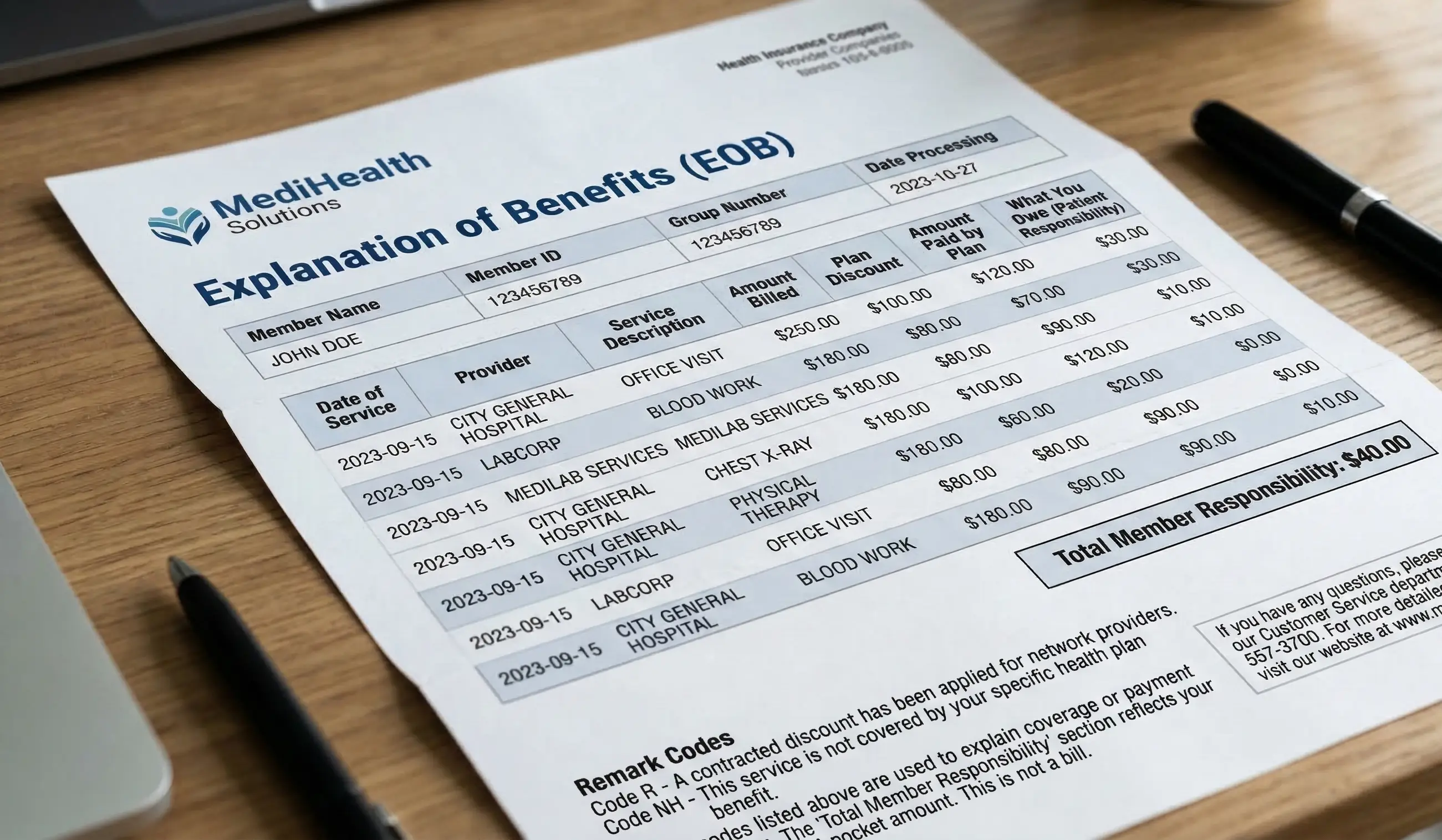
An explanation of benefits (EOB) is a document the insurance company sends to the patient. A remittance advice (RA) is that same information, but it is sent directly to the provider who submitted an insurance claim and often lists multiple patients. A remittance advice is usually sent electronically. If the patient has signed the assignment of benefits statement, the RA will come with a check, if it is in paper format, or a document indicating that funds were electronically transferred.
The healthcare facility cannot just deposit the check and disregard the EOB/RA, which provides detailed accounting for the submitted insurance claim. The EOB/RA breaks down each line-item charge from Block 24 on the CMS-1500 into the charged amount, the amount allowable, and the amount paid. Most EOB/RAs will also indicate how much was applied to the deductible, the patient’s co-insurance amount, and if any services were denied.
Reading an explanation of benefits/remittance advice
The EOB/RA contains essential information about the submitted health insurance claim:
- Patient’s name
- Date of service
- Services provided, including the CPT/HCPCS codes
- Charged amount
- Covered or allowed amount
- Deductible amount
- Co-insurance amount
- Payment amount
- Reason codes to explain a denial or an adjustment to the payment amount
To properly apply payments to a patient’s account, it is vital that the medical assistant understand all the elements of an EOB/RA. When interpreting the EOB/RA, review the following steps:
-
Verify that the EOB/RA applies to the correct patient by comparing the account number and date of service on the EOB/RA with the submitted claim.
-
Confirm that the EOB/RA shows the same charged amount as the submitted claim. In other words, the line items and charges should match. Sometimes the EOB/RA summarizes the entire claim in one charged amount. In this case, confirm that the total charged is the same as in the submitted claim.
-
Post the payment and adjusted amount per line item. In the practice management billing software, these are posted on the same line. The patient’s responsibility, as determined by the primary insurance EOB/RA, is calculated using the following equation:
Charged amount – Payment amount – Adjustment amount = Patient’s responsibility
-
Once the patient’s responsibility has been determined, check for a secondary insurance. If one is listed, submit a health insurance claim with the balance due determined by the primary insurance EOB/RA. If no secondary insurance is listed, the patient is billed for the balance due.
-
Review the remark codes on the EOB/RA for any additional messages or information about the claim. The remark codes area is where the insurance company indicates the conditions under which the claim was paid. For example, code 01 states that the claim amount allowed was established by the contract between the health insurance plan and the provider. Other remark codes give the reasons a claim was denied or rejected. Some remark codes indicate that the claim is pending, awaiting specific information.
-
All remark codes on pending or denied claims should be followed up immediately upon receipt of the EOB/RA to prevent further delay in payment for other claims.
-
There is no standard format for the EOB, so patients often have difficulty understanding them. One of the responsibilities of the medical biller is to explain the EOB to the patient. When patients understand why a claim was paid in a certain way, they are more willing to pay their share.
Rejected claims
The EOB/RA provides detailed information on rejected claims. A rejected claim contains one or more errors. All rejected claims have a code with a legend toward the bottom of the page. Here are some of the reasons claims are rejected:
- The time period for filing the claim expired (check the insurance plan’s billing policies manual for details).
- Incorrect ICD-10-CM, CPT, and/or HCPCS codes or combinations of codes were entered.
- The insurer claims that the ICD-10-CM code and the CPT/HCPCS codes do not match—that is, the claim lacks medical necessity.
- More than one CPT/HCPCS code was filed on the same date of service, and they are mutually exclusive when billed together.
- The claim was submitted to the wrong insurance company.
- Rejected claims should be resubmitted as soon as possible to prevent further delay in reimbursement.
Denied claims
The EOB/RA will list the claims that have been denied, showing a zero payment. It is important the EOB/RA is reviewed to find those denied claims. A medical biller should recognize the reason codes that indicate that a claim has been denied and why.
The two main reasons for denial of payment are technical errors and insurance policy coverage issues. Technical errors include incorrect or incomplete information, data entry, and/or mathematical errors. Common reasons for denial and the process for correcting it include the following:
- The patient was not covered by the insurance plan on the date of service.
- Contact the patient to obtain the correct insurance plan information and submit the claim to that insurance plan.
- A listed procedure was not an insurance benefit.
- Contact the patient to make sure that she or he understands that the procedure was not covered by the person’s insurance plan. This denial can be avoided by obtaining precertification/preauthorization.
- Preauthorization for the service was not obtained.
- Talk to the business office supervisor to determine if the patient can be billed for services or if an adjustment to the patient’s account will need to be made.
- The service was deemed not to be a medical necessity.
- Review the documentation to determine if the correct diagnosis and procedure codes were submitted. If they were incorrect on the original claim, a new claim should be submitted with the corrected information.
After finding the denied claims on the EOB/RA, the medical biller should review the reason codes and make the appropriate changes to the claim to get it paid. If the patient was not covered by that plan at the time the service was provided, they should be contacted for updated insurance information and the claim should be submitted to the new carrier. If there is no insurance coverage, the patient should be billed for those services.
Medical necessity
Insurance companies determine medical necessity based on the diagnostic and procedural codes submitted on the claim. The diagnostic code is the reason that the procedure was necessary. For example, if a claim submitted to the insurance company indicated that a bunionectomy was performed for tonsillitis, the insurer will deny the claim based on medical necessity. Procedure codes are linked to diagnostic codes in the claim. The health record must support the reason for each service provided.
If an insurance claim is denied for medical necessity, the medical assistant should review the claim information and the health record. If there is an error on the claim, such as the wrong diagnostic code on the encounter form, a new claim should be submitted.
If an insurance claim is denied for medical necessity and the medical assistant believes that it was coded correctly, an appeal letter should be sent to the insurance company. The appeal letter should identify the denied claim and include a statement from the provider detailing the medical reasoning for performing the procedure. Additional medical reports (e.g., laboratory reports, operative reports, and history and physical examination findings [H&P]) should be sent if they support the provider’s treatment decision.