



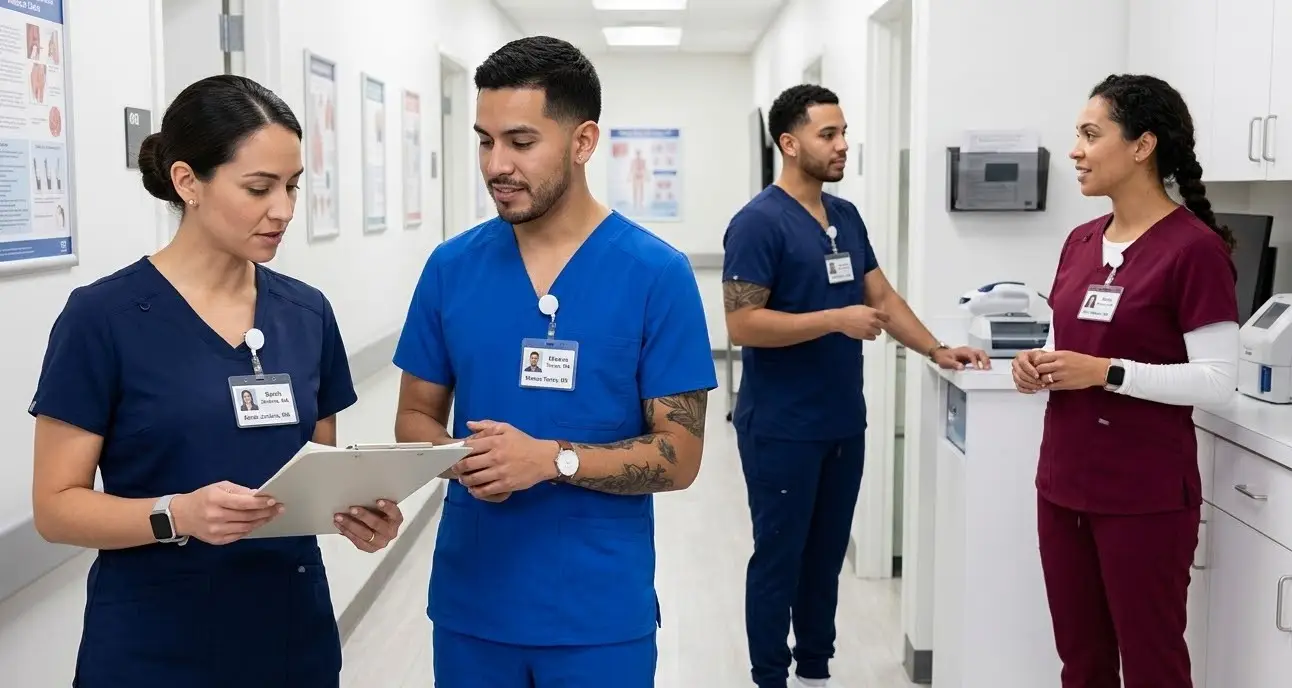
The professional medical assistant
Responsibilities of a medical assistant
Medical assistants are allied health professionals trained specifically to work in ambulatory healthcare settings, such as clinics, group practices, and providers’ offices. Ambulatory settings differ from trauma or tertiary care centers, which are hospital-based facilities built for complex, life-threatening cases; ambulatory surgical centers instead handle same-day, lower-acuity procedures at a lower facility cost, which is why insurers often favor them for eligible procedures. Training includes clinical and administrative skills, in addition to covering a multitude of medical practice needs. The entry-level medical assistant performs skills depending on his or her place of employment. All students of accredited programs are taught a similar skill set.
Administrative skills and responsibilities
The following are included in administrative skills:
- Managing provider/patient scheduling
- Answering telephone calls, taking messages, and returning patients’ messages
- Creating and maintaining patient health records
- Documenting accurately in a paper record, in addition to an EHR
- Performing practice finance procedures
- Coordinating third-party reimbursement
- Performing diagnostic and procedural coding
- Management of facility correspondence
- Communicating professionally with patients, family members, providers, peers, and the public
- Performing patient education and coaching initiatives within the proper scope of practice
- Complying with facility safety practices, including abiding by HIPAA laws.
- Performing routine maintenance of facility equipment and supplies
When working as an administrative medical assistant, you support both the provider and the patient. The skills listed help to ensure that patients get an appointment when needed and the provider is paid appropriately for the services rendered. A combination of clinical and administrative skills are needed to keep patients happy and ensure the healthcare facility runs smoothly and efficiently.
A medical assistant may also serve as a scribe. A medical scribe documents patient care in the health record as the provider examines the patient, which lets the provider focus on the patient rather than on the computer.
Clinical skills and responsibilities
The following are included in clinical skills:
- Examination and procedural support: assisting with physical examinations, patient screening, minor surgical procedures, first aid, suture/staple removal or dressing changes, and CPR when necessary
- Diagnostic and laboratory skills: obtaining and recording vital signs and patient histories, performing ECGs, phlebotomy (venipuncture and dermal puncture), and CLIA-waived tests
- Infection control and safety: medical and surgical asepsis, infection control procedures, and following OSHA regulations
- Medication administration: administering vaccinations and parenteral medications as ordered by the provider
- Patient-centered communication: applying therapeutic communication techniques, patient education and coaching, acting as a patient advocate or navigator, and adapting to a patient’s developmental stage, cultural background, and communication needs
- Documentation and professional conduct: documenting accurately in a paper record and/or EHR, and acting within legal and ethical boundaries
When working as a clinical medical assistant, your role is to aid both the provider and patient. Being proficient in the skill set, you can help ensure that the patient is receiving the best possible care.
Characteristics of professional medical assistants
Medical assistants must have professional characteristics or distinguishing traits. You will start to develop these traits while in school. During practicum is when you will put them in practice. They will follow you into your first job. A student who is unprofessional during practicum will find it difficult to find employment. Unprofessionalism may be detrimental to a medical assistant’s professional career.
Professionalism
As healthcare professionals, medical assistants represent the healthcare facility. They are viewed as an extension of the provider and facility. A healthcare professional:
- Has high ethical standards
- Displays integrity at all times
- Completes work accurately and timely
There are two areas of competence (abilities) that a professional medical assistant must attain:
- Hard skills: specific technical and operational proficiencies
- Soft skills: personal qualifications or behaviors that enhance an individual’s interaction, job performance, and career prospects; these are known as people skills
Hard skills represent the minimum proficiencies necessary to do the job. The following are some examples of hard skills in medical assisting:
- Scheduling appointments
- Coding for insurance purposes
- Managing medical records
- Interviewing patients
- Taking vital signs
- Assisting the provider with examinations and procedures
These hard skills are the ones you will learn throughout this course, and your ability to perform them is readily observable. Your hard skill set is the first screen employers use to determine if you may be qualified for the position.
Soft skills are less concrete and sometimes more difficult to observe and evaluate. These are characteristics, attributes, or attitudes that people develop throughout their lives. Some examples are:
- Respect
- Dependability
- Integrity
These personal attributes or qualities, which are sought after and significant for specific jobs, are also professional attributes or behaviors, and they tend to help define an individual’s personality. Your professional behaviors together produce what is called a good work ethic, which is what employers seek.
A medical assisting credential and the technical skills associated with it are the reasons most graduates are hired. However, the lack of a specific soft skill or poor professional soft skills is also the major reason for most terminations. Weakness in soft skills is also the major reason that some students do not successfully complete their medical assisting education. So knowing how to do something is important, but behaving professionally while practicing is essential.
The majority of the medical assistant’s role involves dealing with other people, whether this a patient, a patient’s family member, a coworker, an insurance agent, a pharmaceutical sales representative, a laboratory staff member, or anyone else with whom you may come in contact in the workplace. Because most professional behaviors and skills are about working with other people, it only makes sense that someone going into a profession that continually deals with people should possess these behaviors and skills to do a good job. As a student and in your medical assisting career, you will experience the ongoing assessment of your professional behaviors in the following environments:
- Classroom
- Student work experience
- Hiring process
- Workplace performance evaluation
- Promotion consideration
So no matter the circumstance, your professionalism contributes to your success and should always be on the top of your list of ongoing self-improvements.
Courtesy and respect
Courtesy, respect, and dignity often come together when it comes to professionalism. Courtesy is having good manners or being polite. Courteous behavior is polite, open, and welcoming. Respect means to show consideration or appreciation for another person. Dignity is the state or quality of being worthy of respect. We show our patients dignity by treating all patients the way we would want to be treated. It does not matter if the patient has bad body odor or is dressed in tattered clothes. A patient is a person worthy of respect. Patients expect to be treated as individuals who matter. They want to be respected and not treated as an annoyance or medical condition.
How can the medical assistant treat others with courtesy and respect?
- Make patients feel welcome and respected. A pleasant greeting and eye contact should be the first things patients experience in the office.
- Display positive nonverbal behaviors. Use a calm tone of voice, make eye contact when appropriate, and provide privacy for patients. Maintain patient confidentiality.
- Learn about other cultures in your area. When working with patients from other cultures, make sure to avoid certain gestures, words, or behaviors that may be perceived as disrespectful.
- Always use proper grammar, avoid using slang words. Explain medical treatments and conditions in simple lay language. If you use a medical term, make sure the patient comprehends it.
Honesty, dependability, responsibility, and integrity
Honest means to be sincere and upright. Dependable is the same as trustworthy or reliable. Responsible is defined as being trusted or depended on. Integrity is adhering to the appropriate code of law and ethics and being honest and trustworthy. All these traits are what employers value in their employees. When given a task, medical assistants should complete it accurately, on time, and to the best of their ability. If they make a mistake, or an error, they should be upfront about it. Patient safety is the number one priority. Any mistake in patient care needs to be reported immediately to the supervisor and provider. Dependability, honesty, and integrity are critical components in earning the trust and respect of others.
How can medical assistants perform their duties using these characteristic:
- Be honest and straightforward when interacting with others.
- Accept responsibility for your mistakes. Determine how to prevent them in the future.
- Follow through on your commitments.
- Complete your work to the best of your abilities. Complete on time.
- Be self-motivated. Do not wait to be asked to complete a task.
- Embrace challenge and change.
Empathy and compassion
It is important that professional medical assistants demonstrate empathy and compassion to their patients. Empathy, sympathy, and compassion can easily be confused. Empathy is the ability to understand another’s perspective, experiences, or motivations. We can share another’s emotional state. Empathy differs from sympathy. Sympathy is feeling sorrow, concern, or pity for what the other person has gone through. Compassion means we have a deep awareness of the suffering of another to wish to ease it. Having these characteristics will help to build positive relationships with our patients.
Professional appearance
Most healthcare facilities have dress codes for employees. Medical assistants are usually required to wear scrubs along with the facility’s nametag (and photo) clearly visible. Dress codes will vary by facility. Some communities may be more conservative and the dress code will reflect this.
A professional appearance is important for a medical assistant, whether the facility’s dress code calls for scrubs or business attire.
Typical dress code for medical assistants
Uniform: scrubs and white shoes
- Acceptable:
- Scrubs must be clean, pressed (ironed), and fit properly
- Scrub pants must be hemmed to the appropriate length
- Closed-toed shoes must be white and clean
- Unacceptable:
- Dirty, wrinkled, ripped scrubs
- Scrub pants dragging on the floor
- Scruffy, dirty shoes
- Open shoes (sandals), fabric shoes
Hair
- Acceptable:
- Natural colors; clean and styled
- Long hair must be tied back
- Unacceptable:
- Unnatural colors; dirty, messy hair
- Hair in face or hanging down
Fingernails, jewelry, tattoos, and piercings
- Fingernails: cut short and unpolished; not long, polished, or artificial
- Jewelry: limited to a plain wedding band (no stones), one pair of stud earrings, and a watch; not multiple earrings, necklaces, bracelets, or lanyards
- Tattoos and body piercings: must follow the healthcare facility’s policy
Cosmetics and body odors
- Acceptable:
- Professional makeup
- No odors on the body
- Unacceptable:
- Overuse of makeup
- Wearing perfume, cologne, etc.
- Using scented lotions
- Smelling like a cigarette
- Body odor (from not bathing)
Professional dress (street clothes) for special events
- Acceptable:
- Blouse, top, or sweater
- Dress pants
- Dress or skirt (to the top of the knee)
- Dress shoes
- Unacceptable:
- Low-cut tops; sheer tops
- Jeans, ripped pants, exercise clothes
- Flip-flops, tennis shoes
- Miniskirts