



Assisting with pediatric examination and screening
Assisting with the examination
The provider will have a designated set of procedures that the medical assistant completes before the provider sees the child. Vital signs are measured first. Depending on the child’s age and level of cooperation, the temperature may be obtained by the axillary, oral, rectal, tympanic, or temporal artery method. The rectal and temporal artery methods are considered most accurate in infants; however, the temporal artery method is easiest, quickest, and less invasive.
It is important to remember that the younger the child, the more immature the ability to regulate body heat. Therefore, the temperature of an infant may fluctuate easily and rapidly. The child’s pulse rate is affected similarly to that of an adult; it can increase due to activity, anxiety, illness, and environmental temperature.
The method for taking a pulse depends on the child’s age. If the child is younger than age 2, the pulse is measured apically by placing the stethoscope on the left side of the chest medial to the nipple, or alternatively at the brachial artery in the upper arm. After age 2, the pulse may be taken at the radial site.
Reference ranges for pediatric vital signs
| Vital sign | Reference range |
| Temperature | |
| Oral | 98.6°F (37°C) |
| Tympanic | 99.6°F (37.6°C) |
| Axillary | 97.6°F (36.4°C) |
| Pulse | |
| Newborn | 100-180 beats per minute |
| 2-10yr | 65-130 beats per minute |
| Respirations | |
| Newborn | 30-60 breaths per minute |
| 1-3yr | 25-30 breaths per minute |
| 4-6yr | 23-25 breaths per minute |
| 7+ yr | 16-20 breaths per minute |
| Blood pressure | |
| Newborn | Systolic 90mm Hg; diastolic 70mm Hg |
| 1-5yr | Systolic 100mm Hg; diastolic 70mm Hg |
| 6-12yr | Systolic 120mm Hg; diastolic 84mm Hg |
| 13+ yr | Systolic, 100mm Hg + age; diastolic, 30-40mm Hg less |
The respiratory rate is easily obtained in a child because the chest can be readily observed. The reference values in the table above are typical rates rather than strict cutoffs; published normal ranges are wider and vary between references, so compare a child’s rate with the ranges the facility uses. The ratio of 4 pulse beats to 1 respiration should remain constant in a healthy child.
It is recommended that blood pressure be checked for children aged 3 years or older. The cuff must be the appropriate width to obtain an accurate reading, and the bell of the stethoscope must be small enough to seal over the site. It is best to use a pediatric stethoscope with a pediatric bell when obtaining an infant’s pressure. Blood pressure readings in a young child are lower than those in an adult.
To prevent a small child or infant from rolling the head from side to side during the provider’s examination, the medical assistant stands at the head of the table and supports the child’s head between the hands, taking care not to press on the ears or the anterior or posterior fontanelles. An infant need not be draped, but privacy is important to an older child. Sincere respect and friendly conversation at the child’s level accomplish a great deal. Always be patient with children. Make sure they understand what is expected. Always involve the parents or caregivers as much as possible.
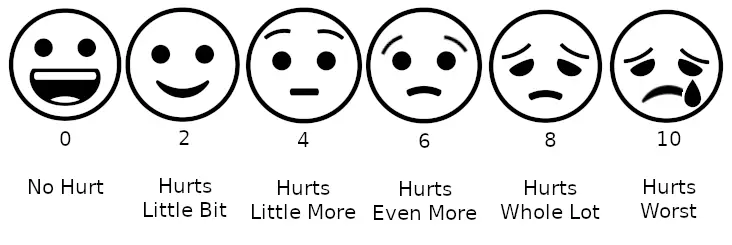
Accurately judging the level of pain a young patient is experiencing can be difficult. If the child is able to communicate, the Wong-Baker FACES Pain Scale could be used, which shows simple drawings of faces that express varying levels of pain on a 0-to-10 scale.
An infant’s first physical assessment comes at the time of delivery when the provider assesses the newborn’s ability to thrive outside the uterus. The Apgar score is a system for evaluating the infant’s physical condition at 1 and 5 minutes after birth. Developed by pediatrician Virginia Apgar, the scoring system evaluates the following: appearance (color), pulse (heart rate), grimace (reflex; response to stimuli), activity (muscle tone), and respiration (breathing). These parameters are each rated 0, 1, or 2. The maximum total score is 10. Infants with low scores require immediate medical attention.
Well-child visits
The frequency of well-child visits varies with the provider and the community. The American Academy of Pediatrics recommends the following pattern:
- 2 to 5 days
- 1 month
- 2 months
- 4 months
- 6 months
- 9 months
- 12 months
- 15 months
- 18 months
- 2 years
- Annually
These visits focus on maintaining the child’s health through basic system examinations, immunizations, and updating the child’s medical history record.
The decision on whether the child is to be seen alone or with the parent depends on the provider and the child’s age. Often the child looks to the parent for approval before answering or performing a skill; for this reason, the provider may want to assess the child alone. If this is the case, explain to the parent that the provider wants to evaluate the child’s independent abilities and that as soon as testing is complete, the provider will explain the results of the tests.
The medical history is an essential guide to the pediatric examination. With an infant, the provider depends on the caregiver for the history, but as the child gets older, some history may be obtained from the child and clarified or amplified by the parent. When asking about things like lead paint, the child may not understand the question, and the parent may have to answer.
Lead paint exposure
Children are especially vulnerable to lead levels in their environment. High blood lead levels can result in serious brain injury, including seizures, coma, and death. Lower levels can cause learning problems, stunted growth, and behavior disorders. The most common causes of lead exposure are lead-based paint in homes and on imported toys and chronic exposure to lead-contaminated dust and water. The Centers for Disease Control and Prevention (CDC) recommend a screening blood test for lead levels in all children between 1 and 2 years of age. For children who show elevated levels, follow-up should include home and school environmental testing to determine the cause of lead exposure.
Sick-child visits
Sick-child visits occur whenever needed, usually on short notice. For this reason, most pediatric offices keep open appointments in the schedule to accommodate calls for sick-child visits. The length and frequency of this type of visit depend entirely on the child and the illness. The medical assistant is frequently the first point of contact for a sick child and the child’s caregiver.
Determining whether the child should be seen immediately or if the problem can wait for an opening in the schedule is crucial to pediatric care. Medical assistants should follow established office policies, but when in doubt about the seriousness of the problem, they should ask the office manager or provider for advice. Usually, providers prefer to see the child rather than delay seeing a patient with a potentially serious condition. Children younger than 2 years old should be seen right away, and the parent should report any of the following:
- Frequent cycles of crying, lethargy, or vomiting that have persisted longer than 24 hours
- Diarrhea (more than six stools in the past 12 hours)
- Fever of 101°F (38.3°C) or higher
- The child cannot verbalize associated pain or problems
The medical assistant should become familiar with important questions for telephone screening of an older child who can communicate symptoms. It is important to focus on the onset (when symptoms first started), frequency (whether symptoms are constant or cycle through recurrences), and duration (how long the episodes last) of the problem, in addition to attempted treatments and their effectiveness. As with any other patient, all telephone communication should be documented to record the reason for the call; the information gathered; the action taken, including whether the provider was consulted; any orders given; and whether and when an appointment was scheduled.
Measurements
Examination of the child during a routine well-child visit includes measuring the circumference of the infant’s head to determine normal growth and development. The size of the child’s head reflects the growth of the brain. Brain growth is 50% complete by 1 year of age, 75% by age 3, and 90% by age 6. Routine head measurement is recommended in children until 36 months of age and in older children whose head size is not within norms. If the circumference of the head deviates greatly from normal measurements, hydrocephaly or microcephaly may be suspected. It is important to discover any congenital problems as early as possible so that appropriate treatment can be started.
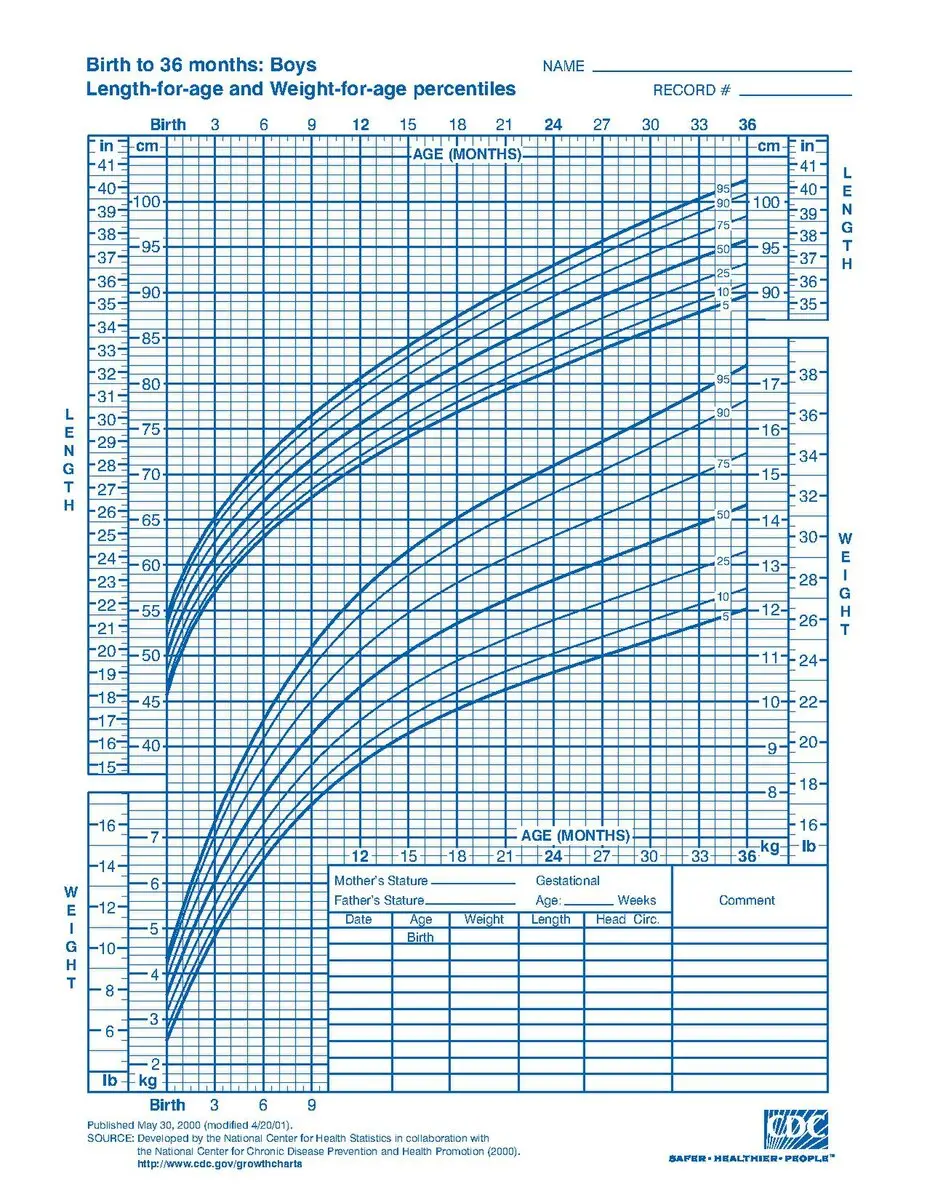
Along with the head circumference, the medical assistant should record the child’s length (or height) and weight on growth charts so that the provider can compare the child’s measurement statistics with national standards. Growth charts consist of a series of percentile curves that illustrate the distribution of selected body measurements.
The CDC has gender-specific growth charts for the following:
- Birth to 36 months
- Length for age
- Weight for age
- Head circumference for age
- Weight for length
- 2 to 20 years
- Stature for age
- Weight for age
- BMI for age
There are 20 CDC charts (10 for boys and 10 for girls). As mentioned previously, BMI is the recommended method of determining whether children or adults are overweight or obese. The BMI growth charts can be used beginning at 2 years of age when height can be measured accurately.
EHRs may automatically plot the measurements on the appropriate growth chart and calculate the percentile.