



Wrapping up
You’ve reached the end of the Achievable AP English Literature and Composition course. Along the way, you’ve practiced close reading, critical thinking, and writing clearly about complex texts. Those skills matter beyond the exam: they’re the same habits you’ll use in college-level reading and writing.
Testing registration
To take the AP English Literature and Composition exam, you must register through a school authorized by the College Board.
- If you’re enrolled in a high school, your AP coordinator will share your school’s registration process, deadlines, and payment details.
- If you’re homeschooled or not enrolled in an AP class, you can still test by contacting a local school that offers AP exams and asking to register as an outside student.
Registration typically opens in the fall (around September or October), and deadlines are usually in early November. Some schools allow late registration with an additional fee, so it helps to contact the school early and confirm their timeline.
Additional information
The AP English Literature and Composition exam is administered once per year, typically in May, at a designated testing center such as your school or another approved location. The exam is not offered virtually, so you’ll need to attend in person.
The standard exam cost is set by the College Board and is typically around $98 in the United States, though this may vary slightly by year. Fee reductions are available for eligible students, so check with your school if cost is a concern.
AP exams are scored on a scale from 1 to 5. A score of 3 is generally considered passing, but many colleges award credit or placement for scores of 4 or 5. Policies vary by institution, so check the requirements for the colleges you’re considering.
You can take the AP exam more than once. Since it’s only offered once per year, retakes must happen in a future testing cycle. There is no limit to how many times you can take it.
Accommodations are available for students with documented needs through the College Board’s Services for Students with Disabilities (SSD). If you need accommodations such as extended time, apply well in advance of the exam date so approval and logistics are in place.
Tips
As test day approaches, shift from learning new content to reinforcing what you already know.
- Review your core strategies for multiple-choice questions and essays.
- Revisit notes and past practice to spot patterns in your strengths and common mistakes.
- Practice under timed conditions so pacing feels familiar.
The day before the exam, avoid cramming. Focus on light review, and prioritize sleep so you can think clearly the next day.
On test day, give yourself enough time to feel fully alert. Eat a balanced breakfast, and arrive early so you can settle in without rushing.
During the exam, keep moving forward.
- If a question feels confusing, eliminate what you can and choose the best remaining option.
- If an essay doesn’t feel perfect, keep drafting and revising anyway. Clear claims, specific evidence, and consistent commentary add up.
Additional resources
For the most accurate and up-to-date information, visit the official College Board AP Students website. You’ll find exam dates, registration details, and score reporting, along with official practice materials.
Dump sheet
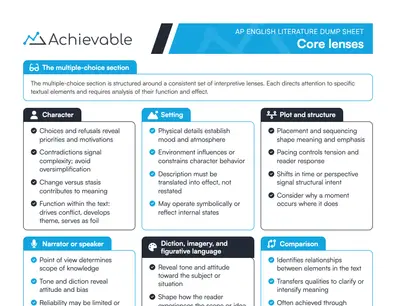
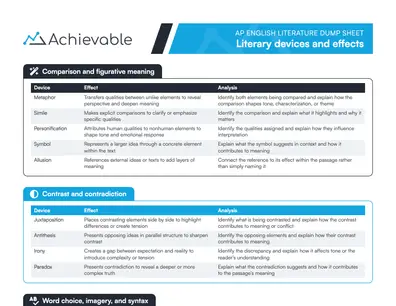
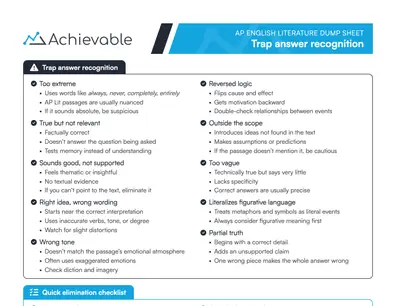
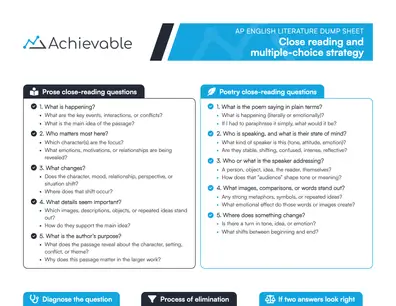
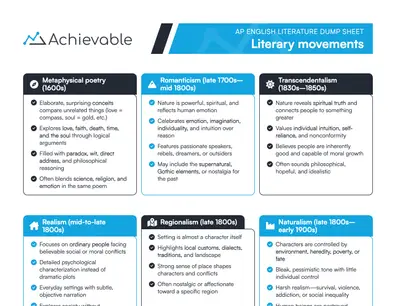
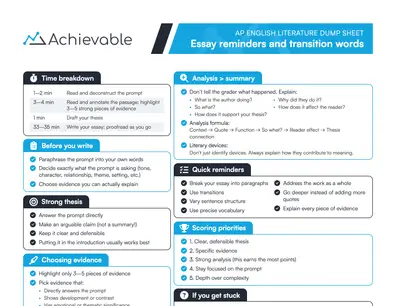
Many test takers use “dump sheets” as study supplements and as a way to create a legal reference during the exam. A dump sheet typically includes visual guides and condensed notes on key topics. The idea is to memorize the material ahead of time and then “dump” it onto your notepad at the beginning of the exam.
These are allowed in the test center as long as they are created after the test has started (and not during the initial tutorial). They aren’t required to succeed, but some test takers find them helpful.
You can certainly create your own, but here are Achievable’s AP English Lit dump sheets:
Download: AP English Lit Dump Sheet - Core lenses
Download: AP English Lit Dump Sheet - Literary devices and effects
Download: AP English Lit Dump Sheet - Trap answer recognition
Download: AP English Lit Dump Sheet - Close reading and multiple-choice strategy
Download: AP English Lit Dump Sheet - Literary movements
Download: AP English Lit Dump Sheet - Essay reminders and transition words
Thank you
Thank you for using this course as part of your AP preparation. The work you’ve done - reading closely, writing with purpose, and revising your thinking - translates directly to exam performance and to the kind of analysis you’ll do in future classes.
Go into the exam ready to read carefully, make defensible choices, and explain your ideas clearly.