



It's and its
On the English ACT, you need to know the rules for it’s and its. This question type usually appears only once or twice per test, but it shows up on every ACT English test.
The good news is that the rules are straightforward and easy to remember.
To use it’s and its correctly, start with a quick review of how apostrophes usually work.
Normally, to make a noun possessive (to show that it owns something), you add an apostrophe and an s ( 's).
Example
If the student has a desk, it is “the student’s desk.”
If the possessive noun is plural (in this case, it would be students instead of student), the apostrophe goes after the s. Thus, they are the students’ desks.
“It’s” and “its” - the exception to the rule
The word its is an exception to the normal apostrophe rules.
- It’s already means something: it is.
- Because it’s is a contraction (not a possessive), it has nothing to do with ownership.
- To make it possessive, you do not use an apostrophe: you write its.
How you’ll encounter “it’s” and “its” on the ACT
Here are the three forms you’ll see on the ACT. If you remember these rules, you’ll answer every it’s/its question correctly.
- It’s = It is
- Its = possessive
- Its’ = does not exist in the English language
Example
Here’s how each one would appear in a sentence.
- It’s = It’s cold outside.
- Its = The bear is protective of its den.
- Its’ = never pick this choice unless… (see below)
Regarding its’
As mentioned above, its’ doesn’t exist in standard English. However, the ACT often includes it as an answer choice. In almost every case, you should not choose its’.
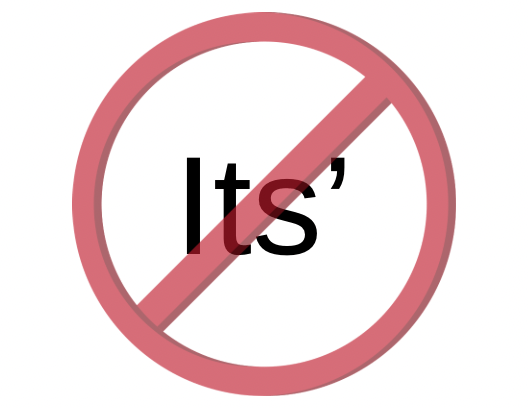
There is one situation where you might choose its’, even though it’s grammatically incorrect: when the question asks you to identify the unacceptable option.
Here’s what that can look like.
Example
It’s tough to graduate high school with a 4.0 grade point average.
Which of the following alternatives to the underlined portion would NOT be acceptable?
A. NO CHANGE
B. It’s really tough
C. It’s difficult
D. Its’ challenging
Notice what the question is asking: you’re not looking for the best or most correct option. You’re looking for the one that is not acceptable.
- Choices A, B, and C all use it’s correctly (meaning it is).
- Choice D uses its’, which is never grammatically correct.
So, option D is the correct answer because it’s the only unacceptable choice.
This is the only scenario where you would pick its’ on the ACT.
“It’s/its” exercise
Use the rules below and see if you can pick the correct form of it’s/its.
Question 1:
Its really cold outside.
A. NO CHANGE
B. It’s
C. Its’
Do you know the answer?
Answer: B. It’s is correct because it’s is short for it is, which is what the sentence needs: “It is really cold outside.”
Question 2:
It’s’ tail almost got shut in the door.
A. NO CHANGE
B. Its’ tail
C. Its tail
Do you know the answer?
Answer: C. Its is correct because the sentence needs the possessive form (the tail belongs to something).
“It’s” vs. “its” shortcut
Here’s a shortcut you can use on any ACT question:
- Substitute it is for the underlined it’s/its.
- If the sentence still makes sense, the correct choice is it’s.
- If the sentence does not make sense, the correct choice is its.
Question 1:
The world continues to spin on it’s/its axis.
Is the answer it’s or its?
Answer: Its is correct. “The world continues to spin on it is axis” doesn’t make sense, so you need the possessive form: its.
Question 2:
That car will hold it’s/its value over time more than others.
Is the answer it’s or its?
Answer: Its is correct. “That car will hold it is value” doesn’t make sense, so you need the possessive form: its.
Question 3:
It’s/Its really a shame that you can’t go tonight.
Is the answer it’s or its?
Answer: It’s is correct. “It is really a shame that you can’t go tonight” makes sense, so the contraction it’s is correct.
Question 4:
Even though it’s/its eyes don’t work, the dog seems to manage fine.
Is the answer it’s or its?
Answer: Its is correct. “It is eyes don’t work” doesn’t make sense, so you need the possessive form: its.
Question 5:
Even though it’s/its blind, the dog seems to manage fine.
Is the answer it’s or its?
Answer: It’s is correct. “Even though it is blind…” makes sense, so the contraction it’s is correct.
You now know the rules for it’s and its. On the ACT, these questions are quick points if you apply the rules consistently.