



Linear Inequalities
Introduction
Inequalities questions typically appear approximately once per SAT math section, while there can also be an inequalities-related aspect to another question in each section. As we’ll see in the Approach Question below, SAT inequalities often invite consideration of coordinates on the -plane. The good news? You have Desmos! This embedded graphing utility is often the best (read: quickest) way to solve an SAT inequalities problem. With this in mind, we’ll include a Desmos solution in this lesson whenever it’s relevant.
Approach Question
The point is a solution to the system of inequalities above. Which of the following could be the value of y?
A. -50
B. -10
C. 10
D. 50
Explanation
Since this is a system of inequalities, we might be tempted to try some sort of substitution or elimination approach to get at the value of y. But these approaches are minimally helpful when inequalities are involved, and some don’t apply at all (see the Systems lesson for more detail). Besides, this is not a typical systems question in the sense that the value of is already provided for you. This provision reduces each of the inequalities to one unknown.
For this reason, each inequality can be solved, or else we could plug in the answers in the hope that this approach is faster. To solve, we begin by plugging in the given value of : . This makes the first inequality quite straightforward: . The only answer choice that this rules out is . But that’s a start!
For the other inequality, there is some more work to do. Here’s how it looks:
Notice the very important change in the direction of the inequality. The rule is that we change the direction of the inequality when dividing or multiplying by a negative. Now that we know the value of must be less than , only one answer is possible. The answer is -50.
If we had approached the problem by plugging in the answers, we would still have begun by substituting for . The first inequality would still have allowed us to eliminate the answer . But now we could plug in the other answer choices, knowing that the value of would have to be greater than . This is only possible if is a negative number so that, by subtracting a negative number, we increase the value of the left side of the inequality. But is not enough; that still leaves a negative value on that side. We need a much more negative number: does the trick because it results in a true mathematical statement: .
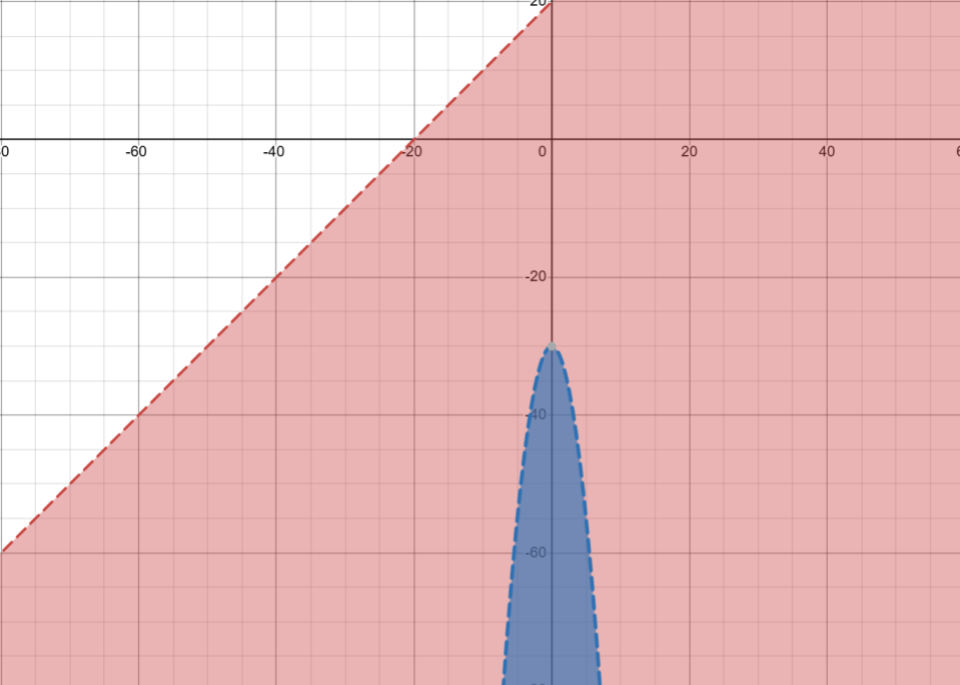
What about Desmos? We can certainly use it in this case; as always, the way to use Desmos is to graph the inequalities and interpret the results. Graphing both equations helps, but it requires some adjustment of the Desmos window and zooming in to see something like this:
Interpreting this graph to answer the question above requires recognizing two things: 1) we’re using only the range of values that fits both inequalities, which is the same thing as saying the area shaded in two colors. Though it may not be obvious according to the colors, this overlapping range would be the area in blue here, since the area in blue is also entirely within the area in red. 2) We’re homing in on on the graph. To do this requires interpreting the -axis; since the domain from to is divided into four segments, each of those segments must have a horizontal length of . So is in the rightward part of the first segment to the right of the -axis. If you click somewhere in the blue area immediately down from on the -axis, you can narrow down the values by moving your cursor until . If you successfully do that, you’ll see that when , the dashed line goes through . So anything less than can be the answer to this question; is confirmed as the answer.
For many students, this may seem an unnecessarily complicated way of solving this problem. If you are very comfortable with Desmos and/or enjoy practicing on the platform and learning more about it, by all means attempt problems like this using Desmos. If neither of these things is true for you, then one of the two approaches presented first above will likely suit you better.
Topics for Cross-Reference
Variations
The chief variation for an inequality problem is the addition of the equality; “less than” becomes “less than or equal to” and “greater than” becomes “greater than or equal to.” The symbols look like this: and .
When graphing inequalities, remember that a dashed line means simply less than or greater than, while a solid line is used when the phrase “or equal to” is included.
Flashcard Fodder
The most important solving principle for inequalities, which merits a flashcard if you don’t remember it automatically, is this: when multiplying or dividing by a negative number, you change the direction of the inequality. “Greater than” becomes “less than” and vice versa. It’s important to be on high alert for this opportunity; if you overlook this principle, you are essentially guaranteed to arrive at the wrong answer choice.
There are few other flashcard-worthy elements to this module, but it might be worth making a flashcard about the rule concerning flipping the direction of the inequality symbol. As a reminder, that happens when you multiply or divide by a negative number in the course of solving.
Sample Questions
Difficulty 1
Which of the following is equivalent to ?
A. z>-11
B. z<-11
C. z>11
D. z<11
The answer is . This inequality might look relatively simple, especially when you know that inequalities can be solved like equations. We divide both sides by , so the right side is . But wait! This is a problem where the “inequality exception” applies; because we are dividing by a negative value, we must change the direction of the inequality symbol. So the answer is not (trap answer), but .
Difficulty 2
A water park closes during summer weather extremes, either when it’s too cold to enjoy the water or when the temperature rises to levels unsafe to patrons. The park has determined that it will close when the temperature falls below 60°F or rises above 95°F. Which of the following inequalities represents all temperatures for which the park will close, with n showing the temperature in degrees Fahrenheit?
A.
B.
C.
D. or
The answer is n<60 or n>95. This question, like a good number of SAT math questions, requires interpretation of a real-life situation. The question is, which inequality models the situation best? Careful reading (the UnCLES method suggests you take notes on your scratch paper as needed!) will reveal that the temperatures given agree with the phrase “weather extremes” in the first sentence. The whole notion of extremes suggests that our inequality should point in opposite directions: either too cold or too hot. The two answers that only model one relationship (n<60 and n>95) can’t be right; they are only pointing to one extreme. But the answer choice showing n existing between two values (60 and 95) can’t be right either; these are not extremes, but rather the comfortable temperature range within which the park can be open.
That leaves our correct answer, which is the only one modeling extremes. Indeed, if an inequality is going to represent extremes, it must have an “or” in between two statements pointing to values moving in opposite directions. In theory, this kind of inequality goes on forever to the left on the number line, and also forever to the right … even though only limited temperature extremes could apply to the real-life situation in this case.
Difficulty 3
Which point (x,y) is a solution to the given system of inequalities in the xy-plane?
A.
B.
C.
D.
The answer is (-2,16). As we saw in the Approach question, systems of inequalities can be difficult to solve like systems of equations. Rather than attempting substitution or elimination, we should approach a question like this either by graphing or plugging in the answers.
If we do the latter, we can start to get a grasp of the inequalities’ tendencies as we go. For example, if the left side of the first inequality must be less than , then either must be negative or must be positive (since the term is subtracted), or both. The makes the opposite of what we want and reveals that won’t work either. The other two choices have the features we want to satisfy the first inequality; the second inequality helps us distinguish between the two. Since the second inequality requires a number greater than , we need to make sure x does not get too negative. This seems to suggest that is the right answer, and indeed it barely works for the second inequality, creating a left of side of , just a bit greater than .
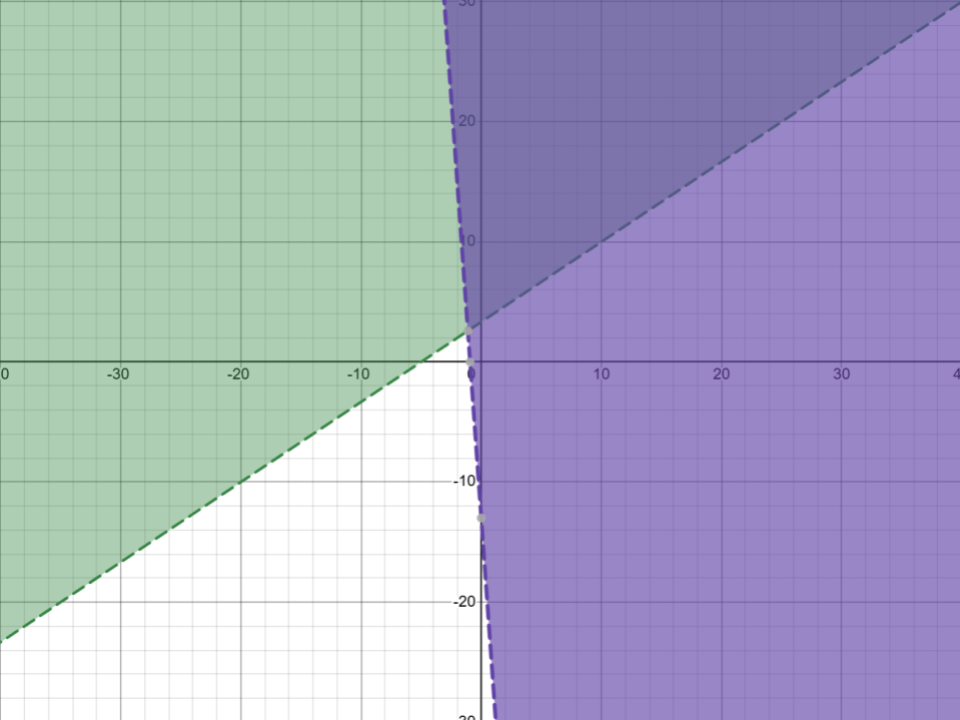
Desmos can also work well here, as long as you apply careful observation. Take a look at this graph of both inequalities:
The dark purple area is the overlapping set of values that satisfy both equations. Remember that, as we saw when plugging in number, the right answer barely satisfies the second inequality. This should suggest that we’ll find close to the edge of the dark purple area. Indeed, if you click around until you find along the leftward boundary of the area, you’ll see that is right on that boundary. Therefore, it makes sense that at the same value will be fit just inside the dark purple area, since it is right above it.
Difficulty 4
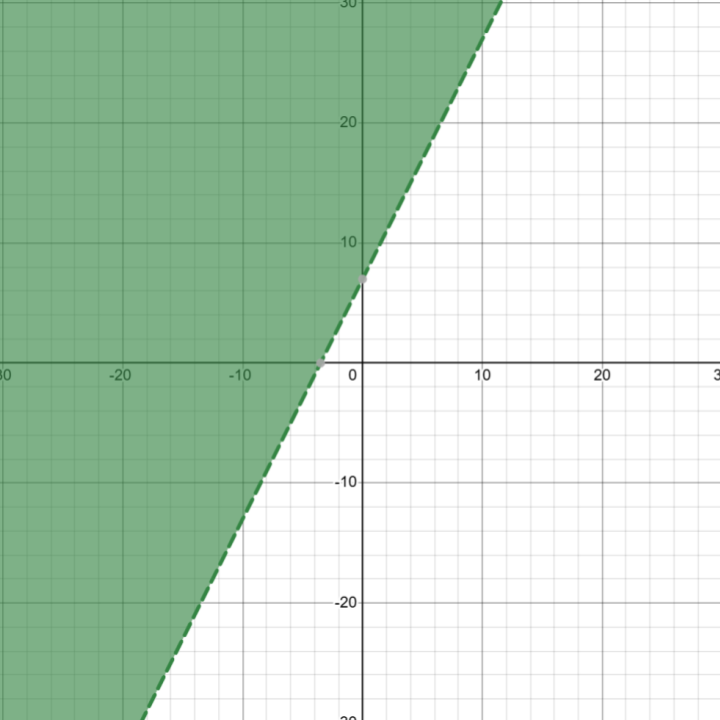
The shaded region shown represents the solutions to which inequality?
A.
B.
C.
D.
The answer is . With lines on an inequality graph in the xy-plane, the rule is that dashed lines refer to greater than or less than without the equals sign, while solid lines denote “greater than or equal to” or “less than or equal to.” This figure has dashed lines, so we can rule out the two answers with the line below the inequality symbol.
Meanwhile, it’s helpful to recognize how to interpret the shading on an inequality graph. There is a simple visual approach if the is isolated: if the shading is above the line, there should be a “greater than” symbol (opening toward the ). If the shading is below the line, there should be a “less than” symbol (opening away from the ). This insight doesn’t help us here, since all the inequality symbols are facing the same direction, but it could certainly be useful in a different system of inequalities question.
To distinguish between and , we can assess either the slope or the y-intercept of the dashed line (just as we would if this were a linear equation rather than an inequality). The -intercept is simpler to observe than the slope since it is represented by a single point. We can see from the graph that the -intercept is , not , so must be the answer (this is in form, which can be reversed to show ).
If you want to check your answer, observe the dashed line to see if it has a slope of (indeed it does). Better still, graph the line yourself on Desmos so you can zoom in enough to see that the line does bear a slope of : for every unit to the right, it moves up two units.
Difficulty 5
The maximum value of is less than three times the square of a number . Which inequality shows the possible values of ?
A.
B.
C.
D.
The answer is . As the UnCLES method suggests, we need to read a “translation” problem like this carefully, noting key terms. You might notice four in particular: “maximum”, “less than”, “three times”, and “square”. The last two of these are simpler than the first two: “three times” means we must multiply by and “square” means raise to the power of two (not to be confused with “square root”).
What does “maximum” tell us? Do we want a “less than” or “greater than” symbol after ? If you think about it, the word “maximum” always provides a limit on something; if you feel you got a maximum of on a certain test, you know your success was limited to no more than out of every possible points. So “maximum” is telling us that the value is no more than a certain amount. But this also means that, in terms of the inequality symbol, we need the symbols showing “less than or equal to,” for the value can be equal to the expression on the other side. So thus far, we can eliminate the answer with the “greater than or equal to” symbol and the answer that has the “less than” marker without conveying “or equal to”. (If you are confronted instead with a “minimum”, the same principle applies but in the opposite direction; all acceptable values must be greater than or equal to the minimum.)
This leaves us with “9 less than .…” This phrase is the trickiest of all to translate since it requires going out of order to do so. This phrase is not asking us to subtract an unknown number from but to subtract from the unknown number. The idea is something like , not . So our correct answer must have . At long last, we’ve made it.