



Writing intro
The GRE exam always begins with an essay called the Issue Essay.
You’ll have 30 minutes to write the essay. We’ll cover what to write in upcoming chapters, but first you need to understand how this essay is graded.
In general, graders evaluate two broad areas: your essay-writing skills and your English language skills. Here are the benchmarks you’re graded on, in order of importance:
Essay writing skills
- Answer the question and stay on topic
- Use clear, logical, and convincing points to defend your position
- Have an effective logical flow to the essay
English language skills
- Use correct spelling
- Use correct grammar
- Use a variety of sentence structures
Your essay is graded by both a human and a computer, and your final score is the average of the two. ETS doesn’t publish the exact details of its scoring process. Most likely, the computer focuses more on English language features, while the human grader is better suited to evaluate reasoning and overall essay structure. Either way, your goal is the same: meet each requirement and write as much as you can within the time limit.
All official GRE essay prompts are publicly available, so you can study and practice with them. When you take our essay exam sections, we’ll randomly select one of these prompts. There are hundreds of prompts in the pool, and you might even see a prompt on test day that you practiced beforehand.
How to write a good GRE essay
You’ll find plenty of general writing advice online, but the GRE rewards a specific style of writing. Tips that work for school essays or creative writing aren’t always the best fit for a timed, standardized exam.
At Achievable, we take a data-focused approach. ETS doesn’t share its exact scoring criteria, but after analyzing thousands of essays using artificial intelligence and machine learning techniques, we’ve developed a strong understanding of the traits that tend to appear in high-scoring essays.
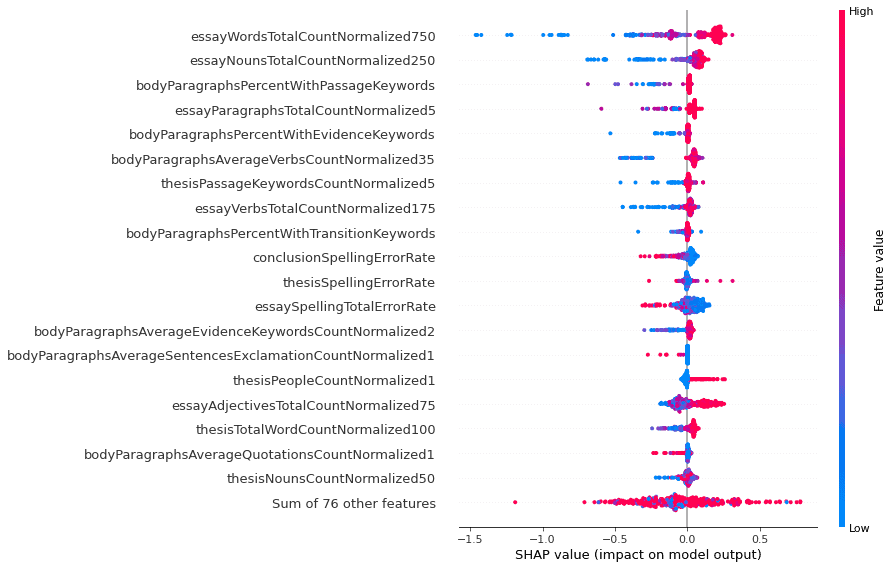
Here are the top ways to write a high-scoring GRE issue essay or GRE argument essay:
- Make sure your essay is long enough to avoid being penalized for a short essay (write 800+ words)
- Ensure your essay is focused by using plenty of nouns that relate to the topic
- Write a descriptive essay by using lots of adjectives to describe your position, evidence, and ideas
- Read the prompt carefully, highlight keywords, and use these keywords throughout your essay, most importantly in your thesis paragraph
- Vary your sentence length, but in general, favor the use of longer sentences
- Avoid making spelling mistakes
- Aim for ~8 sentences per body paragraph and ~5 sentences for thesis and conclusion paragraphs
- Keep your thesis and conclusion paragraphs concise but use at least 100 words
- Reference a person’s name in your thesis paragraph if it’s relevant
- Keep your body paragraphs above 150 words
- Avoid excessive use of exclamation marks and quotations
If you want the full analysis, you can read the complete article 20+ proven ways to boost your GRE essay score on our blog.