
Short puts
This chapter covers the fundamentals of short put options contracts. To get comfortable with the language used when discussing options, watch this video:
When an investor goes short a put, they are bullish on the underlying security’s market price. Selling a put obligates the investor to buy stock at the strike price if assigned (exercised).
- If the stock’s market price falls below the put’s strike price (think “put down” - the put is in the money), the holder may exercise the option, forcing the writer to buy shares at the strike price.
- If the market price rises above the strike price (the put is out of the money), the holder won’t exercise the option, and the writer keeps the premium as profit.
Let’s work through a few examples to understand short puts better:
Short 1 ABC Sep 75 put @ $6
This contract obligates the writer to buy ABC stock at $75 per share if assigned. The writer received $600 for selling the option ($6 premium x 100 shares). The option expires on the third Friday in September.
The investor is betting ABC stock’s market price stays at or above $75 through expiration. If ABC falls below $75, the holder may exercise the option, which can create losses for the writer.
Math-based options questions are common on the exam. They typically ask about potential gains, losses, and breakeven values. Let’s go through each.
An investor goes short 1 ABC Sep 75 put @ $6. The market price falls to $0. What is the gain or loss?
Can you figure it out?
Answer = $6,900 loss
| Action | Result |
|---|---|
| Sell put | +$600 |
| Assigned - bought shares | -$7,500 |
| Share value | +$0 |
| Total | -$6,900 |
At $0, the option is $75 in the money. This is the worst-case scenario for a put writer. We can assume the investor is assigned and must buy 100 ABC shares at $75.
- The shares are worth $0, so the investor loses $75 per share.
- That’s a $7,500 loss from assignment ($75 x 100).
- The $600 premium received up front reduces the net loss to $6,900.
The maximum loss for a short put can be found using this formula:
Here, the strike price of $75 minus the premium of $6 gives a maximum loss of $69 per share (or $6,900 overall).
In the short call chapter, we learned an option is “naked” when it’s sold without a hedge (protection). The same idea applies to a short put.
A short put is risky because assignment may force the investor to buy shares at the higher strike price when the market value is lower. In the worst case, the investor buys worthless shares at the strike price.
In the next chapter, you’ll learn how investors protect themselves from risk on short options. For now, here is a quick list of investments that would cover a short put:
- Short shares
- Long put*
- Cash (equal to the maximum loss)
- Bank guarantee letter**
*For a long put to cover a short put, the long put must maintain the same or higher strike price, plus the expiration must be the same or longer.
**A short put is considered covered if a banking institution provides a guarantee letter stating it will cover the costs related to an assignment.
The risk of a short put comes from buying shares at the strike price and then being stuck with shares worth less (or even worthless). A hedge changes that risk:
-
If the investor is short the shares, the sale already occurred. When the put is assigned, the investor effectively buys back the short shares, closing the short position. There’s no need to worry about selling the shares later at a lower price because the sale already happened.
-
If the investor owns a put (in addition to the short put), they have the right to sell the shares purchased at assignment at the long put’s strike price. Even if the market price drops sharply, they can exercise the long put and sell at the higher strike price.
-
While cash doesn’t prevent losses, posting cash equal to the maximum loss technically “covers” the put because the investor has enough funds available to meet the obligation. Remember that cash can’t cover a short call because a short call’s risk is unlimited.
Let’s look at an example that’s more likely to occur:
An investor goes short 1 ABC Sep 75 put @ $6. The market price falls to $60. What is the gain or loss?
Answer = $900 loss
| Action | Result |
|---|---|
| Sell put | +$600 |
| Assigned - bought shares | -$7,500 |
| Share value | +$6,000 |
| Total | -$900 |
When the market price falls to $60, the option is $15 in the money. If assigned, the writer must buy 100 ABC shares for $75.
- The shares are worth $60, so the investor loses $15 per share.
- That’s a $1,500 assignment loss ($15 x 100).
- Subtract the $600 premium received up front, and the net loss is $900.
Investors who sell puts don’t always lose money. Even if ABC’s market price falls below $75, the premium provides a cushion. The investor won’t have an overall loss until the assignment loss exceeds the premium.
Let’s work through another example.
An investor goes short 1 ABC Sep 75 put @ $6. The market price falls to $69. What is the gain or loss?
Answer = $0 (breakeven)
| Action | Result |
|---|---|
| Sell put | +$600 |
| Assigned - bought shares | -$7,500 |
| Share value | +$6,900 |
| Total | $0 |
At $69, the option is $6 in the money.
- Assignment forces the investor to buy at $75 when the shares are worth $69.
- That’s a $6 per share loss, or $600 total ($6 x 100).
- The $600 premium offsets the $600 assignment loss, so the investor breaks even.
When investing in puts, the breakeven can be found using this formula:
You probably noticed this is the same breakeven formula used for long puts. The long and short positions are opposites, but they reach breakeven at the same stock price.
With a strike price of $75 and a premium of $6, breakeven is $69 per share. At this market price, there’s no profit or loss.
The breakeven formula is also the same as a short put’s maximum loss formula. The difference is how you interpret the result:
- Maximum loss is a dollar loss, so you multiply by 100 to get the per-contract amount.
- Breakeven is a stock price, so you don’t multiply by 100.
If ABC’s market price doesn’t fall too far below $75, the investor could still make a profit. For example:
An investor goes short 1 ABC Sep 75 put @ $6. The market price falls to $74. What is the gain or loss?
Answer = $500 gain
| Action | Result |
|---|---|
| Sell put | +$600 |
| Assigned - bought shares | -$7,500 |
| Share value | +$7,400 |
| Total | +$500 |
At $74, the option is $1 in the money.
- Assignment creates a $1 per share loss ($75 paid vs. $74 value), or $100 total.
- The $600 premium more than offsets that $100 loss.
- Net result: $500 gain.
Expiration is the best-case scenario for investors writing (going short) options. If the option expires worthless, the investor keeps the premium and never has to fulfill the obligation. The same applies to short put contracts.
An investor goes short 1 ABC Sep 75 put @ $6. The market price rises to $84. What is the gain or loss?
Answer = $600 gain
| Action | Result |
|---|---|
| Sell put | +$600 |
| Total | +$600 |
At $84, the option is $9 out of the money and has no intrinsic value. When the market price is above $75, the holder won’t exercise. They wouldn’t choose to sell stock for $75 when it’s trading for $84.
An easy way to remember assignment for puts is “put down”: puts are exercised when the market price is below the strike price. That’s not the case here, so the option expires.
Investors with short options can only make the premium - nothing more. If exercise occurs, losses start eating away at the premium and can push the position into an overall loss.
Writers can also perform closing transactions to exit their obligations before expiration.
An investor goes short 1 ABC Sep 75 put @ $6. After ABC’s market price rises to $79, the premium falls to $2, and the investor does a closing purchase. What is the gain or loss?
Answer = $400 gain
| Action | Result |
|---|---|
| Sell put | +$600 |
| Close put | -$200 |
| Total | +$400 |
To find profit or loss on a closing transaction, compare:
- the premium received when selling the option, and
- the premium paid to buy it back.
Here, the investor sold the put for $6 and later bought it back for $2, for a $4 net gain per share. Since each contract covers 100 shares, the overall gain is $400.
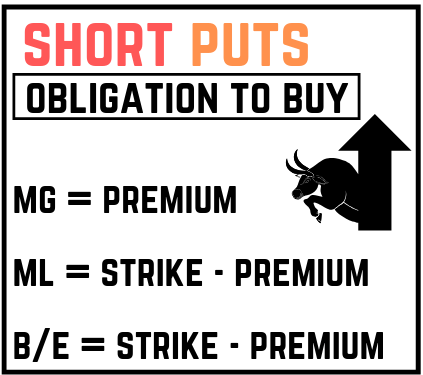
Here’s a visual summarizing the important aspects of short puts:
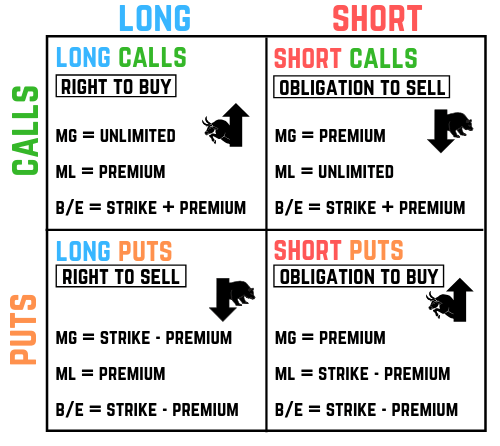
You’ve now worked through all four options positions: long calls, short calls, long puts, and short puts. The following visual puts it all together: