



Enterprise Resource Planning (ERP)
Learning outcome statements
The learning outcome statements relevant for this section are:
- define ERP and identify and explain the advantages and disadvantages of ERP
- explain how ERP helps overcome the challenges of separate financial and nonfinancial systems, integrating all aspects of an organization’s activities
- define relational database and demonstrate an understanding of a database management system
- define data warehouse and data mart
What is enterprise resource planning (ERP)
ERP systems consolidate financial, operational, and human resources data into a unified database, ensuring real-time access to accurate information for decision-making. Unlike AIS, which is primarily designed to process financial data, ERP systems integrate both financial and non-financial information. This allows businesses to analyze a more comprehensive dataset that includes operational metrics, customer interactions, supply chain performance, and other business-critical insights. By consolidating financial and non-financial data, ERP enhances decision-making, improves forecasting accuracy, and fosters cross-departmental collaboration.
Advantages of ERP
- Improved efficiency: ERP streamlines business processes by reducing manual tasks and automating workflows.
- Data integration: A centralized database ensures consistency and accuracy of data across departments.
- Better decision-making: Real-time reporting and analytics provide management with valuable insights for strategic planning.
- Regulatory compliance: ERP systems include built-in compliance features that help businesses adhere to industry regulations.
- Scalability: As organizations grow, ERP systems can be expanded to accommodate increased operations.
Disadvantages of ERP
- High implementation costs: Deploying an ERP system requires significant financial investment.
- Complexity: Customizing and integrating ERP solutions with existing processes can be challenging.
- Lengthy implementation process: The transition to an ERP system may take months or even years to complete.
- Training requirements: Employees must be trained to effectively use the system, which can be time-consuming.
- Data security issues: ERP systems store large amounts of sensitive financial and operational data, making them attractive targets for cyber threats. Organizations must implement robust security measures to protect against data breaches, unauthorized access, and system vulnerabilities.
Database management systems (DBMS) and ERP
A DBMS is essential for managing the vast amounts of data processed by ERP systems. A DBMS provides a structured way to store, retrieve, and manipulate data, ensuring consistency, security, and accessibility across an organization. ERP systems rely on DBMS to handle data from various departments, including finance, human resources, supply chain, and customer relations, allowing for seamless integration of information.
One of the most common types of DBMS used in ERP systems is a relational database. A relational database organizes data into tables with predefined relationships, making it easier to retrieve and analyze data efficiently. This structure allows ERP systems to integrate various business functions by linking data across departments in a logical and structured manner.
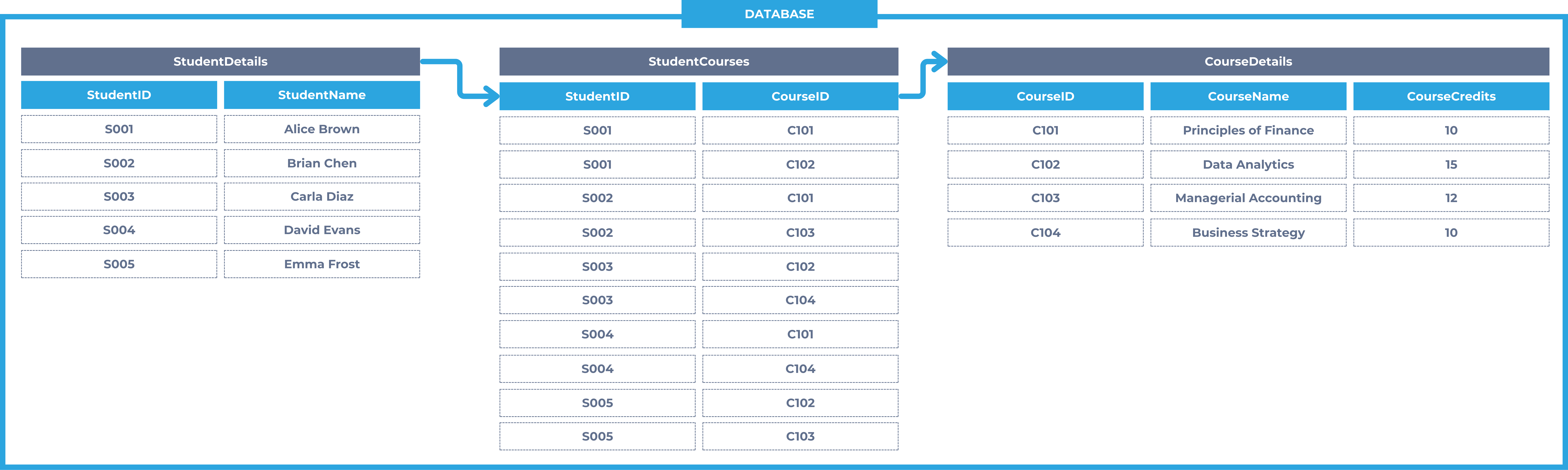
For example, a relational database in a university system might connect student records, enrolled courses, and course details. Each student is stored once in the student table, their enrollments are tracked in a separate table, and course information is maintained in the course table. By linking these tables through shared keys, the database ensures that updates in one area (such as a student registering for a new course) automatically reflect in related areas (like their enrollment list and the course roster).
Popular relational database management systems (RDBMS) used in ERP environments include
- Oracle Database
- Microsoft SQL Server
- MySQL, and
- PostgreSQL.
By utilizing a DBMS, ERP systems enhance data accuracy, streamline reporting, and enable real-time decision-making, making them a crucial component of modern business operations.
Data storage
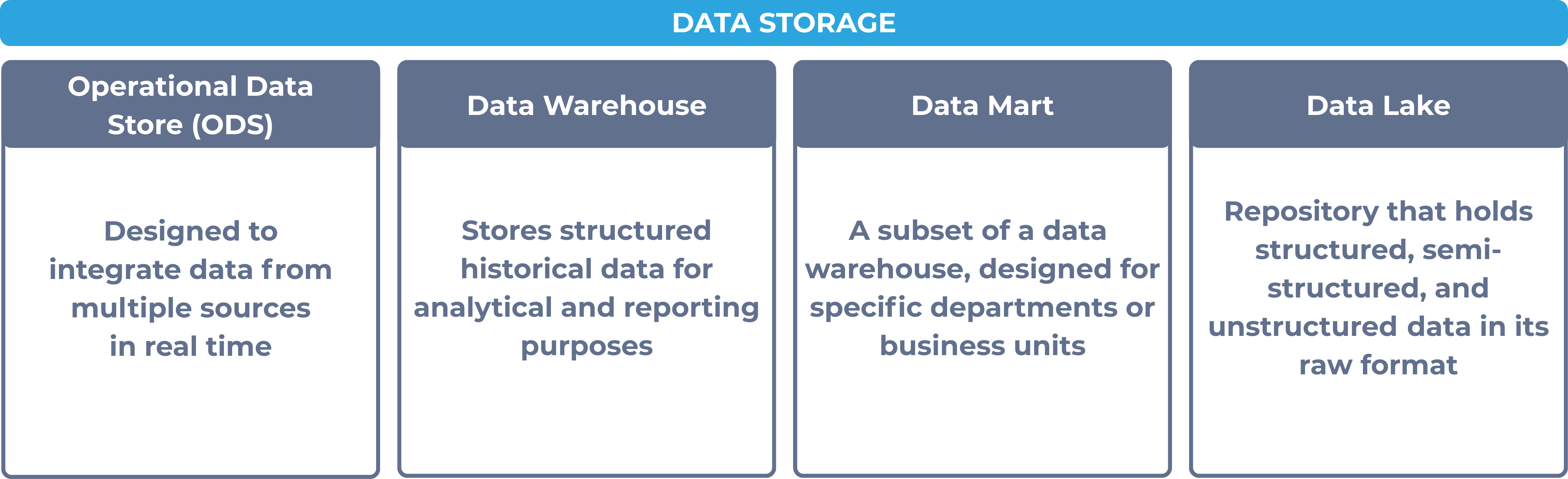
Efficient data storage is critical for ERP systems, ensuring that organizations can manage vast amounts of structured and unstructured data effectively. Different types of data storage solutions serve various purposes in ERP systems, including:
- Operational Data Stores (ODS)
- Data Warehouses
- Data Marts, and
- Data Lakes
Each of these data storage solutions plays a vital role in ERP systems, ensuring that data is available for operational decision-making, business intelligence, and advanced analytics.
Operational data store (ODS)
An Operational Data Store (ODS) is a centralized database designed to integrate data from multiple sources in real time. Unlike a data warehouse, an ODS is used for operational reporting and supports short-term business processes. It provides a consolidated view of current data, making it ideal for real-time decision-making and quick reporting. However, it does not retain historical data for long-term analysis.
Characteristics of an Operational Data Store:
- Integrates real-time or near real-time data from multiple operational systems.
- Optimized for transactional and short-term reporting, not long-term analytics.
- Provides a current, consolidated view of data to support day-to-day decision-making.
- Stores only recent or current data, not extensive historical records.
Data warehouse
A Data Warehouse is a large repository that stores structured historical data for analytical and reporting purposes. Data is extracted from various transactional systems, transformed, and loaded into the warehouse in a structured format. Unlike an ODS, which handles real-time data, a data warehouse is optimized for complex queries, trend analysis, and business intelligence.
Characteristics of a Data Warehouse:
- Stores historical data from multiple sources.
- Optimized for analytical processing rather than transactional operations.
- Provides a single source of truth for business intelligence and reporting.
- Uses Extract, Transform, Load (ETL) processes to prepare data for analysis.
Data mart
A Data Mart is a subset of a data warehouse, designed for specific departments or business units within an organization. Instead of storing enterprise-wide data, a data mart focuses on a particular function, such as finance, sales, or human resources, enabling quicker and more targeted data retrieval for decision-making.
Characteristics of a Data Mart:
- A smaller, specialized version of a data warehouse.
- Contains domain-specific data relevant to a particular department.
- Enhances performance by reducing query complexity and processing time.
- Can be independent or dependent on a larger data warehouse.
Data lake
A Data Lake is a vast storage repository that holds structured, semi-structured, and unstructured data in its raw format. Unlike data warehouses and data marts, data lakes do not require data to be pre-structured before storage, allowing businesses to store large volumes of data without predefined schemas.
Characteristics of a Data Lake:
- Stores data in its raw form, without prior structuring.
- Supports various data types, including text, images, and log files.
- Provides flexibility for data scientists and analysts to process data as needed.
- Often used for big data analytics, machine learning, and artificial intelligence applications.