


Achievable logoAchievable logo
CMA Part 1
Sign in
Sign up
Purchase
Textbook
Practice exams
Support
How it works
Exam catalog
Mountain with a flag at the peak
Textbook
1. External financial reporting decisions
2. Planning, budgeting, and forecasting
3. Performance management
4. Cost management
5. Internal control
6. Technology and analytics
Achievable logoAchievable logo
2.2.4.4 Other budgeting concepts
Achievable CMA Part 1
2. Planning, budgeting, and forecasting
2.2. Budgeting concepts
2.2.4. Other budgeting concepts
Our CMA Part 1 course is currently in development and is a work-in-progress.

Other budgeting concepts

8 min read
Font
Discuss
Share
Feedback

Developing standards for direct materials and direct labor

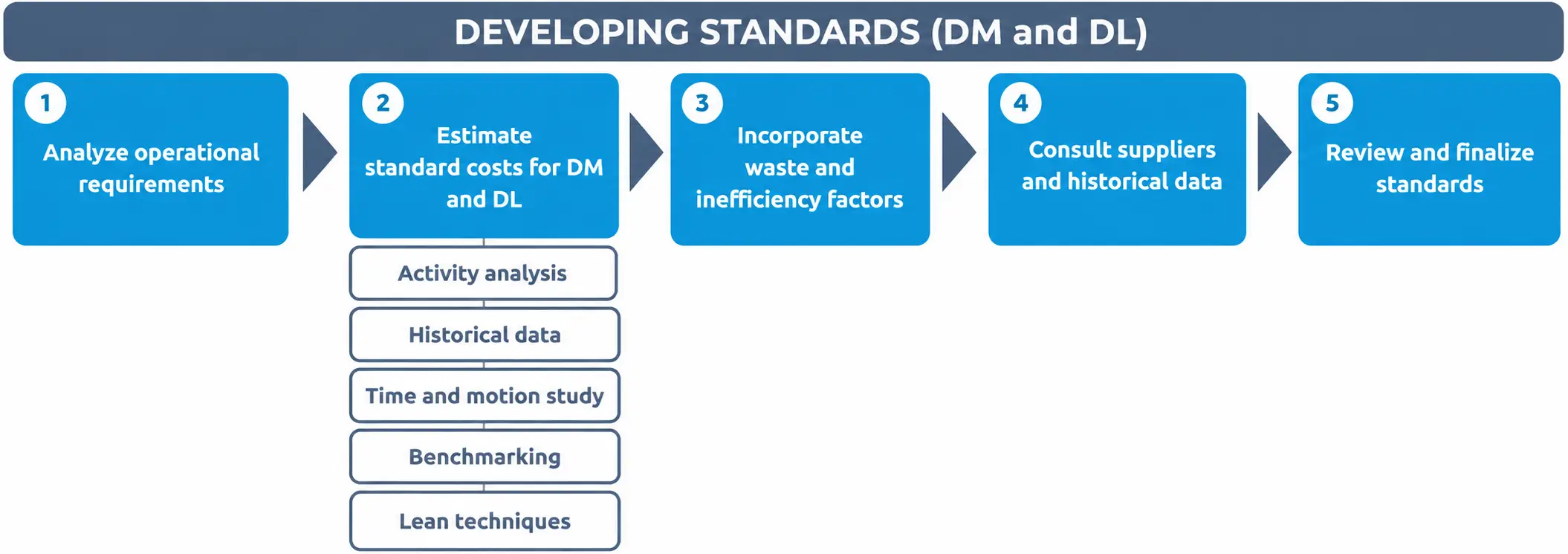
The process of developing standards for Direct Materials (DM) and Direct Labor (DL) involves several steps. These standards provide benchmarks for budgeting and performance evaluation, ensuring that the organization operates efficiently. The following is a general step-by-step process for developing DM and DL standards:

Five-step flowchart for developing direct material and direct labor standards, from analysis to finalization.
Developing DM and DL Standards

This process allows organizations to establish reliable standards that can serve as benchmarks for efficient production, helping to control costs and measure performance.

Step 1. Analyze operational requirements

Begin by identifying the specific materials and labor required to complete a production process. This includes determining the types and quantities of materials needed for each unit of production and the types of labor (skilled, unskilled) necessary to complete each task.

Step 2. Estimate standard costs for DM and DL

Estimate the standard costs for direct materials (DM) and direct labor (DL). This involves determining:

  • The standard quantity of DM needed per unit of output and the expected cost per unit of material.
  • The standard time of DL required to complete each task and the expected labor rate per hour.

Two commonly used techniques for developing cost standards are:

  • Activity analysis: This involves analyzing the specific activities that contribute to the production process and identifying where efficiencies or inefficiencies occur in order to develop standard costs.
  • Use of historical data: Historical data on past performance provides a solid foundation for setting cost standards, adjusted for anticipated changes in technology, production methods, or market conditions. However, this approach should be partnered with other approaches to provide more relevant standard costs for the current situation of the company.

In addition to activity analysis and historical data, several other techniques can be used to develop cost standards. These methods provide alternative approaches for setting accurate and realistic benchmarks for both direct materials and direct labor.

  • Time and motion study: A time and motion study involves analyzing a process or task by observing the time taken for each step and the specific movements involved. This data helps pinpoint areas for optimization and allows for the development of more precise standards.
  • Benchmarking against industry standards: Benchmarking involves comparing the organization’s production processes and costs with those of similar organizations or industry averages. By analyzing how other companies handle their direct materials and labor costs, the organization can set standards that are competitive and aligned with industry best practices.
  • Lean manufacturing techniques: Lean manufacturing principles focus on minimizing waste and improving efficiency. Standards developed through lean techniques emphasize the elimination of non-value-added activities, ensuring that cost standards reflect the most efficient production processes. This approach helps set more ambitious yet attainable standards for both materials and labor.

Step 3. Incorporate waste and inefficiency factors

Adjust the standard quantities and times to account for normal levels of waste, downtime, and inefficiency. This ensures that the standards reflect real-world conditions and are not overly optimistic.

Step 4. Consult suppliers and historical data

For direct materials, consult suppliers to get up-to-date pricing and evaluate historical purchase data to refine material cost estimates. For direct labor, review historical payroll data and consider expected wage increases or adjustments.

Step 5. Review and finalize standards

Collaborate with relevant department managers and employees to review the proposed standards. Ensure that they are realistic, achievable, and aligned with operational goals before finalizing them for budgeting and performance evaluation.

Budget flexibility and revisions

A successful budgeting process should include a policy that allows for budget revisions to accommodate significant changes in assumptions. Economic conditions, market shifts, and operational changes may require adjustments to the original budget. A budget process should allow for these revisions, ensuring that the organization can respond to new circumstances without losing sight of its objectives. By regularly revisiting the assumptions behind the budget, management can make timely adjustments and avoid disruptions that could impact financial performance or strategic initiatives.

However, while flexibility in budgeting and having a revision policy is important for adapting to changing conditions, there are potential pitfalls that organizations should be aware of:

  • Overuse of revisions: If budgets are revised too frequently, it can undermine the original purpose of budgeting, which is to set clear financial targets and expectations. Constant changes can create confusion and reduce accountability, as managers may come to rely on revisions rather than sticking to the original plan.
  • Loss of discipline: Excessive flexibility may lead to a lack of financial discipline, where managers feel less pressure to control costs or meet revenue targets because they know the budget can be adjusted. This can weaken the organization’s overall financial control.
  • Loss of credibility: When budgets are revised too often, it can lead to a perception that the budgeting process is unreliable or ineffective. This may slowly destroy trust in the budget as a tool for planning and performance measurement.

Therefore, while it is essential to have a policy for budget revisions to account for significant changes, it is equally important to ensure that revisions are not abused to maintain the integrity of the budgeting process.

Monitoring and controlling expenditures

Budgets serve as a powerful tool for monitoring and controlling expenditures by:

1. Setting financial targets

Budgets establish expected spending levels for each department or project, serving as a benchmark against which actual expenditures are compared.

2. Variance analysis

Regular comparison of actual spending to the budget allows for the identification of variances (differences between budgeted and actual costs), highlighting areas where costs are exceeding expectations.

3. Accountability

By assigning specific budgetary responsibilities to department managers, budgets help ensure that individuals are accountable for managing their resources effectively.

4. Cost control

Budgets encourage managers to monitor their spending closely and make adjustments when actual costs begin to exceed budgeted amounts, helping to avoid unnecessary expenses.

5. Resource allocation

Budgets provide a framework for deciding how to allocate financial resources, ensuring that funds are directed toward priority areas that align with the organization’s strategic goals.

Budgetary slack and goal congruence

Definitions
Budgetary slack
This occurs when managers intentionally overestimate costs or underestimate revenues in their budgets to make targets easier to achieve. While this might provide a buffer for the department, it can lead to inefficiencies and misallocation of resources.

Budgetary slack undermines goal congruence, which is the alignment of individual managers’ goals with the overall objectives of the organization. If managers prioritize their departmental interests over the organization’s strategic goals, it can distort the budgeting process and hinder the company’s ability to achieve its long-term objectives.

To decrease the incidence of budgetary slack, organizations can implement the following strategies:

  • Transparent review processes: Regularly review budgets at multiple levels of the organization to ensure that estimates are reasonable and consistent with actual operational conditions.
  • Linking compensation to performance: Tying manager compensation or bonuses to actual performance against realistic budget targets can reduce the incentive to create slack. When managers are rewarded for achieving challenging but attainable goals, they are less likely to pad the budget.
  • Participative budgeting: Involving managers and employees in the budget-setting process can help ensure that targets are seen as fair and achievable, reducing the desire to create slack to protect against failure.
  • Data-driven budgeting: Using historical data, industry benchmarks, and analytical tools to set budgetary standards can help prevent the inclusion of unnecessary slack by providing objective baselines for performance.

By adopting these practices, organizations can better align individual goals with organizational objectives and reduce the impact of budgetary slack.

Conclusion

Understanding and applying these various budgeting concepts is essential for building a robust and adaptable budgeting process that supports the organization’s strategic objectives. By identifying the appropriate time frame for different budget types and ensuring the right participants are involved, organizations can create more accurate and effective financial plans. The role of top management is crucial in guiding this process, while collaboration and diversity of opinion further enhance the quality of the budget.

Standards play a key role in budgeting, with practical standards providing realistic performance benchmarks, and ideal standards serving as aspirational targets. While participative standards foster engagement and alignment with the realities of operations, authoritative standards offer efficiency and consistency. Developing direct materials and labor standards requires a structured approach, with techniques like time and motion studies and engineering analyses providing accurate benchmarks.

Flexibility in budgeting is necessary, but organizations must be cautious of the pitfalls of frequent revisions, as they can undermine accountability and financial discipline. Budgets also serve a vital role in monitoring and controlling expenditures, ensuring resources are allocated effectively and variances are addressed promptly. To prevent budgetary slack and promote goal congruence, organizations should implement transparent review processes, link performance to compensation, and rely on data-driven standards.

By integrating these budgeting concepts, organizations can create financial plans that are flexible, fair, and aligned with both short-term operational needs and long-term strategic goals.

Developing standards for direct materials and direct labor

  • Identify required materials and labor types/quantities for production
  • Estimate standard costs using:
    • Activity analysis, historical data, time and motion studies, benchmarking, lean manufacturing
  • Adjust for normal waste, downtime, inefficiency
  • Consult suppliers and review historical cost/payroll data
  • Collaborate with managers to finalize realistic, achievable standards

Budget flexibility and revisions

  • Policy for budget revisions accommodates significant changes (economic, market, operational)
  • Regularly revisit budget assumptions for timely adjustments
  • Risks of excessive revisions:
    • Undermines targets and accountability
    • Reduces financial discipline and credibility

Monitoring and controlling expenditures

  • Budgets set financial targets for departments/projects
  • Variance analysis identifies differences between actual and budgeted costs
  • Assign budget responsibility to managers for accountability
  • Encourage cost control and resource allocation aligned with strategic goals

Budgetary slack and goal congruence

  • Budgetary slack: intentional overestimation of costs/underestimation of revenues
  • Undermines alignment between individual and organizational goals (goal congruence)
  • Reduce slack by:
    • Transparent budget reviews
    • Linking compensation to performance
    • Participative budgeting
    • Data-driven standards

Conclusion

  • Robust budgeting requires appropriate time frames, participant involvement, and top management guidance
  • Standards (practical, ideal, participative, authoritative) provide performance benchmarks
  • Flexibility is necessary but must be balanced to avoid undermining discipline
  • Budgets monitor/control expenditures and support strategic resource allocation
  • Transparent, data-driven processes promote goal congruence and minimize slack

Sign up for free to take 7 quiz questions on this topic

Previous
Next  | 2.3.1 Regression analysis
All rights reserved ©2016 - 2026 Achievable, Inc.

Other budgeting concepts

Developing standards for direct materials and direct labor

The process of developing standards for Direct Materials (DM) and Direct Labor (DL) involves several steps. These standards provide benchmarks for budgeting and performance evaluation, ensuring that the organization operates efficiently. The following is a general step-by-step process for developing DM and DL standards:

This process allows organizations to establish reliable standards that can serve as benchmarks for efficient production, helping to control costs and measure performance.

Step 1. Analyze operational requirements

Begin by identifying the specific materials and labor required to complete a production process. This includes determining the types and quantities of materials needed for each unit of production and the types of labor (skilled, unskilled) necessary to complete each task.

Step 2. Estimate standard costs for DM and DL

Estimate the standard costs for direct materials (DM) and direct labor (DL). This involves determining:

  • The standard quantity of DM needed per unit of output and the expected cost per unit of material.
  • The standard time of DL required to complete each task and the expected labor rate per hour.

Two commonly used techniques for developing cost standards are:

  • Activity analysis: This involves analyzing the specific activities that contribute to the production process and identifying where efficiencies or inefficiencies occur in order to develop standard costs.
  • Use of historical data: Historical data on past performance provides a solid foundation for setting cost standards, adjusted for anticipated changes in technology, production methods, or market conditions. However, this approach should be partnered with other approaches to provide more relevant standard costs for the current situation of the company.

In addition to activity analysis and historical data, several other techniques can be used to develop cost standards. These methods provide alternative approaches for setting accurate and realistic benchmarks for both direct materials and direct labor.

  • Time and motion study: A time and motion study involves analyzing a process or task by observing the time taken for each step and the specific movements involved. This data helps pinpoint areas for optimization and allows for the development of more precise standards.
  • Benchmarking against industry standards: Benchmarking involves comparing the organization’s production processes and costs with those of similar organizations or industry averages. By analyzing how other companies handle their direct materials and labor costs, the organization can set standards that are competitive and aligned with industry best practices.
  • Lean manufacturing techniques: Lean manufacturing principles focus on minimizing waste and improving efficiency. Standards developed through lean techniques emphasize the elimination of non-value-added activities, ensuring that cost standards reflect the most efficient production processes. This approach helps set more ambitious yet attainable standards for both materials and labor.

Step 3. Incorporate waste and inefficiency factors

Adjust the standard quantities and times to account for normal levels of waste, downtime, and inefficiency. This ensures that the standards reflect real-world conditions and are not overly optimistic.

Step 4. Consult suppliers and historical data

For direct materials, consult suppliers to get up-to-date pricing and evaluate historical purchase data to refine material cost estimates. For direct labor, review historical payroll data and consider expected wage increases or adjustments.

Step 5. Review and finalize standards

Collaborate with relevant department managers and employees to review the proposed standards. Ensure that they are realistic, achievable, and aligned with operational goals before finalizing them for budgeting and performance evaluation.

Budget flexibility and revisions

A successful budgeting process should include a policy that allows for budget revisions to accommodate significant changes in assumptions. Economic conditions, market shifts, and operational changes may require adjustments to the original budget. A budget process should allow for these revisions, ensuring that the organization can respond to new circumstances without losing sight of its objectives. By regularly revisiting the assumptions behind the budget, management can make timely adjustments and avoid disruptions that could impact financial performance or strategic initiatives.

However, while flexibility in budgeting and having a revision policy is important for adapting to changing conditions, there are potential pitfalls that organizations should be aware of:

  • Overuse of revisions: If budgets are revised too frequently, it can undermine the original purpose of budgeting, which is to set clear financial targets and expectations. Constant changes can create confusion and reduce accountability, as managers may come to rely on revisions rather than sticking to the original plan.
  • Loss of discipline: Excessive flexibility may lead to a lack of financial discipline, where managers feel less pressure to control costs or meet revenue targets because they know the budget can be adjusted. This can weaken the organization’s overall financial control.
  • Loss of credibility: When budgets are revised too often, it can lead to a perception that the budgeting process is unreliable or ineffective. This may slowly destroy trust in the budget as a tool for planning and performance measurement.

Therefore, while it is essential to have a policy for budget revisions to account for significant changes, it is equally important to ensure that revisions are not abused to maintain the integrity of the budgeting process.

Monitoring and controlling expenditures

Budgets serve as a powerful tool for monitoring and controlling expenditures by:

1. Setting financial targets

Budgets establish expected spending levels for each department or project, serving as a benchmark against which actual expenditures are compared.

2. Variance analysis

Regular comparison of actual spending to the budget allows for the identification of variances (differences between budgeted and actual costs), highlighting areas where costs are exceeding expectations.

3. Accountability

By assigning specific budgetary responsibilities to department managers, budgets help ensure that individuals are accountable for managing their resources effectively.

4. Cost control

Budgets encourage managers to monitor their spending closely and make adjustments when actual costs begin to exceed budgeted amounts, helping to avoid unnecessary expenses.

5. Resource allocation

Budgets provide a framework for deciding how to allocate financial resources, ensuring that funds are directed toward priority areas that align with the organization’s strategic goals.

Budgetary slack and goal congruence

Definitions
Budgetary slack
This occurs when managers intentionally overestimate costs or underestimate revenues in their budgets to make targets easier to achieve. While this might provide a buffer for the department, it can lead to inefficiencies and misallocation of resources.

Budgetary slack undermines goal congruence, which is the alignment of individual managers’ goals with the overall objectives of the organization. If managers prioritize their departmental interests over the organization’s strategic goals, it can distort the budgeting process and hinder the company’s ability to achieve its long-term objectives.

To decrease the incidence of budgetary slack, organizations can implement the following strategies:

  • Transparent review processes: Regularly review budgets at multiple levels of the organization to ensure that estimates are reasonable and consistent with actual operational conditions.
  • Linking compensation to performance: Tying manager compensation or bonuses to actual performance against realistic budget targets can reduce the incentive to create slack. When managers are rewarded for achieving challenging but attainable goals, they are less likely to pad the budget.
  • Participative budgeting: Involving managers and employees in the budget-setting process can help ensure that targets are seen as fair and achievable, reducing the desire to create slack to protect against failure.
  • Data-driven budgeting: Using historical data, industry benchmarks, and analytical tools to set budgetary standards can help prevent the inclusion of unnecessary slack by providing objective baselines for performance.

By adopting these practices, organizations can better align individual goals with organizational objectives and reduce the impact of budgetary slack.

Conclusion

Understanding and applying these various budgeting concepts is essential for building a robust and adaptable budgeting process that supports the organization’s strategic objectives. By identifying the appropriate time frame for different budget types and ensuring the right participants are involved, organizations can create more accurate and effective financial plans. The role of top management is crucial in guiding this process, while collaboration and diversity of opinion further enhance the quality of the budget.

Standards play a key role in budgeting, with practical standards providing realistic performance benchmarks, and ideal standards serving as aspirational targets. While participative standards foster engagement and alignment with the realities of operations, authoritative standards offer efficiency and consistency. Developing direct materials and labor standards requires a structured approach, with techniques like time and motion studies and engineering analyses providing accurate benchmarks.

Flexibility in budgeting is necessary, but organizations must be cautious of the pitfalls of frequent revisions, as they can undermine accountability and financial discipline. Budgets also serve a vital role in monitoring and controlling expenditures, ensuring resources are allocated effectively and variances are addressed promptly. To prevent budgetary slack and promote goal congruence, organizations should implement transparent review processes, link performance to compensation, and rely on data-driven standards.

By integrating these budgeting concepts, organizations can create financial plans that are flexible, fair, and aligned with both short-term operational needs and long-term strategic goals.

Key points

Developing standards for direct materials and direct labor

  • Identify required materials and labor types/quantities for production
  • Estimate standard costs using:
    • Activity analysis, historical data, time and motion studies, benchmarking, lean manufacturing
  • Adjust for normal waste, downtime, inefficiency
  • Consult suppliers and review historical cost/payroll data
  • Collaborate with managers to finalize realistic, achievable standards

Budget flexibility and revisions

  • Policy for budget revisions accommodates significant changes (economic, market, operational)
  • Regularly revisit budget assumptions for timely adjustments
  • Risks of excessive revisions:
    • Undermines targets and accountability
    • Reduces financial discipline and credibility

Monitoring and controlling expenditures

  • Budgets set financial targets for departments/projects
  • Variance analysis identifies differences between actual and budgeted costs
  • Assign budget responsibility to managers for accountability
  • Encourage cost control and resource allocation aligned with strategic goals

Budgetary slack and goal congruence

  • Budgetary slack: intentional overestimation of costs/underestimation of revenues
  • Undermines alignment between individual and organizational goals (goal congruence)
  • Reduce slack by:
    • Transparent budget reviews
    • Linking compensation to performance
    • Participative budgeting
    • Data-driven standards

Conclusion

  • Robust budgeting requires appropriate time frames, participant involvement, and top management guidance
  • Standards (practical, ideal, participative, authoritative) provide performance benchmarks
  • Flexibility is necessary but must be balanced to avoid undermining discipline
  • Budgets monitor/control expenditures and support strategic resource allocation
  • Transparent, data-driven processes promote goal congruence and minimize slack

More from Other budgeting concepts

  • Learning outcomes
  • Budgeting time frames and participants
  • Budgeting standards