


Achievable logoAchievable logo
CMA Part 1
Sign in
Sign up
Purchase
Textbook
Practice exams
Support
How it works
Exam catalog
Mountain with a flag at the peak
Textbook
1. External financial reporting decisions
2. Planning, budgeting, and forecasting
3. Performance management
4. Cost management
5. Internal control
6. Technology and analytics
Achievable logoAchievable logo
3.2.4.1 Transfer pricing objectives and methods
Achievable CMA Part 1
3. Performance management
3.2. Responsibility centers and reporting segments
3.2.4. Transfer pricing
Our CMA Part 1 course is currently in development and is a work-in-progress.

Transfer pricing objectives and methods

7 min read
Font
Discuss
Share
Feedback

Learning outcome statements

The learning outcome statements relevant for this section are:

  1. define transfer pricing and identify the objectives of transfer pricing
  2. identify the methods for determining transfer prices, and list and explain the advantages and disadvantages of each method
  3. calculate transfer prices using variable cost, full cost, market price, negotiated price, and dual-rate pricing
  4. explain how transfer pricing is affected by business issues, such as the presence of outside suppliers and the opportunity costs associated with capacity usage
  5. describe how special issues such as tariffs, exchange rates, taxes, currency restrictions, expropriation risk, and the availability of materials and skills affect performance evaluation in multinational companies

Objectives of transfer pricing

Definitions
Transfer pricing (TP)
The practice of determining the value of goods, services, or intangible assets transferred between different units or divisions within the same organization.

Transfer pricing establishes an internal price for transactions occurring between related entities, such as a parent company and its subsidiaries or between divisions of the same company. Effective transfer pricing ensures accurate representation of the economic value of intercompany transactions.

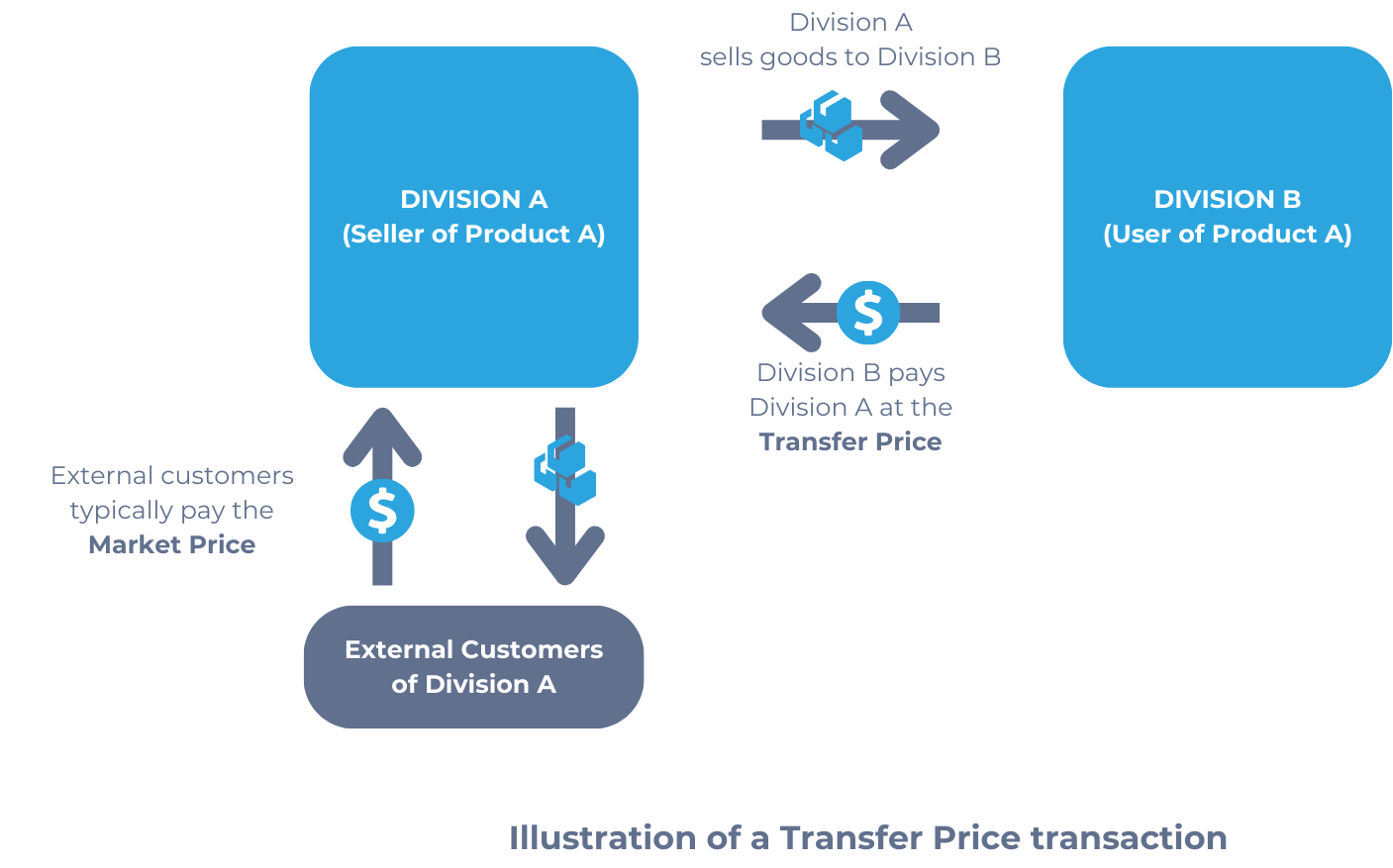
Consider a manufacturing company with two divisions: Division A produces a component (Product A) that is used by Division B in assembling the final product. Division A has two choices: it can sell the component to external customers at the market price, or it can transfer the component internally to Division B at an agreed transfer price.

Illustration of a transfer price transaction

The transfer price directly affects how each division’s performance is measured. If the transfer price is set too low, Division A may appear less profitable even though it is efficient, while Division B will benefit from lower input costs. If the transfer price is set too high, Division B may appear unprofitable despite creating value for the company as a whole.

This illustrates why transfer pricing is important: it ensures that intercompany transactions reflect economic reality, so divisional results are measured fairly and company-wide decisions are made on reliable information.

The objectives of transfer pricing are as follows:

  • Accurate performance evaluation: To ensure that the performance of individual units or divisions is evaluated fairly by assigning an appropriate value to the goods or services they exchange.
  • Fair cost allocation: To allocate costs appropriately among different units, enabling better transparency and accountability within the organization.
  • Tax compliance: To meet regulatory requirements and ensure compliance with tax laws and transfer pricing guidelines in various jurisdictions.
  • Financial reporting accuracy: To produce financial reports that accurately reflect the financial performance of each division and the organization as a whole.
  • Support strategic decision-making: To enable the organization to make informed decisions regarding resource allocation, pricing strategies, and investment opportunities.

Methods of determining transfer prices

1. Cost-based pricing methods

1.1. Variable cost price

The variable cost method sets the transfer price equal to the variable costs incurred to produce a good or service. This approach ensures that the receiving division is not burdened with fixed costs and reflects the true incremental cost of production.

Transfer Price=Variable Cost per Unit

It is simple to calculate, encourages marginal cost decision-making, and ensures transparency in cost control. When using this method, it is generally advisable to base the transfer price on standard variable costs. This approach ensures that any inefficiencies in the production process remain with the supplying division and are not unfairly transferred to the buying division. By isolating inefficiencies, the buying division can better focus on its own operations without being impacted by cost overruns from the supplying division.

Disadvantages:

  • Does not cover fixed costs, potentially leading to under-recovery for the supplying division.
  • Discourages long-term profitability analysis.
  • May lead to disputes if fixed costs are significant for overall operations.

1.2. Full cost price

The full cost method incorporates both variable and fixed costs into the transfer price. This approach ensures that all production costs are covered, making it particularly useful for long-term planning and profitability analysis.

Transfer Price=Variable Cost per Unit+Fixed Cost Allocation per Unit

Full cost pricing provides a comprehensive view of production expenses and promotes fairness in cost recovery for the supplying division. When using this method, it is generally advisable to base the transfer price on standard costs. This approach ensures that any inefficiencies in the production process remain with the supplying division and are not unfairly transferred to the buying division. By isolating inefficiencies, the buying division can better focus on its own operations without being impacted by cost overruns from the supplying division.

Disadvantages:

  • Subjective allocation of fixed costs can cause disputes.
  • Higher transfer prices may reduce competitiveness for the receiving division.
  • Discourages marginal decision-making.

1.3. Cost-plus price

The cost-plus method adds a predetermined markup to the production cost, which can be based on variable or full costs.

Transfer Price = Cost per Unit (Variable or Full) + Markup

This approach encourages profitability for the supplying division while reflecting fair value for internal transactions. Cost-plus pricing is flexible and widely used across different industries to ensure cost recovery and incentivize internal suppliers.

Disadvantages:

  • Subjectivity in determining the markup can lead to inconsistencies.
  • May inflate transfer prices, reducing the receiving division’s profitability.

2. Market price method

The market price method sets the transfer price based on the price at which the goods or services could be sold externally. If no external demand exists, the price of a similar product in the market can be used.

Transfer Price = Market Price (or Adjusted Market Price)

Adjustments can be made for cost savings, such as reduced selling expenses, when transactions occur internally. This method encourages market-based decision-making, reduces internal disputes, and provides a clear benchmark for divisional performance.

Disadvantages:

  • Not feasible if no external market or comparable product exists.
  • Adjustments to market price may introduce subjectivity.
  • High transfer prices can reduce the competitiveness of the receiving division.

3. Negotiated price method

The negotiated price method allows divisions to negotiate a mutually agreed transfer price.

Transfer Price = Agreed Price between Divisions

This method fosters collaboration and ensures both divisions’ goals are considered, providing flexibility to adapt to unique circumstances. It reflects economic realities and avoids rigid pricing structures, making it suitable for organizations with diverse operational priorities.

Disadvantages:

  • Time-consuming and prone to conflicts during negotiations.
  • May lead to imbalances if one division has more negotiating power.
  • Requires strong managerial oversight to prevent disputes.

4. Dual pricing method

The dual pricing method involves recording different transfer prices for the selling and receiving divisions. For instance, the selling division may record the transfer at the market price, ensuring it recovers its full costs, while the receiving division records it at variable cost, reflecting cost savings from internal transactions.

Selling Division Price = Market Price

Receiving Division Price = Full Cost Price

This method reduces internal disputes and promotes divisional harmony. However, it may complicate tax compliance and distort consolidated financial statements. An example of a dual pricing method for each division would be: It’s important to note that the policies governing this approach are determined by the organization. The dual-pricing method simply involves using two different prices for the same transaction: one for the selling division and another for the buying division.

Disadvantages:

  • It can be more complex to implement and reconcile.
  • Raises potential tax compliance issues, especially in multinational operations.
  • May misrepresent overall organizational performance in financial reporting.

Objectives of transfer pricing

  • Assigns value to intercompany transactions for fair divisional performance evaluation
  • Ensures accurate cost allocation, tax compliance, and financial reporting
  • Supports strategic decision-making on resource allocation and pricing

Cost-based pricing methods

  • Variable cost price:
    • Transfer price = variable cost per unit (preferably standard variable cost)
    • Simple, transparent; does not cover fixed costs
  • Full cost price:
    • Transfer price = variable cost + fixed cost allocation per unit (preferably standard costs)
    • Covers all costs; subjective fixed cost allocation
  • Cost-plus price:
    • Transfer price = cost per unit (variable or full) + markup
    • Ensures supplier profitability; markup subjectivity

Market price method

  • Transfer price set at external market price (or adjusted market price)
  • Encourages market-based decisions; not feasible without external market

Negotiated price method

  • Transfer price determined by agreement between divisions
  • Flexible, considers both divisions’ interests; time-consuming, potential for conflict

Dual pricing method

  • Different transfer prices for selling (market price) and receiving (full cost price) divisions
  • Reduces disputes, promotes harmony; complex, potential tax/reporting issues

Sign up for free to take 10 quiz questions on this topic

Previous
Next  | 3.2.4.2 Transfer pricing and business issues
All rights reserved ©2016 - 2026 Achievable, Inc.

Transfer pricing objectives and methods

Learning outcome statements

The learning outcome statements relevant for this section are:

  1. define transfer pricing and identify the objectives of transfer pricing
  2. identify the methods for determining transfer prices, and list and explain the advantages and disadvantages of each method
  3. calculate transfer prices using variable cost, full cost, market price, negotiated price, and dual-rate pricing
  4. explain how transfer pricing is affected by business issues, such as the presence of outside suppliers and the opportunity costs associated with capacity usage
  5. describe how special issues such as tariffs, exchange rates, taxes, currency restrictions, expropriation risk, and the availability of materials and skills affect performance evaluation in multinational companies

Objectives of transfer pricing

Definitions
Transfer pricing (TP)
The practice of determining the value of goods, services, or intangible assets transferred between different units or divisions within the same organization.

Transfer pricing establishes an internal price for transactions occurring between related entities, such as a parent company and its subsidiaries or between divisions of the same company. Effective transfer pricing ensures accurate representation of the economic value of intercompany transactions.

Consider a manufacturing company with two divisions: Division A produces a component (Product A) that is used by Division B in assembling the final product. Division A has two choices: it can sell the component to external customers at the market price, or it can transfer the component internally to Division B at an agreed transfer price.

The transfer price directly affects how each division’s performance is measured. If the transfer price is set too low, Division A may appear less profitable even though it is efficient, while Division B will benefit from lower input costs. If the transfer price is set too high, Division B may appear unprofitable despite creating value for the company as a whole.

This illustrates why transfer pricing is important: it ensures that intercompany transactions reflect economic reality, so divisional results are measured fairly and company-wide decisions are made on reliable information.

The objectives of transfer pricing are as follows:

  • Accurate performance evaluation: To ensure that the performance of individual units or divisions is evaluated fairly by assigning an appropriate value to the goods or services they exchange.
  • Fair cost allocation: To allocate costs appropriately among different units, enabling better transparency and accountability within the organization.
  • Tax compliance: To meet regulatory requirements and ensure compliance with tax laws and transfer pricing guidelines in various jurisdictions.
  • Financial reporting accuracy: To produce financial reports that accurately reflect the financial performance of each division and the organization as a whole.
  • Support strategic decision-making: To enable the organization to make informed decisions regarding resource allocation, pricing strategies, and investment opportunities.

Methods of determining transfer prices

1. Cost-based pricing methods

1.1. Variable cost price

The variable cost method sets the transfer price equal to the variable costs incurred to produce a good or service. This approach ensures that the receiving division is not burdened with fixed costs and reflects the true incremental cost of production.

Transfer Price=Variable Cost per Unit

It is simple to calculate, encourages marginal cost decision-making, and ensures transparency in cost control. When using this method, it is generally advisable to base the transfer price on standard variable costs. This approach ensures that any inefficiencies in the production process remain with the supplying division and are not unfairly transferred to the buying division. By isolating inefficiencies, the buying division can better focus on its own operations without being impacted by cost overruns from the supplying division.

Disadvantages:

  • Does not cover fixed costs, potentially leading to under-recovery for the supplying division.
  • Discourages long-term profitability analysis.
  • May lead to disputes if fixed costs are significant for overall operations.

1.2. Full cost price

The full cost method incorporates both variable and fixed costs into the transfer price. This approach ensures that all production costs are covered, making it particularly useful for long-term planning and profitability analysis.

Transfer Price=Variable Cost per Unit+Fixed Cost Allocation per Unit

Full cost pricing provides a comprehensive view of production expenses and promotes fairness in cost recovery for the supplying division. When using this method, it is generally advisable to base the transfer price on standard costs. This approach ensures that any inefficiencies in the production process remain with the supplying division and are not unfairly transferred to the buying division. By isolating inefficiencies, the buying division can better focus on its own operations without being impacted by cost overruns from the supplying division.

Disadvantages:

  • Subjective allocation of fixed costs can cause disputes.
  • Higher transfer prices may reduce competitiveness for the receiving division.
  • Discourages marginal decision-making.

1.3. Cost-plus price

The cost-plus method adds a predetermined markup to the production cost, which can be based on variable or full costs.

Transfer Price = Cost per Unit (Variable or Full) + Markup

This approach encourages profitability for the supplying division while reflecting fair value for internal transactions. Cost-plus pricing is flexible and widely used across different industries to ensure cost recovery and incentivize internal suppliers.

Disadvantages:

  • Subjectivity in determining the markup can lead to inconsistencies.
  • May inflate transfer prices, reducing the receiving division’s profitability.

2. Market price method

The market price method sets the transfer price based on the price at which the goods or services could be sold externally. If no external demand exists, the price of a similar product in the market can be used.

Transfer Price = Market Price (or Adjusted Market Price)

Adjustments can be made for cost savings, such as reduced selling expenses, when transactions occur internally. This method encourages market-based decision-making, reduces internal disputes, and provides a clear benchmark for divisional performance.

Disadvantages:

  • Not feasible if no external market or comparable product exists.
  • Adjustments to market price may introduce subjectivity.
  • High transfer prices can reduce the competitiveness of the receiving division.

3. Negotiated price method

The negotiated price method allows divisions to negotiate a mutually agreed transfer price.

Transfer Price = Agreed Price between Divisions

This method fosters collaboration and ensures both divisions’ goals are considered, providing flexibility to adapt to unique circumstances. It reflects economic realities and avoids rigid pricing structures, making it suitable for organizations with diverse operational priorities.

Disadvantages:

  • Time-consuming and prone to conflicts during negotiations.
  • May lead to imbalances if one division has more negotiating power.
  • Requires strong managerial oversight to prevent disputes.

4. Dual pricing method

The dual pricing method involves recording different transfer prices for the selling and receiving divisions. For instance, the selling division may record the transfer at the market price, ensuring it recovers its full costs, while the receiving division records it at variable cost, reflecting cost savings from internal transactions.

Selling Division Price = Market Price

Receiving Division Price = Full Cost Price

This method reduces internal disputes and promotes divisional harmony. However, it may complicate tax compliance and distort consolidated financial statements. An example of a dual pricing method for each division would be: It’s important to note that the policies governing this approach are determined by the organization. The dual-pricing method simply involves using two different prices for the same transaction: one for the selling division and another for the buying division.

Disadvantages:

  • It can be more complex to implement and reconcile.
  • Raises potential tax compliance issues, especially in multinational operations.
  • May misrepresent overall organizational performance in financial reporting.
Key points

Objectives of transfer pricing

  • Assigns value to intercompany transactions for fair divisional performance evaluation
  • Ensures accurate cost allocation, tax compliance, and financial reporting
  • Supports strategic decision-making on resource allocation and pricing

Cost-based pricing methods

  • Variable cost price:
    • Transfer price = variable cost per unit (preferably standard variable cost)
    • Simple, transparent; does not cover fixed costs
  • Full cost price:
    • Transfer price = variable cost + fixed cost allocation per unit (preferably standard costs)
    • Covers all costs; subjective fixed cost allocation
  • Cost-plus price:
    • Transfer price = cost per unit (variable or full) + markup
    • Ensures supplier profitability; markup subjectivity

Market price method

  • Transfer price set at external market price (or adjusted market price)
  • Encourages market-based decisions; not feasible without external market

Negotiated price method

  • Transfer price determined by agreement between divisions
  • Flexible, considers both divisions’ interests; time-consuming, potential for conflict

Dual pricing method

  • Different transfer prices for selling (market price) and receiving (full cost price) divisions
  • Reduces disputes, promotes harmony; complex, potential tax/reporting issues

More from Transfer pricing

  • Transfer pricing and business issues