


Achievable logoAchievable logo
CMA Part 1
Sign in
Sign up
Purchase
Textbook
Practice exams
Support
How it works
Exam catalog
Mountain with a flag at the peak
Textbook
1. External financial reporting decisions
2. Planning, budgeting, and forecasting
3. Performance management
4. Cost management
5. Internal control
6. Technology and analytics
Achievable logoAchievable logo
1.2.8.2 Income taxes and interperiod tax allocations
Achievable CMA Part 1
1. External financial reporting decisions
1.2. Financial transactions
1.2.8. Income taxes
Our CMA Part 1 course is currently in development and is a work-in-progress.

Income taxes and interperiod tax allocations

7 min read
Font
Discuss
Share
Feedback

Interperiod tax allocations simply means the allocation of income tax expense to the correct period through the accounting of current income taxes and deferred taxes . Income taxes are the amounts due to the tax authorities associated with the company’s income.

They can either be due in the current period (i.e., current income tax) or in a future period (i.e., deferred tax).

Definitions
Current income tax
Pertains to income taxes that are due to be paid to the tax authorities (or refunded to the company) in the current period.

This income tax is based on the company’s taxable income computed using the tax rate enacted as of the balance sheet date. (IFRS also permits a substantively enacted rate; under US GAAP, ASC 740 requires the rate to be enacted.)

Deferred income tax
Pertains to income taxes that will be due in the future.

Deferred taxes arise from temporary differences between the carrying amounts of assets and liabilities for financial reporting purposes and the amounts used for tax purposes (their tax bases). Deferred tax items exist only in the accounting books and are not actually due to the tax authorities until future periods.

Tax reconciliation

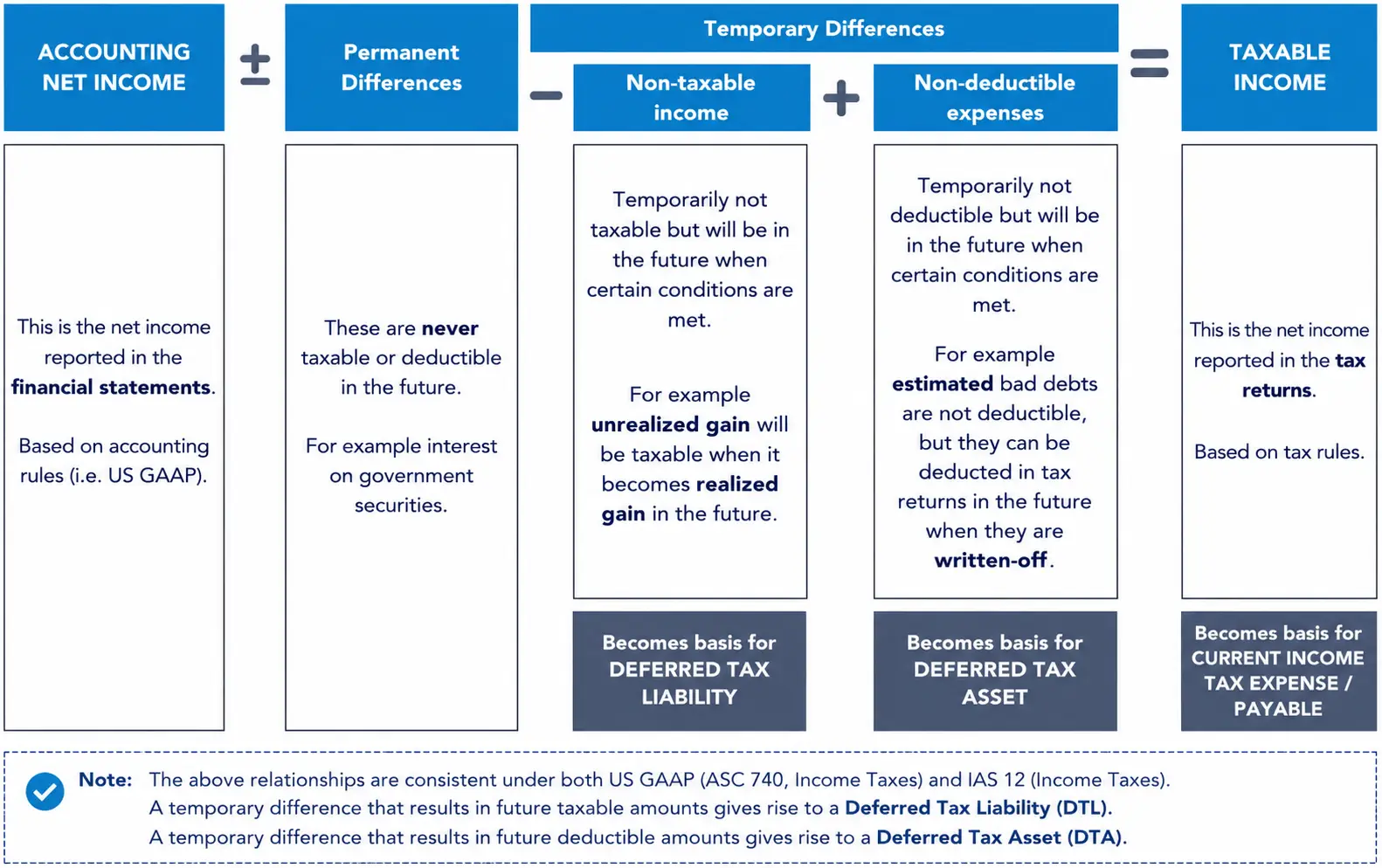
To understand the concepts of income tax better, it is best to be familiar with the two types of income and how they reconcile to each other.

Reconciling accounting net income to taxable income through permanent and temporary differences.
Tax Reconciliation Summary

Note 1: Permanent differences

These are income and expenses that will never be taxable or deductible under income tax rules - for example, tax-exempt income or nondeductible expenses. Since they never affect taxable income, no deferred tax is recognized on them.

Note 2: Temporary differences

These are income and expenses that are taxable or deductible only in the future. To compute the taxable income, we need to remove these items from the accounting income because they are not yet taxable or deductible. These are called “temporary differences” because when certain conditions are finally met, they can form part of the taxable income in a future time. Finally, taxable temporary differences become the basis for the deferred tax accounting. These are discussed in more detail in succeeding sections.

Note 3: Taxable temporary differences

These are temporary differences that will increase taxable income in a future period - for example, when tax depreciation is claimed faster than book depreciation. Taxable temporary differences become the basis for a deferred tax liability.

Note 4: Deductible temporary differences

These are temporary differences that will decrease taxable income in a future period - for example, an expense accrued for book purposes but not deductible until it’s paid. Deductible temporary differences become the basis for a deferred tax asset.

Deferred income taxes - introduction and journal entries

These arise from temporary differences between the carrying amounts of assets and liabilities for financial reporting purposes and their tax bases. These differences can lead to either deferred tax liabilities or deferred tax assets, depending on their nature. This concept aligns with the accrual basis of accounting, where income taxes are recognized in the period the related transaction affects the income statement, regardless of when the tax payment is due.

For instance, if a transaction is recognized in the current period’s income statement but is taxable in a future period, the associated tax effect is already accrued in the current period even though we are not expected to pay the taxes in right now. This approach ensures that the financial statements accurately reflect the company’s tax obligations corresponding to its reported earnings.

For example, say accounting income is $500,000, taxed at an enacted rate of 21%. It includes $20,000 of tax-exempt interest (a permanent difference) and $50,000 of excess tax depreciation (a taxable temporary difference reversing later). Taxable income is:

$500,000−$20,000−$50,000=$430,000

Current tax expense is $430,000×21%=$90,300. Since the $50,000 difference will increase taxable income later, it also creates a deferred tax liability of $50,000×21%=$10,500. The journal entry to record the deferred portion is:

Account Debit Credit Financial statement element
Deferred tax expense $10,500 Expense
Deferred tax liability $10,500 Liability
To record deferred tax liability from a $50,000 taxable temporary difference (excess tax depreciation)

The deferred tax liability represents future income tax payable. The logic reverses for deductible temporary differences: say the company also accrues a $30,000 warranty expense for book purposes that isn’t deductible until paid. This creates a deferred tax asset of $30,000×21%=$6,300:

Account Debit Credit Financial statement element
Deferred tax asset $6,300 Asset
Deferred tax expense $6,300 Expense
To record deferred tax asset from a $30,000 deductible temporary difference (warranty accrual)

The deferred tax asset represents future deductible amounts.

In the next section on temporary differences, we’ll cover specific sources and examples of deferred tax items.

Temporary differences

Temporary differences are income or expenses that are not recognized at the same time in the accounting income and taxable income. This is the reason why these are also called timing differences.

Whenever there are timing differences, it means that the current income tax (based on the taxable income) is incomplete because we also need to accrue the tax impacts of the temporary differences.

Accounting for temporary differences can either result in:

  • deferred tax liability; or
  • deferred tax asset.

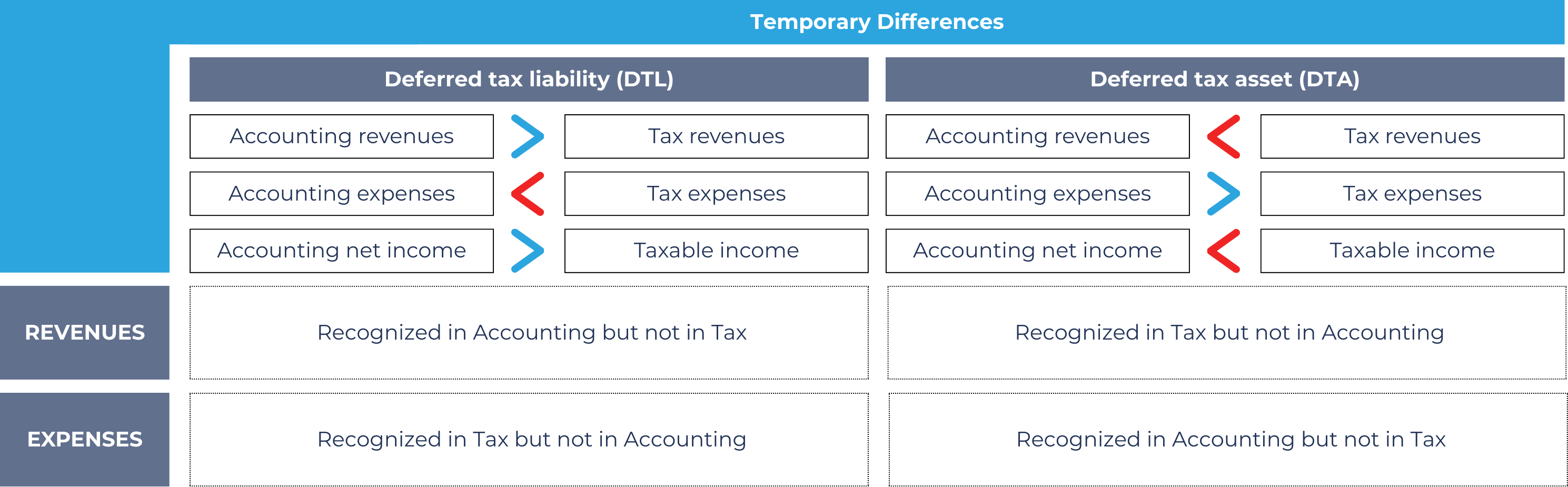
Determining whether a temporary difference gives rise to a deferred tax liability (DTL) or a deferred tax asset (DTA) often comes down to comparing accounting income with taxable income. In simple terms, it is a matter of identifying whether revenues, expenses, or net income are reported earlier or later in the accounting records than in the tax return.

Common pitfall: A permanent difference (like tax-exempt interest) never reverses and never creates deferred tax. A temporary difference always creates deferred tax, and the direction depends on timing:

  • Taxable later (book recognizes income, or a tax deduction, before the tax return does) → deferred tax liability.
  • Deductible later (book recognizes an expense before the tax return allows the deduction) → deferred tax asset.

The concept can be summarized in the following illustration:

Summary of deferred tax assessment

Under ASC 740, deferred tax assets and liabilities are always classified as noncurrent, regardless of when the temporary difference reverses. Within each tax jurisdiction, they’re offset and presented as a single net noncurrent amount; amounts from different jurisdictions aren’t netted together.

Interperiod tax allocations

  • Allocates income tax expense to correct period
  • Involves current income taxes and deferred taxes
  • Income taxes: amounts due to tax authorities on company income

Current vs. deferred income tax

  • Current income tax: due/paid in current period, based on taxable income and current tax rate
  • Deferred income tax: due in future periods, arises from temporary differences between accounting and tax bases

Tax reconciliation

  • Reconciles accounting income and taxable income
  • Permanent differences: never taxable/deductible, no deferred tax recognized
  • Temporary differences: taxable/deductible in future, basis for deferred tax accounting
    • Non-taxable income (temporary): basis for deferred tax liability
    • Non-deductible expenses (temporary): basis for deferred tax asset

Deferred income taxes: introduction and journal entries

  • Result from temporary differences (timing differences)
  • Aligns with accrual accounting: recognize tax effects in period of related income/expense
  • Journal entries:
    • Deferred tax liability: Debit deferred tax expense, Credit deferred tax liability
    • Deferred tax asset: Debit deferred tax asset, Credit deferred tax expense
  • Deferred tax liability: future income tax payable
  • Deferred tax asset: future deductible amounts

Temporary differences

  • Income/expenses recognized at different times for accounting vs. tax
  • Cause timing differences between accounting and taxable income
  • Lead to:
    • Deferred tax liability (DTL): taxable temporary differences
    • Deferred tax asset (DTA): deductible temporary differences
  • Determined by comparing timing of revenue/expense recognition in accounting vs. tax returns

Sign up for free to take 10 quiz questions on this topic

Previous
Next  | 1.2.8.3 Deferred tax liabilities
All rights reserved ©2016 - 2026 Achievable, Inc.

Income taxes and interperiod tax allocations

Interperiod tax allocations simply means the allocation of income tax expense to the correct period through the accounting of current income taxes and deferred taxes . Income taxes are the amounts due to the tax authorities associated with the company’s income.

They can either be due in the current period (i.e., current income tax) or in a future period (i.e., deferred tax).

Definitions
Current income tax
Pertains to income taxes that are due to be paid to the tax authorities (or refunded to the company) in the current period.

This income tax is based on the company’s taxable income computed using the tax rate enacted as of the balance sheet date. (IFRS also permits a substantively enacted rate; under US GAAP, ASC 740 requires the rate to be enacted.)

Deferred income tax
Pertains to income taxes that will be due in the future.

Deferred taxes arise from temporary differences between the carrying amounts of assets and liabilities for financial reporting purposes and the amounts used for tax purposes (their tax bases). Deferred tax items exist only in the accounting books and are not actually due to the tax authorities until future periods.

Tax reconciliation

To understand the concepts of income tax better, it is best to be familiar with the two types of income and how they reconcile to each other.

Note 1: Permanent differences

These are income and expenses that will never be taxable or deductible under income tax rules - for example, tax-exempt income or nondeductible expenses. Since they never affect taxable income, no deferred tax is recognized on them.

Note 2: Temporary differences

These are income and expenses that are taxable or deductible only in the future. To compute the taxable income, we need to remove these items from the accounting income because they are not yet taxable or deductible. These are called “temporary differences” because when certain conditions are finally met, they can form part of the taxable income in a future time. Finally, taxable temporary differences become the basis for the deferred tax accounting. These are discussed in more detail in succeeding sections.

Note 3: Taxable temporary differences

These are temporary differences that will increase taxable income in a future period - for example, when tax depreciation is claimed faster than book depreciation. Taxable temporary differences become the basis for a deferred tax liability.

Note 4: Deductible temporary differences

These are temporary differences that will decrease taxable income in a future period - for example, an expense accrued for book purposes but not deductible until it’s paid. Deductible temporary differences become the basis for a deferred tax asset.

Deferred income taxes - introduction and journal entries

These arise from temporary differences between the carrying amounts of assets and liabilities for financial reporting purposes and their tax bases. These differences can lead to either deferred tax liabilities or deferred tax assets, depending on their nature. This concept aligns with the accrual basis of accounting, where income taxes are recognized in the period the related transaction affects the income statement, regardless of when the tax payment is due.

For instance, if a transaction is recognized in the current period’s income statement but is taxable in a future period, the associated tax effect is already accrued in the current period even though we are not expected to pay the taxes in right now. This approach ensures that the financial statements accurately reflect the company’s tax obligations corresponding to its reported earnings.

For example, say accounting income is $500,000, taxed at an enacted rate of 21%. It includes $20,000 of tax-exempt interest (a permanent difference) and $50,000 of excess tax depreciation (a taxable temporary difference reversing later). Taxable income is:

$500,000−$20,000−$50,000=$430,000

Current tax expense is $430,000×21%=$90,300. Since the $50,000 difference will increase taxable income later, it also creates a deferred tax liability of $50,000×21%=$10,500. The journal entry to record the deferred portion is:

Account Debit Credit Financial statement element
Deferred tax expense $10,500 Expense
Deferred tax liability $10,500 Liability
To record deferred tax liability from a $50,000 taxable temporary difference (excess tax depreciation)

The deferred tax liability represents future income tax payable. The logic reverses for deductible temporary differences: say the company also accrues a $30,000 warranty expense for book purposes that isn’t deductible until paid. This creates a deferred tax asset of $30,000×21%=$6,300:

Account Debit Credit Financial statement element
Deferred tax asset $6,300 Asset
Deferred tax expense $6,300 Expense
To record deferred tax asset from a $30,000 deductible temporary difference (warranty accrual)

The deferred tax asset represents future deductible amounts.

In the next section on temporary differences, we’ll cover specific sources and examples of deferred tax items.

Temporary differences

Temporary differences are income or expenses that are not recognized at the same time in the accounting income and taxable income. This is the reason why these are also called timing differences.

Whenever there are timing differences, it means that the current income tax (based on the taxable income) is incomplete because we also need to accrue the tax impacts of the temporary differences.

Accounting for temporary differences can either result in:

  • deferred tax liability; or
  • deferred tax asset.

Determining whether a temporary difference gives rise to a deferred tax liability (DTL) or a deferred tax asset (DTA) often comes down to comparing accounting income with taxable income. In simple terms, it is a matter of identifying whether revenues, expenses, or net income are reported earlier or later in the accounting records than in the tax return.

Common pitfall: A permanent difference (like tax-exempt interest) never reverses and never creates deferred tax. A temporary difference always creates deferred tax, and the direction depends on timing:

  • Taxable later (book recognizes income, or a tax deduction, before the tax return does) → deferred tax liability.
  • Deductible later (book recognizes an expense before the tax return allows the deduction) → deferred tax asset.

The concept can be summarized in the following illustration:

Under ASC 740, deferred tax assets and liabilities are always classified as noncurrent, regardless of when the temporary difference reverses. Within each tax jurisdiction, they’re offset and presented as a single net noncurrent amount; amounts from different jurisdictions aren’t netted together.

Key points

Interperiod tax allocations

  • Allocates income tax expense to correct period
  • Involves current income taxes and deferred taxes
  • Income taxes: amounts due to tax authorities on company income

Current vs. deferred income tax

  • Current income tax: due/paid in current period, based on taxable income and current tax rate
  • Deferred income tax: due in future periods, arises from temporary differences between accounting and tax bases

Tax reconciliation

  • Reconciles accounting income and taxable income
  • Permanent differences: never taxable/deductible, no deferred tax recognized
  • Temporary differences: taxable/deductible in future, basis for deferred tax accounting
    • Non-taxable income (temporary): basis for deferred tax liability
    • Non-deductible expenses (temporary): basis for deferred tax asset

Deferred income taxes: introduction and journal entries

  • Result from temporary differences (timing differences)
  • Aligns with accrual accounting: recognize tax effects in period of related income/expense
  • Journal entries:
    • Deferred tax liability: Debit deferred tax expense, Credit deferred tax liability
    • Deferred tax asset: Debit deferred tax asset, Credit deferred tax expense
  • Deferred tax liability: future income tax payable
  • Deferred tax asset: future deductible amounts

Temporary differences

  • Income/expenses recognized at different times for accounting vs. tax
  • Cause timing differences between accounting and taxable income
  • Lead to:
    • Deferred tax liability (DTL): taxable temporary differences
    • Deferred tax asset (DTA): deductible temporary differences
  • Determined by comparing timing of revenue/expense recognition in accounting vs. tax returns

More from Income taxes

  • Learning outcomes
  • Deferred tax liabilities
  • Deferred tax assets
  • Permanent differences
  • Other topics