



Initial recognition of accounts receivables
Introduction
The learning outcome statements related to accounts receivables are covered across three separate chapters in this textbook:
- Recognition of accounts receivable - covers how an accounts receivable is initially recorded when a sale has been made
- Allowance for credit losses - covers subsequent valuation, specifically to recognize the impacts of potential uncollectible accounts; and
- Factoring of accounts receivables - covers the accounting impacts of selling a company’s accounts receivables to another company.
There are other types of receivables defined in ASC 310 such as those arising from loans or other transactions. For purposes of the exam, only those arising from credit sales are relevant.
An accounts receivable is an asset because there is an expectation of future benefit from the receivable, representing the future inflows of cash. An accounts receivable is typically classified as a short-term asset because it is expected to be collected within the company’s operating cycle.
As with all types of balance sheet elements, we should learn how to record accounts receivable at initial recognition and also determine the requirements for subsequent measurement for when we are preparing the financial statements.
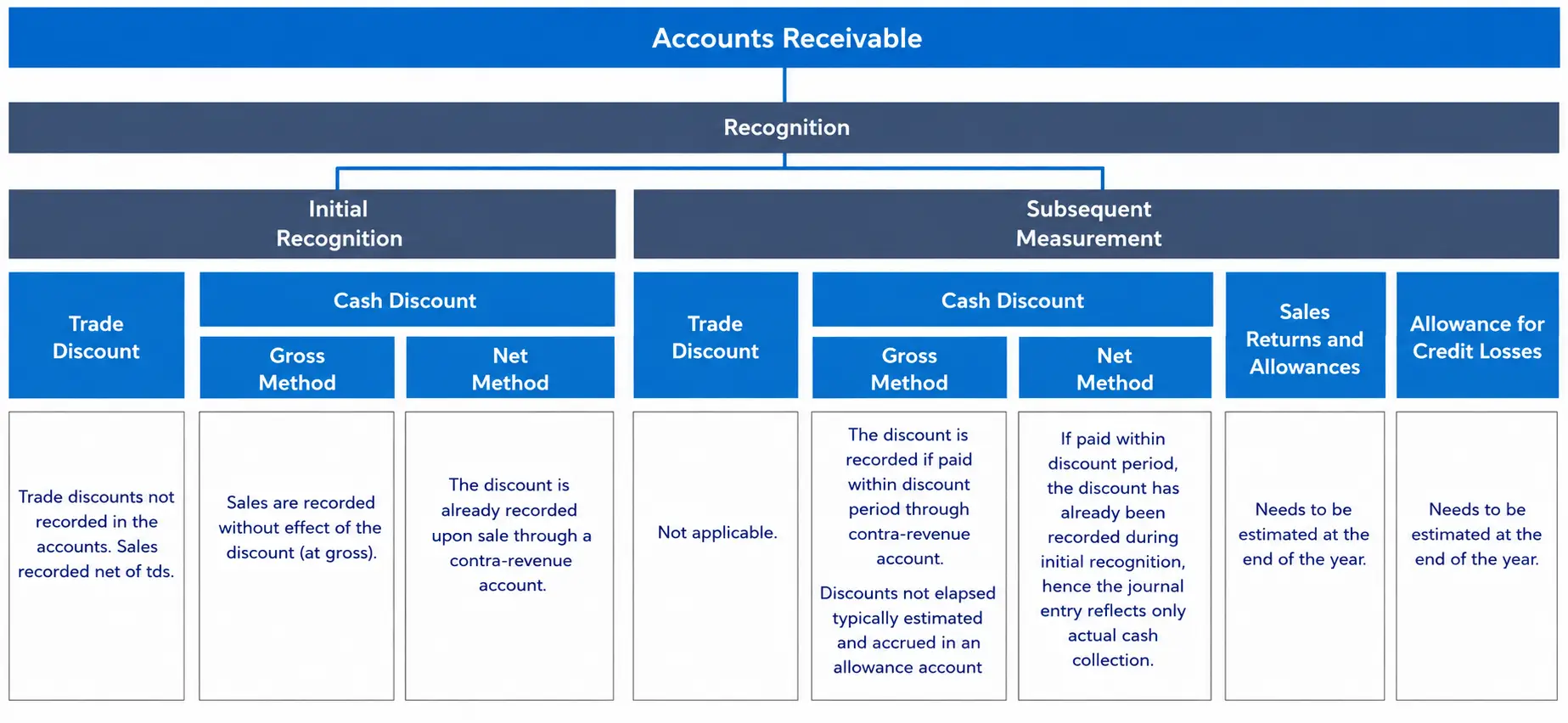
The following figures shows the concept map of this topic to guide you through the texts.
Initial recognition of accounts receivables
The initial recognition of an accounts receivable means how a company should account for an account receivable when a credit sale transaction has been made. For this purpose, it is important to know the definition of the transaction price.
It should be noted that because of certain features of the sales transaction, the transaction price is not always the amount of accounts receivable in the balance sheet of the company. This is because GAAP requires companies to record accounts receivables at the net amount expected to be received from the customer and not simply the face value of the transaction price. Under ASC 606, an expected discount reduces the transaction price as a form of variable consideration, which is why revenue and the related receivable are recorded net of anticipated discounts.
Under initial recognition, the main item relevant for the CMA exam, related to the net amount recognition for accounts receivables, is the presence of discounts. There are generally two types of discounts: (a) trade discounts; and (b) cash discount.
Trade discounts
Trade discounts are offered by the seller as a reduction of the list price of goods or services typically provided for large orders, special offerings, or to business partners.
The accounting for trade discounts is simple because they are not recorded in the books. The journal entry to record a sales transaction where a trade discount was provided records the accounts receivable and the revenue at net of the trade discount.
Note that for purposes of the illustration, we will not show the journal entry for the cost of goods sold. The journal entry for initial recognition of the accounts receivable is shown below:
| Account | Debit | Credit |
| Accounts receivable | $200,000 | |
| Sales | $200,000 | |
| To record sales with Wholesale Company on April 1. Trade discount of 20% applied. | ||
Cash discounts
Cash discounts can also be called prompt payment discounts because their nature is to incentivize the customer for paying the accounts receivable earlier than the due date. This is typically included in the invoice that is provided to the customer with the following format:
The discounter terms of the above can be interpreted as follows:
- the first portion (“2/15”) of the above terms relates to the cash discount
- the second section (“n/30”) relates to the due date of the invoice
The above terms mean that if the payment is made within 15 days, a 2% discount is provided on the transaction price and that the whole amount is due 30 days from the invoice date.
As a consequence, if the payment is made beyond 15 days but still within the 30 days of full term, the full transaction price is due. In contrast, if the 30 days of term has elapsed and the customer has failed to make a payment, the accounts receivable is considered as past due. The term past due will be relevant in the discussion about the allowance for doubtful accounts.
In practice, the cash discounts can be in different combinations of percentages, discount periods, and due dates depending on the policy of the companies providing them. There are two ways of accounting for cash or prompt payment discounts:
- the gross method; and
- the net method
Initial recognition of cash discount: gross method
The gross method is the one that is used more frequently in practice. This method initially records the accounts receivable at the gross amount without initial accounting for future cash discounts that the customer will take. This provides for simpler accounting for when the customer does not take advantage of the discount period because the amount initially recorded as a receivable is the same amount collected. Sample journal entries illustrating the gross method follow:
Journal entry upon sale
| Account | Debit | Credit | Financial statement element |
| Accounts receivable | $10,000 | Asset | |
| Sales | $10,000 | Revenue | |
| To record sales of $10,000 with term 2/15, n/30 | |||
At initial recognition, the discount is ignored when using the gross method
Journal entry upon payment beyond the discount period
| Account | Debit | Credit | Financial statement element |
| Cash | $10,000 | Asset | |
| Accounts receivable | $10,000 | Asset | |
| To record the receipt of cash beyond the discount period | |||
The journal entry below shows an alternate journal entry if the customer decided to take advantage of the discount.
Journal entry upon payment within the discount period
| Account | Debit | Credit | Financial statement element |
| Cash | $9,800 | Asset | |
| Cash discounts allowed | $200 | Revenue (contra account) | |
| Accounts receivable | $10,000 | Asset | |
| To record the receipt of cash within the discount period | |||
The whole balance of the accounts receivable from the transaction is removed from the balance sheet upon payment while the cash is increased only by the actual amount received. The difference is recorded in the P&L.
From the above, since the discount was initially ignored, the journal entry for cash receipt should account for the discount in a way that reduces the sales previously recorded. This is the reason why the “cash discounts allowed” account is recorded as a contra-revenue account.
A less-common allowance variation of the gross method exists, but it isn’t tested beyond computing the amount of discount allowed or forfeited in a transaction.
Initial recognition of cash discount: net method
The net method is not commonly used in practice because it requires a lot of maintenance and monitoring for each individual sales transaction. This method allows companies to record both the accounts receivable and sales at the net amount and is used when customers typically take the discounts. The initial accounting is the same as how the trade discounts are recorded.
Journal entry upon sale
| Account | Debit | Credit | Financial statement element |
| Accounts receivable | $9,800 | Asset | |
| Sales | $9,800 | Revenue | |
| To record sales of $10,000 with term 2/15, n/30 | |||
At initial recognition, the discount is already considered when using the net method
Notice that under the net method, the accounts receivable and sales are both recorded at net and there is no separate account used for the discount applied. This is similar to accounting for trade discounts.
Journal entry upon payment beyond the discount period
| Account | Debit | Credit | Financial statement element |
| Cash | $10,000 | Asset | |
| Discounts forfeited | $200 | Other income | |
| Accounts receivable | $9,800 | Asset | |
| To record the receipt of cash beyond the discount period | |||
The accounts receivable credited in the journal entry is the same net amount initially recorded, otherwise you will have a credit balance in the accounts receivable account. This results to a more tedious tracking requirement in practice, compared to the gross method, especially if there is a history of customers not taking advantage of the discount.
The above shows the accounting if the customer does not take advantage of the discount under the net method. Notice that the company collected the full amount of the transaction price ($10,000) in cash. The difference between the net amount and the transaction price ($10,000 − $9,800 = $200) is recorded in a “discounts forfeited” account, which is classified as other income (similar to interest revenue) rather than sales revenue. It increases other income in the income statement, while the net sales figure recorded at initial recognition stays unchanged.
The journal entry below shows an alternate journal entry if the customer decided to take advantage of the discount.
Journal entry upon payment within the discount period
| Account | Debit | Credit | Financial statement element |
| Cash | $9,800 | Asset | |
| Accounts receivable | $9,800 | Asset | |
| To record the receipt of cash within the discount period | |||