


This browser is too old to run Achievable.

Update it, or open this page in a current version of Chrome, Safari, Firefox or Edge. On an iPhone or iPad, update iOS: every browser there runs on the version of Safari that comes with it.

Achievable logoAchievable logo
CMA Part 1
Sign in
Sign up
Purchase
Textbook
Practice exams
Support
How it works
Resources
Exam catalog
Mountain with a flag at the peak
Textbook
Introduction
1. External financial reporting decisions
2. Planning, budgeting, and forecasting
3. Performance management
4. Cost management
5. Internal control
6. Technology and analytics
Wrapping up
Achievable logoAchievable logo
1.2.1.2 Initial recognition of accounts receivables
Achievable CMA Part 1
1. External financial reporting decisions
1.2. Financial transactions
1.2.1. Accounts receivable
Our CMA Part 1 course is currently in development and is a work-in-progress.

Initial recognition of accounts receivables

9 min read
Font
Discuss
Share
Feedback

Introduction

This chapter covers how an accounts receivable is initially recorded when a sale is made on credit. Subsequent valuation - including sales returns, the allowance for credit losses, and factoring - is covered in later chapters.

Definitions
Accounts receivable
An accounts receivable is an asset that arises from a credit sale.
Credit sale
A credit sale is a sale of goods or services to a customer in exchange for payment in the future.

An accounts receivable is an asset because there is an expectation of future benefit from the receivable, representing the future inflows of cash. An accounts receivable is typically classified as a short-term asset because it is expected to be collected within one year or the operating cycle, whichever is longer.

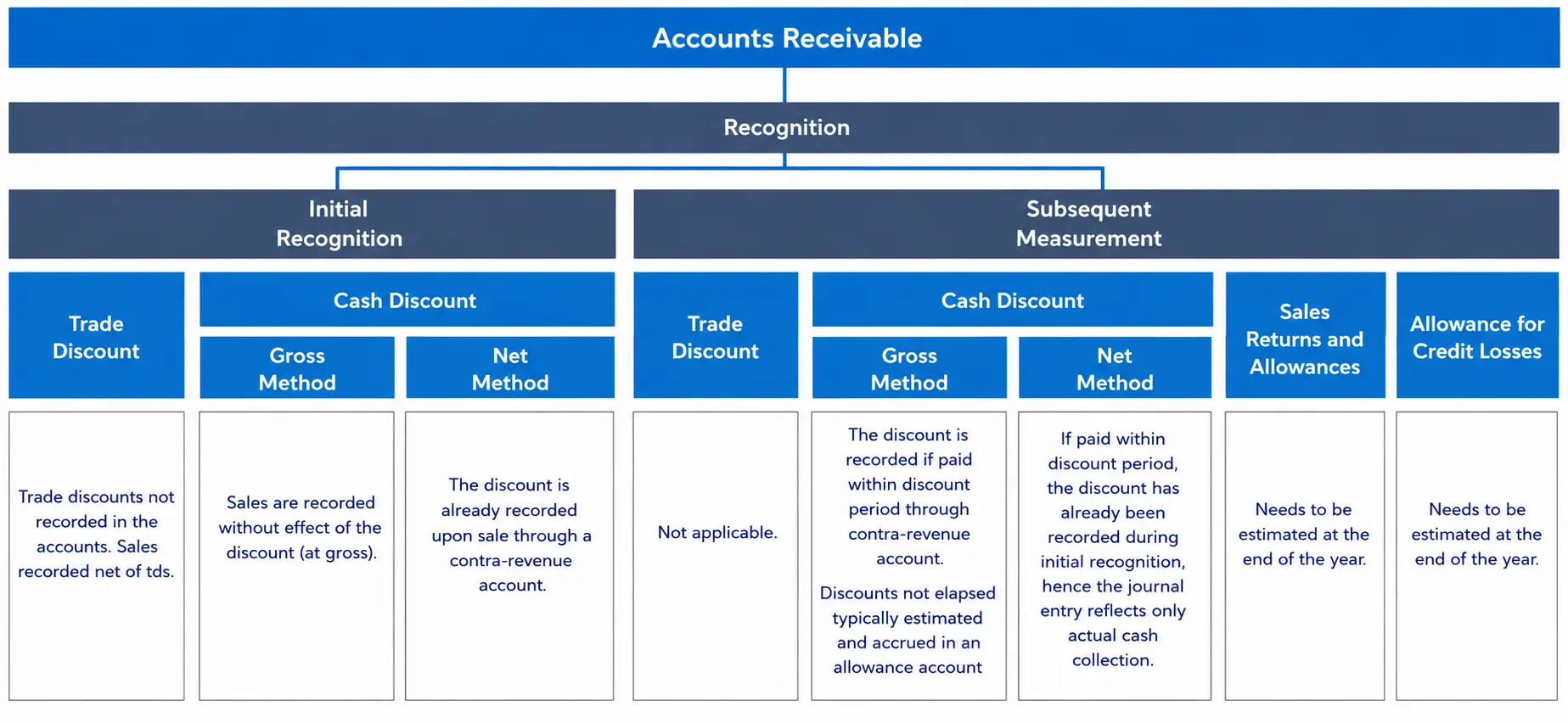
The following figure shows the concept map of this topic to guide you through the text.

Outlining accounts receivable recognition covering trade discounts, cash discounts, sales returns, and credit loss allowances.
Accounts Receivable Concept Map
Achievable

Initial recognition of accounts receivables

The initial recognition of an accounts receivable means how a company should account for an account receivable when a credit sale transaction has been made. For this purpose, it is important to know the definition of the transaction price.

Definitions
Transaction price
Under ASC 606, this is the amount of consideration an entity expects to be entitled to in exchange for transferring goods or services to a customer.

The receivable and the related revenue are recognized when control of the goods or services transfers to the customer - typically at shipment or delivery, depending on the shipping terms.

It should be noted that because of certain features of a sale, the amount recorded can differ from the list or invoice price. Trade discounts are always netted out before anything is recorded. Cash (prompt-payment) discounts are a form of variable consideration under ASC 606, which may reduce the transaction price - but in practice, companies record them using either the gross method (receivable at the full invoice amount, with the discount recognized only if the customer takes it) or the net method (receivable at the discounted amount). The gross method remains the more common, exam-tested approach despite not reflecting the net amount at initial recognition.

On the balance sheet, however, GAAP requires accounts receivable to be reported at the net amount expected to be received from the customer, not simply the face value of the transaction price.

Trade discounts

Trade discounts are offered by the seller as a reduction of the list price of goods or services typically provided for large orders, special offerings, or to business partners.

Trade discount=List price×Trade discount %

Sales=List price−Trade discount

The accounting for trade discounts is simple because they are not recorded in the books. The journal entry to record a sales transaction where a trade discount was provided records the accounts receivable and the revenue at net of the trade discount.

Example: Trade discount

On April 1, Company XYZ sold 25,000 units of inventory for $10 per unit to Wholesale Company, a strategic business partner who is a wholesaler of the inventory that Company XYZ produces. The company provides a 20% trade discount for wholesale orders above 20,000 units. How is the accounts receivable recorded at initial recognition?

  • Total sales at list price: 25,000 × $10 = $250,000
  • Trade discount (20% of list price): $(50,000)
  • Net sales (and accounts receivable): $200,000

Answer: Dr accounts receivable $200,000 / Cr sales $200,000, to record the sale to Wholesale Company on April 1, net of the 20% trade discount.

Cash discounts

Cash discounts can also be called prompt payment discounts because their nature is to incentivize the customer for paying the accounts receivable earlier than the due date. This is typically included in the invoice that is provided to the customer with the following format:

Cash discount terms: 2/15, n/30

The discount terms above can be interpreted as follows:

  • the first portion (“2/15”) of the above terms relates to the cash discount
  • the second section (“n/30”) relates to the due date of the invoice

The above terms mean that if the payment is made within 15 days, a 2% discount is provided on the transaction price and that the whole amount is due 30 days from the invoice date.

As a consequence, if the payment is made beyond 15 days but still within the 30 days of full term, the full transaction price is due. In contrast, if the 30 days of term has elapsed and the customer has failed to make a payment, the accounts receivable is considered as past due. The term past due will be relevant in the discussion about the allowance for credit losses.

In practice, the cash discounts can be in different combinations of percentages, discount periods, and due dates depending on the policy of the companies providing them. There are two ways of accounting for cash or prompt payment discounts:

  1. the gross method
  2. the net method

For example, on a $10,000 sale with 2/15, n/30 terms, the 2% discount is $200: the net amount is $9,800 if the customer pays within the discount period, compared with the $10,000 gross amount recorded initially under the gross method.

Initial recognition of cash discount: gross method

The gross method, the more common approach in practice, initially records the accounts receivable at the gross amount, without accounting for the discount the customer might take. This keeps the accounting simple when the customer doesn’t take the discount, since the amount initially recorded as a receivable equals the amount collected. Sample journal entries illustrating the gross method follow:

Journal entry upon sale

Account Debit Credit Financial statement element
Accounts receivable $10,000 Asset
Sales $10,000 Revenue
To record sales of $10,000 with term 2/15, n/30

At initial recognition, the discount is ignored when using the gross method

Journal entry upon payment beyond the discount period

Account Debit Credit Financial statement element
Cash $10,000 Asset
Accounts receivable $10,000 Asset
To record the receipt of cash beyond the discount period

The journal entry below shows an alternate journal entry if the customer decided to take advantage of the discount.

Journal entry upon payment within the discount period

Account Debit Credit Financial statement element
Cash $9,800 Asset
Cash discounts allowed $200 Revenue (contra account)
Accounts receivable $10,000 Asset
To record the receipt of cash within the discount period

Key concept: The term contra-revenue account means that the normal balance of this account is a debit instead of a credit. This has an effect of reducing the total revenues in the income statement.

Initial recognition of cash discount: net method

The net method records both the accounts receivable and sales at the net amount, and is used when customers typically take the discount. The initial accounting is the same as how trade discounts are recorded.

Journal entry upon sale

Account Debit Credit Financial statement element
Accounts receivable $9,800 Asset
Sales $9,800 Revenue
To record sales of $10,000 (net of 2% discount = $9,800) with term 2/15, n/30

At initial recognition, the discount is already considered when using the net method

Journal entry upon payment beyond the discount period

Account Debit Credit Financial statement element
Cash $10,000 Asset
Discounts forfeited $200 Other income
Accounts receivable $9,800 Asset
To record the receipt of cash beyond the discount period

The journal entry below shows an alternate journal entry if the customer decided to take advantage of the discount.

Journal entry upon payment within the discount period

Account Debit Credit Financial statement element
Cash $9,800 Asset
Accounts receivable $9,800 Asset
To record the receipt of cash within the discount period

Accounts Receivable Basics

  • Asset arising from a credit sale (sale with future payment)
  • Classified short-term if collected within one year or operating cycle, whichever longer
  • Recognized when control of goods/services transfers to customer (per ASC 606), typically at shipment/delivery
  • Recorded at transaction price; balance sheet reports net amount expected to be collected, not just face value

Trade Discounts

  • Reduction off list price for large orders/special offers/business partners
  • Never recorded in the books — netted out before initial recognition
  • Formulas:
    • Trade discount=List price×Trade discount %
    • Sales=List price−Trade discount
  • Journal entry records AR and revenue at net amount only

Cash (Prompt-Payment) Discounts

  • Incentive for early payment, expressed as e.g. “2/15, n/30” (2% discount if paid in 15 days; full amount due in 30 days)
  • Payment after discount period but within full term = full price due; after full term = account is past due (relevant to allowance for credit losses)
  • Considered variable consideration under ASC 606; two recording methods: gross method and net method

Gross Method

  • More common in practice; records AR/sales at full (gross) invoice amount initially
  • If paid within discount period: Dr Cash (net amount), Dr Cash discounts allowed (contra-revenue, reduces total revenue), Cr AR (gross)
  • If paid after discount period: Dr Cash (gross), Cr AR (gross) — no discount recorded

Net Method

  • Records AR and sales at net (discounted) amount from the start, similar to trade discount accounting
  • If paid within discount period: Dr Cash (net), Cr AR (net) — no additional entry needed
  • If paid after discount period: Dr Cash (gross), Cr Discounts forfeited (other income), Cr AR (net) — recognizes extra amount collected as income

Sign up for free to take 10 quiz questions on this topic

Previous
Next  | 1.2.1.3.1 Discounts and sales returns
All rights reserved ©2016 - 2026 Achievable, Inc.

Initial recognition of accounts receivables

Introduction

This chapter covers how an accounts receivable is initially recorded when a sale is made on credit. Subsequent valuation - including sales returns, the allowance for credit losses, and factoring - is covered in later chapters.

Definitions
Accounts receivable
An accounts receivable is an asset that arises from a credit sale.
Credit sale
A credit sale is a sale of goods or services to a customer in exchange for payment in the future.

An accounts receivable is an asset because there is an expectation of future benefit from the receivable, representing the future inflows of cash. An accounts receivable is typically classified as a short-term asset because it is expected to be collected within one year or the operating cycle, whichever is longer.

The following figure shows the concept map of this topic to guide you through the text.

Initial recognition of accounts receivables

The initial recognition of an accounts receivable means how a company should account for an account receivable when a credit sale transaction has been made. For this purpose, it is important to know the definition of the transaction price.

Definitions
Transaction price
Under ASC 606, this is the amount of consideration an entity expects to be entitled to in exchange for transferring goods or services to a customer.

The receivable and the related revenue are recognized when control of the goods or services transfers to the customer - typically at shipment or delivery, depending on the shipping terms.

It should be noted that because of certain features of a sale, the amount recorded can differ from the list or invoice price. Trade discounts are always netted out before anything is recorded. Cash (prompt-payment) discounts are a form of variable consideration under ASC 606, which may reduce the transaction price - but in practice, companies record them using either the gross method (receivable at the full invoice amount, with the discount recognized only if the customer takes it) or the net method (receivable at the discounted amount). The gross method remains the more common, exam-tested approach despite not reflecting the net amount at initial recognition.

On the balance sheet, however, GAAP requires accounts receivable to be reported at the net amount expected to be received from the customer, not simply the face value of the transaction price.

Trade discounts

Trade discounts are offered by the seller as a reduction of the list price of goods or services typically provided for large orders, special offerings, or to business partners.

Trade discount=List price×Trade discount %

Sales=List price−Trade discount

The accounting for trade discounts is simple because they are not recorded in the books. The journal entry to record a sales transaction where a trade discount was provided records the accounts receivable and the revenue at net of the trade discount.

Example: Trade discount

On April 1, Company XYZ sold 25,000 units of inventory for $10 per unit to Wholesale Company, a strategic business partner who is a wholesaler of the inventory that Company XYZ produces. The company provides a 20% trade discount for wholesale orders above 20,000 units. How is the accounts receivable recorded at initial recognition?

  • Total sales at list price: 25,000 × $10 = $250,000
  • Trade discount (20% of list price): $(50,000)
  • Net sales (and accounts receivable): $200,000

Answer: Dr accounts receivable $200,000 / Cr sales $200,000, to record the sale to Wholesale Company on April 1, net of the 20% trade discount.

Cash discounts

Cash discounts can also be called prompt payment discounts because their nature is to incentivize the customer for paying the accounts receivable earlier than the due date. This is typically included in the invoice that is provided to the customer with the following format:

Cash discount terms: 2/15, n/30

The discount terms above can be interpreted as follows:

  • the first portion (“2/15”) of the above terms relates to the cash discount
  • the second section (“n/30”) relates to the due date of the invoice

The above terms mean that if the payment is made within 15 days, a 2% discount is provided on the transaction price and that the whole amount is due 30 days from the invoice date.

As a consequence, if the payment is made beyond 15 days but still within the 30 days of full term, the full transaction price is due. In contrast, if the 30 days of term has elapsed and the customer has failed to make a payment, the accounts receivable is considered as past due. The term past due will be relevant in the discussion about the allowance for credit losses.

In practice, the cash discounts can be in different combinations of percentages, discount periods, and due dates depending on the policy of the companies providing them. There are two ways of accounting for cash or prompt payment discounts:

  1. the gross method
  2. the net method

For example, on a $10,000 sale with 2/15, n/30 terms, the 2% discount is $200: the net amount is $9,800 if the customer pays within the discount period, compared with the $10,000 gross amount recorded initially under the gross method.

Initial recognition of cash discount: gross method

The gross method, the more common approach in practice, initially records the accounts receivable at the gross amount, without accounting for the discount the customer might take. This keeps the accounting simple when the customer doesn’t take the discount, since the amount initially recorded as a receivable equals the amount collected. Sample journal entries illustrating the gross method follow:

Journal entry upon sale

Account Debit Credit Financial statement element
Accounts receivable $10,000 Asset
Sales $10,000 Revenue
To record sales of $10,000 with term 2/15, n/30

At initial recognition, the discount is ignored when using the gross method

Journal entry upon payment beyond the discount period

Account Debit Credit Financial statement element
Cash $10,000 Asset
Accounts receivable $10,000 Asset
To record the receipt of cash beyond the discount period

The journal entry below shows an alternate journal entry if the customer decided to take advantage of the discount.

Journal entry upon payment within the discount period

Account Debit Credit Financial statement element
Cash $9,800 Asset
Cash discounts allowed $200 Revenue (contra account)
Accounts receivable $10,000 Asset
To record the receipt of cash within the discount period

Key concept: The term contra-revenue account means that the normal balance of this account is a debit instead of a credit. This has an effect of reducing the total revenues in the income statement.

Initial recognition of cash discount: net method

The net method records both the accounts receivable and sales at the net amount, and is used when customers typically take the discount. The initial accounting is the same as how trade discounts are recorded.

Journal entry upon sale

Account Debit Credit Financial statement element
Accounts receivable $9,800 Asset
Sales $9,800 Revenue
To record sales of $10,000 (net of 2% discount = $9,800) with term 2/15, n/30

At initial recognition, the discount is already considered when using the net method

Journal entry upon payment beyond the discount period

Account Debit Credit Financial statement element
Cash $10,000 Asset
Discounts forfeited $200 Other income
Accounts receivable $9,800 Asset
To record the receipt of cash beyond the discount period

The journal entry below shows an alternate journal entry if the customer decided to take advantage of the discount.

Journal entry upon payment within the discount period

Account Debit Credit Financial statement element
Cash $9,800 Asset
Accounts receivable $9,800 Asset
To record the receipt of cash within the discount period
Key points

Accounts Receivable Basics

  • Asset arising from a credit sale (sale with future payment)
  • Classified short-term if collected within one year or operating cycle, whichever longer
  • Recognized when control of goods/services transfers to customer (per ASC 606), typically at shipment/delivery
  • Recorded at transaction price; balance sheet reports net amount expected to be collected, not just face value

Trade Discounts

  • Reduction off list price for large orders/special offers/business partners
  • Never recorded in the books — netted out before initial recognition
  • Formulas:
    • Trade discount=List price×Trade discount %
    • Sales=List price−Trade discount
  • Journal entry records AR and revenue at net amount only

Cash (Prompt-Payment) Discounts

  • Incentive for early payment, expressed as e.g. “2/15, n/30” (2% discount if paid in 15 days; full amount due in 30 days)
  • Payment after discount period but within full term = full price due; after full term = account is past due (relevant to allowance for credit losses)
  • Considered variable consideration under ASC 606; two recording methods: gross method and net method

Gross Method

  • More common in practice; records AR/sales at full (gross) invoice amount initially
  • If paid within discount period: Dr Cash (net amount), Dr Cash discounts allowed (contra-revenue, reduces total revenue), Cr AR (gross)
  • If paid after discount period: Dr Cash (gross), Cr AR (gross) — no discount recorded

Net Method

  • Records AR and sales at net (discounted) amount from the start, similar to trade discount accounting
  • If paid within discount period: Dr Cash (net), Cr AR (net) — no additional entry needed
  • If paid after discount period: Dr Cash (gross), Cr Discounts forfeited (other income), Cr AR (net) — recognizes extra amount collected as income

More from Accounts receivable

  • Learning outcomes
  • Factoring of accounts receivables