



Controls against security breaches
Learning outcome statements
The learning outcome statements relevant for this section are:
- identify and explain controls and tools to detect and thwart cyberattacks, such as penetration and vulnerability testing, biometrics, advanced firewalls, and access controls
Examples of controls
Organizations use layered security controls to prevent, detect, and recover from cyberattacks. Most of these controls fall into one of three types: preventive controls stop an attack before it happens, detective controls identify an attack or a weakness that already exists, and corrective controls limit the damage and restore systems after an incident. The table below maps each control covered in this chapter to its primary type.
| Control | Primary type |
|---|---|
| Vulnerability and penetration testing | Detective |
| Biometrics | Preventive |
| Firewalls | Preventive |
| Access controls (RBAC, MFA, least privilege) | Preventive |
| Intrusion detection systems (IDS) | Detective |
| Intrusion prevention systems (IPS) | Preventive |
| Endpoint detection and response (EDR) | Detective/corrective |
| Encryption and VPNs | Preventive |
Example: Matching the control to the need
Suppose you’re advising a company’s security team on three different situations:
- An external auditor wants proof that the company’s network defenses would hold up against a real attacker, not just a list of theoretical weaknesses.
- The security team is seeing a spike in outbound traffic late at night and wants to be alerted to it without automatically blocking anything, in case it’s a false alarm.
- A web application keeps getting hit with malicious SQL statements through its login form.
Answer:
- For the auditor’s request, penetration testing is the right tool: it simulates a real attack to show actual impact, rather than just scanning for known weaknesses the way vulnerability testing does.
- For the traffic spike, an intrusion detection system (IDS) fits best: it’s a detective control that alerts administrators without blocking traffic, unlike an IPS, which would actively (and possibly wrongly) block the traffic before anyone can confirm the alert is real.
- For the SQL injection attempts, a web application firewall (WAF) is designed specifically to filter out attacks like SQL injection and cross-site scripting before they reach the application.
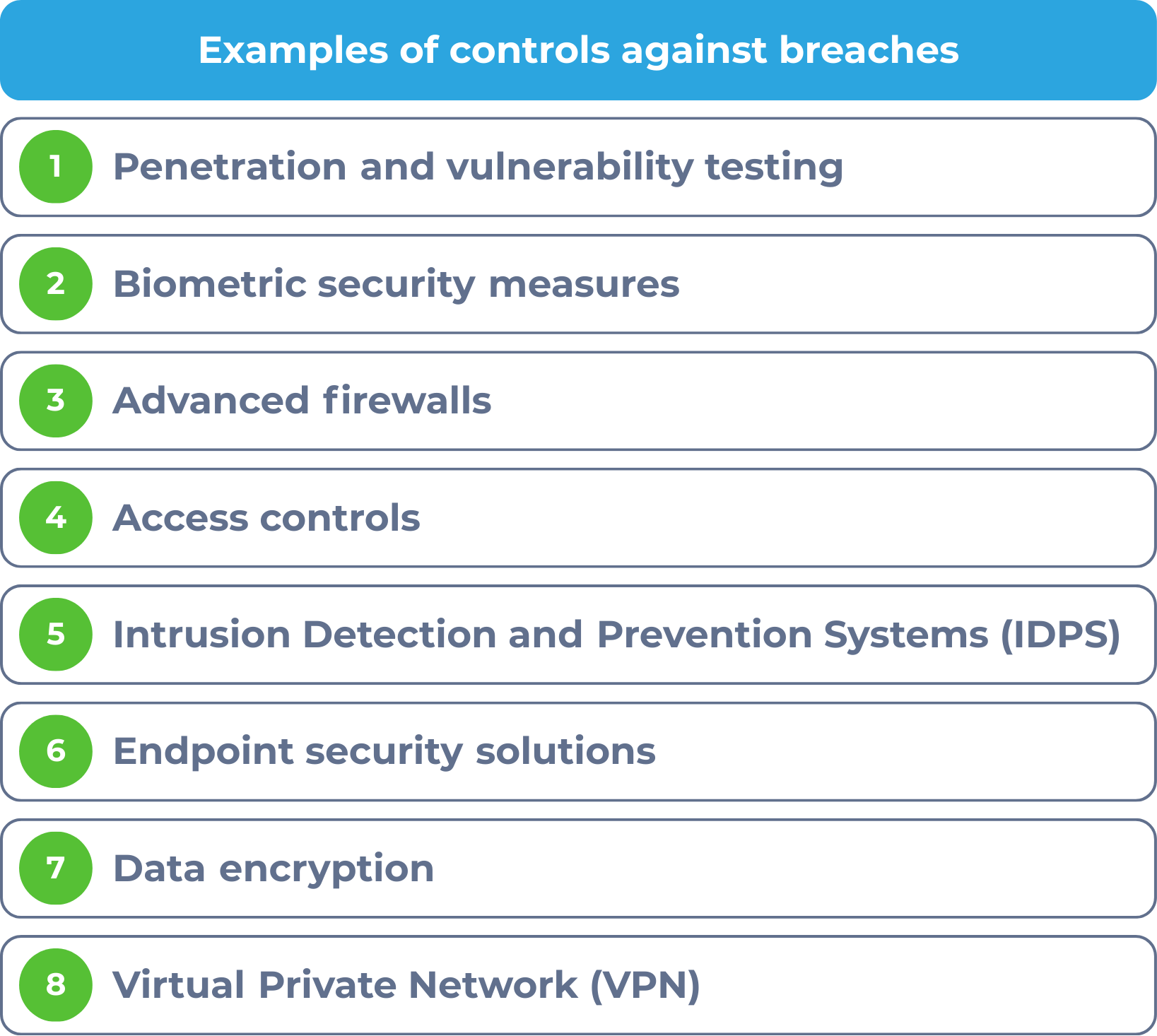
Below are key mechanisms used to strengthen cybersecurity defenses:
1. Penetration and vulnerability testing
Penetration and vulnerability testing are proactive security measures that help organizations identify weaknesses in their IT infrastructure before malicious actors exploit them.
Vulnerability testing involves automated scans to detect security weaknesses in networks, applications, and systems. These tests assess system configurations, outdated software, and known vulnerabilities that hackers could exploit.
Penetration testing (pen testing) is a simulated cyberattack performed by ethical hackers (or penetration testers) to evaluate the effectiveness of an organization’s security defenses. Unlike vulnerability testing, which automatically scans for known weaknesses, pen testing manually exploits those weaknesses to show the real-world impact of an attack. Pen testing is itself a detective control, since it uncovers gaps that already exist, but its findings directly inform preventive controls, such as patching and system hardening.
2. Biometric security measures
Biometrics verify identity using physical or behavioral traits, such as fingerprints or voice patterns, that, unlike passwords, cannot be forgotten or easily shared. They can replace passwords entirely or supplement them as one factor in multi-factor authentication. Limitations include false acceptances or rejections, privacy concerns over stored biometric data, and the fact that a compromised trait can’t be changed the way a password can.
Examples of biometric security measures include:
- Fingerprint recognition: Scans and matches a user’s fingerprint to stored biometric data before granting access to systems or devices.
- Facial recognition: Uses artificial intelligence (AI) to analyze facial features for identity verification, commonly used in smartphones and corporate security systems.
- Iris and retina scans: Optical recognition methods that offer a highly secure authentication mechanism for sensitive environments.
- Voice recognition: Identifies users based on voice patterns, providing an alternative method of biometric authentication.
3. Advanced firewalls
Firewalls are a primary line of defense in network security, preventing unauthorized access to internal systems. Advanced firewalls offer enhanced features to combat modern cyber threats.
Examples of firewalls include:
- Traditional firewalls: Filter incoming and outgoing network traffic based on predefined security rules.
- Next-generation firewalls (NGFWs): Incorporate deep packet inspection, intrusion prevention systems (IPS), and advanced threat intelligence to detect and block sophisticated cyber threats.
- Web application firewalls (WAFs): Specifically designed to protect web applications from common attacks such as SQL injection and cross-site scripting (XSS).
4. Access controls
Access control mechanisms regulate who can view, modify, and use system resources, minimizing the risk of unauthorized access and data breaches. These controls can be physical, technical, or administrative in nature.
Examples of access controls include:
- Role-based access control (RBAC): Assigns user permissions based on job roles, ensuring that employees only have access to the data necessary for their responsibilities.
- Multi-factor authentication (MFA): Requires verification from at least two different factor categories: something you know (a password or PIN), something you have (a security token or phone), and something you are (a biometric trait). Two factors from the same category, such as a password and a PIN, do not count as MFA.
- Least privilege principle: Limits user access to the minimum level necessary to perform their tasks, reducing the impact of potential security breaches.
- Zero trust architecture (ZTA): Assumes that threats may exist inside and outside the network, enforcing strict verification processes for every access request.
- CAPTCHA (completely automated public Turing test to tell computers and humans apart): Prevents automated bots from gaining unauthorized access to systems by requiring users to complete a challenge-response test.
- Physical access controls: Security doors, badges and ID cards, and locked server rooms restrict physical access to critical IT infrastructure and other restricted areas.
5. Intrusion detection and prevention systems (IDPS)
Intrusion detection and prevention systems monitor network traffic for signs of malicious activity and respond to potential threats in real time.
Examples include:
- Intrusion detection systems (IDS): Passively monitor network traffic, alerting administrators when suspicious activity is detected.
- Intrusion prevention systems (IPS): Actively block detected threats, preventing unauthorized access and mitigating security risks.
- Behavioral analysis: Uses AI and machine learning to detect anomalies in user behavior that may indicate cyberattacks.
6. Endpoint security solutions
Endpoint security protects individual devices, such as laptops, desktops, and mobile phones, from cyber threats. Endpoint detection and response (EDR) is the key tool here: it provides continuous monitoring and threat detection for endpoint devices, flagging suspicious activity and helping contain the damage once a device is compromised.
7. Data encryption
Encryption protects sensitive data by converting it into an unreadable format that can only be deciphered with the appropriate decryption key. Encryption is vital for protecting confidential data from cybercriminals and ensuring compliance with privacy regulations.
There are two main types of encryption used in cybersecurity:
- Public key encryption (asymmetric encryption): Uses a key pair: the public key, which can be shared freely, encrypts data; only the matching private key, kept secret by its owner, can decrypt it. Used in SSL/TLS and email encryption.
- Private key encryption (symmetric encryption): Uses a single secret key for both encryption and decryption. This method is faster and more efficient but requires secure key management to prevent unauthorized access. Examples include AES (Advanced Encryption Standard) and DES (Data Encryption Standard).
8. Virtual private network (VPN)
A VPN enhances security by creating an encrypted tunnel between a user’s device and a secure server. This process masks the user’s IP address and encrypts all data transmitted, protecting sensitive information from interception and surveillance.
Key security benefits of a VPN
- Secure remote access: A VPN lets employees connect to an organization’s internal network from remote locations through an encrypted connection, preventing unauthorized users from accessing sensitive systems and data.
- Data confidentiality: By encrypting all data traveling through the tunnel, a VPN keeps intercepted data unreadable to attackers, even on a public or unsecured network.