


This browser is too old to run Achievable.

Update it, or open this page in a current version of Chrome, Safari, Firefox or Edge. On an iPhone or iPad, update iOS: every browser there runs on the version of Safari that comes with it.

Achievable logoAchievable logo
CMA Part 1
Sign in
Sign up
Purchase
Textbook
Practice exams
Support
How it works
Resources
Exam catalog
Mountain with a flag at the peak
Textbook
Introduction
1. External financial reporting decisions
2. Planning, budgeting, and forecasting
3. Performance management
3.1 Cost and variance measures
3.2 Responsibility centers and reporting segments
3.2.1 Responsibility centers
3.2.2 Contribution margin
3.2.3 Reporting of organizational segments
3.2.4 Transfer pricing
3.3 Performance measures
4. Cost management
5. Internal control
6. Technology and analytics
Wrapping up
Achievable logoAchievable logo
3.2.1 Responsibility centers
Achievable CMA Part 1
3. Performance management
3.2. Responsibility centers and reporting segments
Our CMA Part 1 course is currently in development and is a work-in-progress.

Responsibility centers

7 min read
Font
Discuss
Share
Feedback

Learning outcome statements

The learning outcome statements relevant for this section are:

  1. identify and explain the different types of responsibility centers
  2. recommend appropriate responsibility centers given a business scenario

Types of responsibility centers

Definitions
Responsibility center
A specific unit or department within an organization that has defined objectives, goals, and financial responsibilities. These centers are created to delegate accountability, enabling organizations to monitor performance, control costs, and make informed decisions.

Responsibility centers are categorized based on their financial focus, with each type serving distinct roles and requiring unique performance metrics.

The four main types of responsibility centers are:

  1. Cost center
  2. Revenue center
  3. Profit center
  4. Investment center
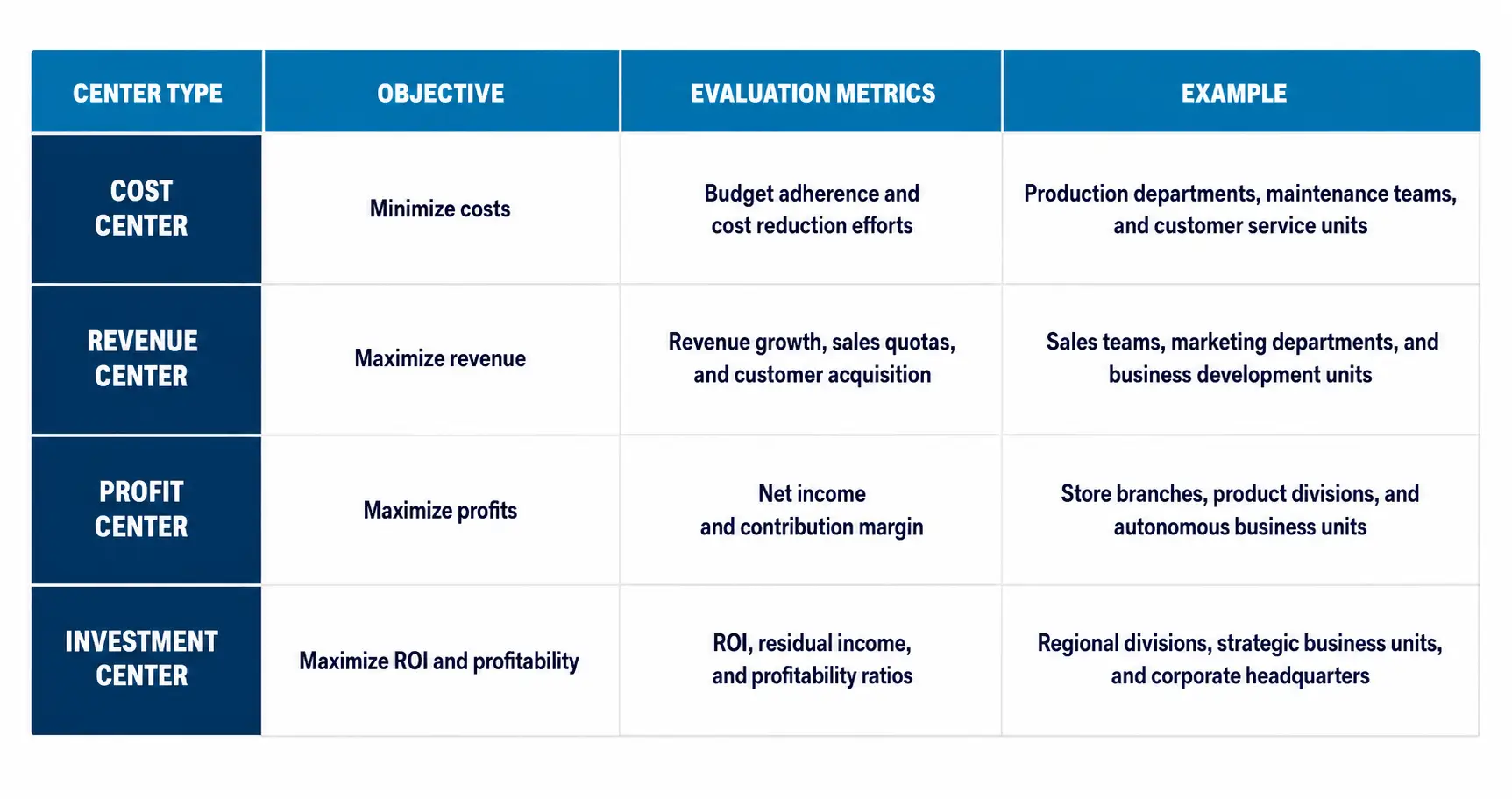
Summarizing objectives, evaluation metrics, and examples for cost, revenue, profit, and investment centers.
Responsibility Centers Summary
Achievable

1. Cost center

Definitions
Cost center
A type of responsibility center that is only responsible for managing and controlling expenses but does not generate revenue.

The primary goal of a cost center is to minimize costs while maintaining the required level of quality and efficiency. Cost centers are evaluated based on their ability to adhere to budgeted expenses and maintain operational performance. In a clothing manufacturing company, the production department functions as a cost center. It is responsible for managing labor, raw material usage, and overhead costs, focusing on producing goods efficiently without exceeding budgeted expenses.

2. Revenue center

Definitions
Revenue center
A type of responsibility center that focuses on generating revenue for the organization. It is responsible for activities that drive sales and customer acquisition.

Revenue centers are evaluated based on their ability to meet or exceed revenue targets. A sales department in a retail chain is a revenue center. It focuses on achieving sales quotas, building customer relationships, and driving store revenue.

3. Profit center

Definitions
Profit center
A type of responsibility center that is responsible for both generating revenue and managing costs, with the ultimate goal of achieving profitability.

Profit centers are evaluated based on their controllable margin - the revenue they generate minus the costs their manager can actually control - or segment margin, which also deducts the segment’s traceable costs the manager can’t control, rather than unadjusted net income, since a profit center’s reported income often includes allocated corporate costs the manager has no say over. In a multi-department store, individual store locations can operate as profit centers. Each location is responsible for managing its revenue from sales and controlling operational expenses to maximize profits.

4. Investment center

Definitions
Investment center
A type of responsibility center that has the highest level of accountability among responsibility centers. It is responsible for generating revenue, managing costs, and making investment decisions to ensure a strong return on investment (ROI).

Investment centers are evaluated based on profitability and the efficiency of asset utilization. The regional headquarters of a global retail chain operates as an investment center, with responsibilities including managing regional sales, operational costs, and decisions about opening new store locations.

One way to assess the performance of an investment center is residual income (RI) - the amount of income remaining after subtracting a required return on the assets the division uses. The required return is calculated using an imputed interest rate that represents the cost of the funds tied up in those assets.

Example: Residual income

A division has assets of $1,000,000 and generates income of $200,000. The company’s imputed interest rate is 12%.

  • Required return: $1,000,000×12%=$120,000
  • Residual income: $200,000−$120,000=$80,000

Answer: residual income is $80,000.

Sidenote
Looking ahead

ROI, residual income, and the calculation issues that come with them (such as choosing the investment base) are covered in depth in the later Performance measures chapters. Transfer pricing between responsibility centers and segment reporting are covered in their own dedicated chapters.

Assigning responsibility centers

Responsibility centers are essential tools for aligning organizational goals with operational performance.

By assigning specific types of responsibility centers, such as cost centers, revenue centers, profit centers, or investment centers, organizations can address unique challenges and opportunities in various business scenarios.

If appearing in the CMA exams, it is crucial to:

  1. carefully analyze the scenario provided and identify the primary goal or challenge, such as cost control, revenue generation, or investment management
  2. then, recommend the responsibility center that best aligns with that objective, ensuring your answer includes specific functions or actions the center would oversee.

The following examples demonstrate how to apply these concepts effectively.

Scenario 1: Balancing costs and revenue in a restaurant chain

A restaurant chain is struggling with rising operational costs while maintaining consistent revenue levels, leading to declining profitability.

Recommendation: To address this challenge, the restaurant chain should establish profit centers for each restaurant location. These profit centers would be accountable for managing both revenue and expenses, enabling managers to focus on achieving profitability.

Each location’s profit center should monitor food costs, labor expenses, and sales performance. Managers can implement strategies such as optimizing menus, reducing waste, and increasing table turnover to boost profit margins. By designating restaurant branches as profit centers, the organization can identify high-performing locations and address inefficiencies in underperforming ones.

Scenario 2: Maximizing returns in a technology company

A technology company has developed several product lines and wants to allocate resources efficiently to maximize profitability and ROI.

Recommendation: In this case, the company should designate strategic business units as investment centers. These centers would be responsible for managing revenues, controlling costs, and making investment decisions related to product development and market expansion.

For instance, a division responsible for launching a new software product could be evaluated based on ROI and residual income metrics. By assigning investment center responsibilities, the company ensures that divisions with high decision-making autonomy are held accountable for their overall financial performance.

Scenario 3: Managing costs in a healthcare organization

A hospital wants to reduce operating costs in its support services, such as housekeeping and maintenance, without compromising patient care.

Recommendation: In this scenario, the hospital should establish cost centers for its support service departments. Each cost center would be responsible for controlling expenses while maintaining operational standards. For example, the housekeeping cost center would monitor labor hours, cleaning supplies, and equipment usage to minimize costs while ensuring cleanliness and compliance with health regulations.

By implementing cost centers, the hospital can focus on efficient resource utilization in non-revenue-generating departments, supporting overall financial health.

Scenario 4: Increasing sales in a retail chain

A retail chain is experiencing stagnant sales growth and wants to enhance its revenue performance by focusing on customer acquisition and retention.

Recommendation: In this scenario, it would be appropriate to establish a revenue center for the sales department. The revenue center should focus on driving sales, increasing customer engagement, and meeting revenue targets. This center would be responsible for implementing promotional campaigns, developing pricing strategies, and expanding the customer base. By assigning this responsibility center, the retail chain can focus its efforts on generating revenue and achieving growth goals.

Responsibility centers overview

  • Defined units/departments with assigned financial accountability for performance monitoring and cost control
  • Four types: cost center, revenue center, profit center, investment center
  • Each type evaluated using distinct performance metrics suited to its objective

Cost center

  • Manages/controls expenses only; does not generate revenue
  • Goal: minimize costs while maintaining quality/efficiency
  • Evaluated on adherence to budgeted expenses
  • Example: production department in a manufacturing company

Revenue center

  • Focuses solely on generating revenue (sales, customer acquisition)
  • Evaluated on meeting/exceeding revenue targets
  • Example: sales department in a retail chain

Profit center

  • Responsible for both revenue generation and cost control to achieve profitability
  • Evaluated using controllable margin (revenue minus manager-controllable costs) or segment margin (also subtracts traceable but non-controllable costs) — not unadjusted net income, since allocated corporate costs distort it
  • Example: individual store locations in a multi-department chain

Investment center

  • Highest accountability: manages revenue, costs, and investment/asset decisions for ROI
  • Evaluated on profitability and asset utilization efficiency
  • Example: regional HQ of a global retail chain
  • Residual income (RI): income remaining after subtracting required return on assets used
    • Formula: RI=Income−(Assets×Imputed interest rate)
    • Example: $1,000,000 assets × 12% = $120,000 required return; $200,000 income − $120,000 = $80,000 RI
  • ROI, RI calculation nuances, transfer pricing, and segment reporting covered in later chapters

Applying responsibility centers to scenarios (exam strategy)

  • Step 1: identify the business’s primary goal/challenge (cost control, revenue growth, profitability, investment efficiency)
  • Step 2: recommend the responsibility center type matching that objective, specifying functions it would oversee
  • Example mappings:
    • Rising costs + inconsistent profit → profit centers per location (manage both revenue and expenses)
    • Resource allocation across product lines for ROI → investment centers (control revenue, costs, and investment decisions)
    • Reducing support service costs without harming care quality → cost centers (control expenses only)
    • Stagnant sales needing growth focus → revenue center (drive sales/customer engagement)

Sign up for free to take 22 quiz questions on this topic

Previous
Next  | 3.2.2 Contribution margin
All rights reserved ©2016 - 2026 Achievable, Inc.

Responsibility centers

Learning outcome statements

The learning outcome statements relevant for this section are:

  1. identify and explain the different types of responsibility centers
  2. recommend appropriate responsibility centers given a business scenario

Types of responsibility centers

Definitions
Responsibility center
A specific unit or department within an organization that has defined objectives, goals, and financial responsibilities. These centers are created to delegate accountability, enabling organizations to monitor performance, control costs, and make informed decisions.

Responsibility centers are categorized based on their financial focus, with each type serving distinct roles and requiring unique performance metrics.

The four main types of responsibility centers are:

  1. Cost center
  2. Revenue center
  3. Profit center
  4. Investment center

1. Cost center

Definitions
Cost center
A type of responsibility center that is only responsible for managing and controlling expenses but does not generate revenue.

The primary goal of a cost center is to minimize costs while maintaining the required level of quality and efficiency. Cost centers are evaluated based on their ability to adhere to budgeted expenses and maintain operational performance. In a clothing manufacturing company, the production department functions as a cost center. It is responsible for managing labor, raw material usage, and overhead costs, focusing on producing goods efficiently without exceeding budgeted expenses.

2. Revenue center

Definitions
Revenue center
A type of responsibility center that focuses on generating revenue for the organization. It is responsible for activities that drive sales and customer acquisition.

Revenue centers are evaluated based on their ability to meet or exceed revenue targets. A sales department in a retail chain is a revenue center. It focuses on achieving sales quotas, building customer relationships, and driving store revenue.

3. Profit center

Definitions
Profit center
A type of responsibility center that is responsible for both generating revenue and managing costs, with the ultimate goal of achieving profitability.

Profit centers are evaluated based on their controllable margin - the revenue they generate minus the costs their manager can actually control - or segment margin, which also deducts the segment’s traceable costs the manager can’t control, rather than unadjusted net income, since a profit center’s reported income often includes allocated corporate costs the manager has no say over. In a multi-department store, individual store locations can operate as profit centers. Each location is responsible for managing its revenue from sales and controlling operational expenses to maximize profits.

4. Investment center

Definitions
Investment center
A type of responsibility center that has the highest level of accountability among responsibility centers. It is responsible for generating revenue, managing costs, and making investment decisions to ensure a strong return on investment (ROI).

Investment centers are evaluated based on profitability and the efficiency of asset utilization. The regional headquarters of a global retail chain operates as an investment center, with responsibilities including managing regional sales, operational costs, and decisions about opening new store locations.

One way to assess the performance of an investment center is residual income (RI) - the amount of income remaining after subtracting a required return on the assets the division uses. The required return is calculated using an imputed interest rate that represents the cost of the funds tied up in those assets.

Example: Residual income

A division has assets of $1,000,000 and generates income of $200,000. The company’s imputed interest rate is 12%.

  • Required return: $1,000,000×12%=$120,000
  • Residual income: $200,000−$120,000=$80,000

Answer: residual income is $80,000.

Sidenote
Looking ahead

ROI, residual income, and the calculation issues that come with them (such as choosing the investment base) are covered in depth in the later Performance measures chapters. Transfer pricing between responsibility centers and segment reporting are covered in their own dedicated chapters.

Assigning responsibility centers

Responsibility centers are essential tools for aligning organizational goals with operational performance.

By assigning specific types of responsibility centers, such as cost centers, revenue centers, profit centers, or investment centers, organizations can address unique challenges and opportunities in various business scenarios.

If appearing in the CMA exams, it is crucial to:

  1. carefully analyze the scenario provided and identify the primary goal or challenge, such as cost control, revenue generation, or investment management
  2. then, recommend the responsibility center that best aligns with that objective, ensuring your answer includes specific functions or actions the center would oversee.

The following examples demonstrate how to apply these concepts effectively.

Scenario 1: Balancing costs and revenue in a restaurant chain

A restaurant chain is struggling with rising operational costs while maintaining consistent revenue levels, leading to declining profitability.

Recommendation: To address this challenge, the restaurant chain should establish profit centers for each restaurant location. These profit centers would be accountable for managing both revenue and expenses, enabling managers to focus on achieving profitability.

Each location’s profit center should monitor food costs, labor expenses, and sales performance. Managers can implement strategies such as optimizing menus, reducing waste, and increasing table turnover to boost profit margins. By designating restaurant branches as profit centers, the organization can identify high-performing locations and address inefficiencies in underperforming ones.

Scenario 2: Maximizing returns in a technology company

A technology company has developed several product lines and wants to allocate resources efficiently to maximize profitability and ROI.

Recommendation: In this case, the company should designate strategic business units as investment centers. These centers would be responsible for managing revenues, controlling costs, and making investment decisions related to product development and market expansion.

For instance, a division responsible for launching a new software product could be evaluated based on ROI and residual income metrics. By assigning investment center responsibilities, the company ensures that divisions with high decision-making autonomy are held accountable for their overall financial performance.

Scenario 3: Managing costs in a healthcare organization

A hospital wants to reduce operating costs in its support services, such as housekeeping and maintenance, without compromising patient care.

Recommendation: In this scenario, the hospital should establish cost centers for its support service departments. Each cost center would be responsible for controlling expenses while maintaining operational standards. For example, the housekeeping cost center would monitor labor hours, cleaning supplies, and equipment usage to minimize costs while ensuring cleanliness and compliance with health regulations.

By implementing cost centers, the hospital can focus on efficient resource utilization in non-revenue-generating departments, supporting overall financial health.

Scenario 4: Increasing sales in a retail chain

A retail chain is experiencing stagnant sales growth and wants to enhance its revenue performance by focusing on customer acquisition and retention.

Recommendation: In this scenario, it would be appropriate to establish a revenue center for the sales department. The revenue center should focus on driving sales, increasing customer engagement, and meeting revenue targets. This center would be responsible for implementing promotional campaigns, developing pricing strategies, and expanding the customer base. By assigning this responsibility center, the retail chain can focus its efforts on generating revenue and achieving growth goals.

Key points

Responsibility centers overview

  • Defined units/departments with assigned financial accountability for performance monitoring and cost control
  • Four types: cost center, revenue center, profit center, investment center
  • Each type evaluated using distinct performance metrics suited to its objective

Cost center

  • Manages/controls expenses only; does not generate revenue
  • Goal: minimize costs while maintaining quality/efficiency
  • Evaluated on adherence to budgeted expenses
  • Example: production department in a manufacturing company

Revenue center

  • Focuses solely on generating revenue (sales, customer acquisition)
  • Evaluated on meeting/exceeding revenue targets
  • Example: sales department in a retail chain

Profit center

  • Responsible for both revenue generation and cost control to achieve profitability
  • Evaluated using controllable margin (revenue minus manager-controllable costs) or segment margin (also subtracts traceable but non-controllable costs) — not unadjusted net income, since allocated corporate costs distort it
  • Example: individual store locations in a multi-department chain

Investment center

  • Highest accountability: manages revenue, costs, and investment/asset decisions for ROI
  • Evaluated on profitability and asset utilization efficiency
  • Example: regional HQ of a global retail chain
  • Residual income (RI): income remaining after subtracting required return on assets used
    • Formula: RI=Income−(Assets×Imputed interest rate)
    • Example: $1,000,000 assets × 12% = $120,000 required return; $200,000 income − $120,000 = $80,000 RI
  • ROI, RI calculation nuances, transfer pricing, and segment reporting covered in later chapters

Applying responsibility centers to scenarios (exam strategy)

  • Step 1: identify the business’s primary goal/challenge (cost control, revenue growth, profitability, investment efficiency)
  • Step 2: recommend the responsibility center type matching that objective, specifying functions it would oversee
  • Example mappings:
    • Rising costs + inconsistent profit → profit centers per location (manage both revenue and expenses)
    • Resource allocation across product lines for ROI → investment centers (control revenue, costs, and investment decisions)
    • Reducing support service costs without harming care quality → cost centers (control expenses only)
    • Stagnant sales needing growth focus → revenue center (drive sales/customer engagement)

More from Responsibility centers and reporting segments

  • Contribution margin
  • Reporting of organizational segments