



Pharmacology math
The pediatric dose
As with all medication calculations, accuracy is critical for patient safety. Know the facility’s policies and procedures for calculating pediatric doses, since variations exist across facilities.
Steps to calculate a pediatric dose
Medication dosages for children are typically based on the child’s weight. For this type of problem, the medical assistant needs the child’s weight, the drug order, and the information on the stock medication label. For instance, a child’s weight is 33 pounds (lb), the drug order is ABC medication 0.1 mg/kg, and the stock medication label states “ABC medication 1 mg/mL.” Notice that the child’s weight is in pounds, and the order is 0.1 mg per every kilogram of weight. The unit of measure for weight is different, one being pounds and the other kilograms.
The following are the steps to calculate a pediatric dose:
Step 1: Convert the patient’s weight to kilograms. This goes back to converting between the household and metric systems, covered in Math basics for medications.
Step 2: Calculate the number of milligrams of medication the child needs. Imagine this scenario: A person tells you that you can have two chocolate bars for each kilogram you weigh. How would you figure it out? A simple way is to multiply the number of kilograms you weigh by 2 (68 × 2 = 136 bars). You can use this same method to calculate the medication order - multiply the kilograms by the order.
Step 3: Calculate the liquid medication dose or the number of milliliters you will give. An example of this step was shown in Calculating liquid and solution doses.
Calculating the amount of medication
The following steps show how to calculate the amount of medication for a pediatric patient. You can modify the steps and use the formula method if you like.
Problem
Patient’s weight: 33 lb
Order: ABC medication 0.1 mg/kg
Stock: ABC medication 1 mg/mL
How much medication (in mL) should be given?
Solution for problem
Tips for solving the problem
There are three main steps to this problem. Each step sets up a proportion and solves it the same way - cross-multiply the two diagonal numbers, then divide by the remaining number. This works whether you use a calculator or solve by hand. When you complete a step, round two places beyond your answer. For instance, if your answer is to be in tenths, then during the problem, round to the thousandth (3 places after the decimal). This will ensure accuracy in the answer.
Step 1: Convert the patient’s weight into kg
This can be done several ways. Use your favorite method or follow the example and solve for the unknown.
Example problem:
Cross-multiply (33 × 1) and divide by 2.2, rounding to the nearest thousandth (if needed):
Step 2: Calculate the number of mg of medication needed
Again, there are several ways. The easiest is to multiply the weight by the order (15 kg × 0.1 mg), or you can set it up like the example and solve it. Because this is in the middle of the problem, round to the nearest thousandth (if needed).
Updated order: ABC medication 1.5 mg
Step 3: Calculate the liquid medication dose
Put the stock information into a fraction. Put the order information on the other side. Make sure the labels are in the exact same location.
Cross-multiply (1.5 × 1) and divide by 1, rounding to the nearest tenth (if needed):
Answer: 1.5 mL
Reading syringes
For the safety of patients, it is important that medical assistants be accurate when measuring medications in syringes. Syringes have calibrations printed on the barrel. These markings are used when measuring the medication prior to administration. The calibration markings include longer or darker lines and shorter lines. The first step in reading a syringe is to identify the amount of each calibration line. With many types of syringes, a person should count the number of lines for 1 mL or 0.1 mL, depending on the syringe.
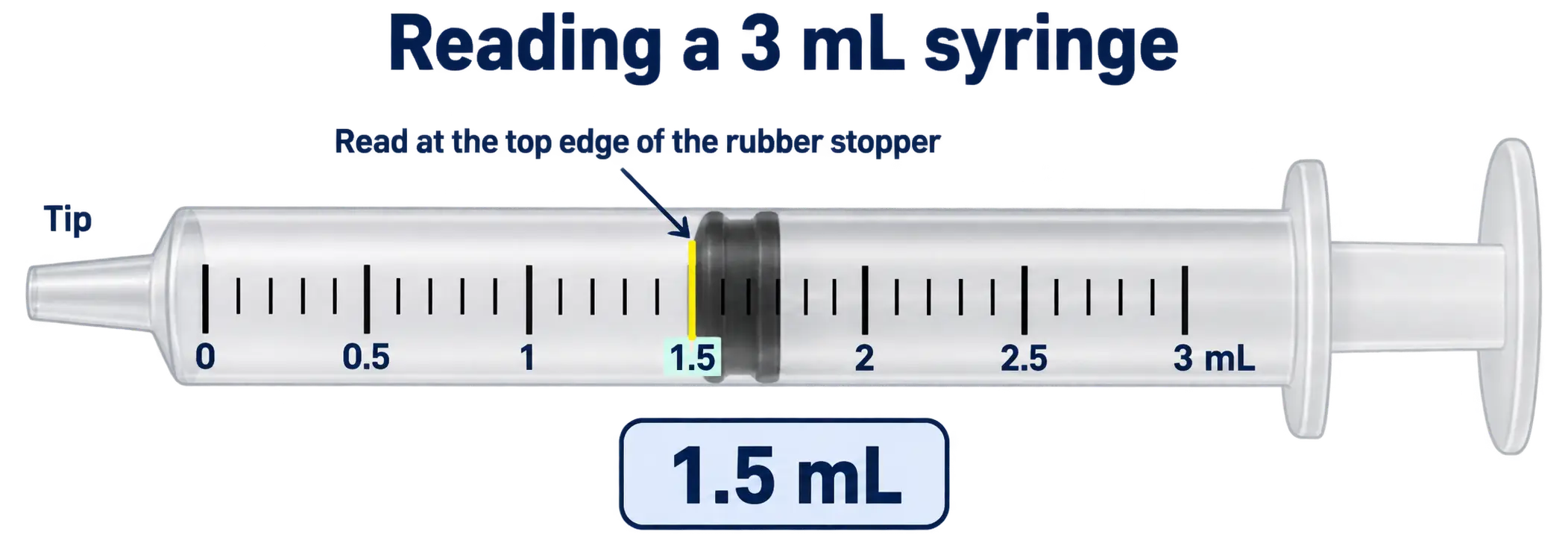
When you use a syringe, the rubber stopper on the plunger indicates the amount in the syringe. Some rubber stoppers are pointed, and others are flat. Regardless of shape, the point where the top of the rubber stopper meets the barrel is what you read - line that point up exactly with the correct calibration mark to measure the dose accurately.
Reading a 3-mL syringe
A 3-mL syringe, the most commonly used syringe in ambulatory care. The maximum amount that the syringe can hold is indicated at the bottom of the syringe. To identify what each line is worth, count the lines for 1 mL. For this syringe, there are 10 lines for 1 mL, which means each line is equal to 0.1 mL. Medication amounts to the nearest tenth (one place after the decimal point) can be measured using this syringe.
Reading a 10-mL syringe
The calibration markings on 10-mL syringe are the same as on most 5-, 6-, 10-, and 12-mL syringes. For this syringe, there are 5 lines for 1 mL, which means each line is equal to 0.2 mL. Syringes with this type of calibration can only measure amounts that fall on a 0.2 mL line, i.e., multiples of 0.2 mL (e.g., 1.2 mL, 2.0 mL, 3.6 mL).
Reading a 60-mL syringe
The calibration markings are different with a 60-mL syringe. Unlike prior syringes, the numbers labeled are in increments of 5 (e.g., 5, 10, 15). Each line is equal to 1 mL. Syringes with this type of calibration can only measure whole number amounts (e.g., 5, 9, 11). This type of syringe may be used in ambulatory care for irrigation.
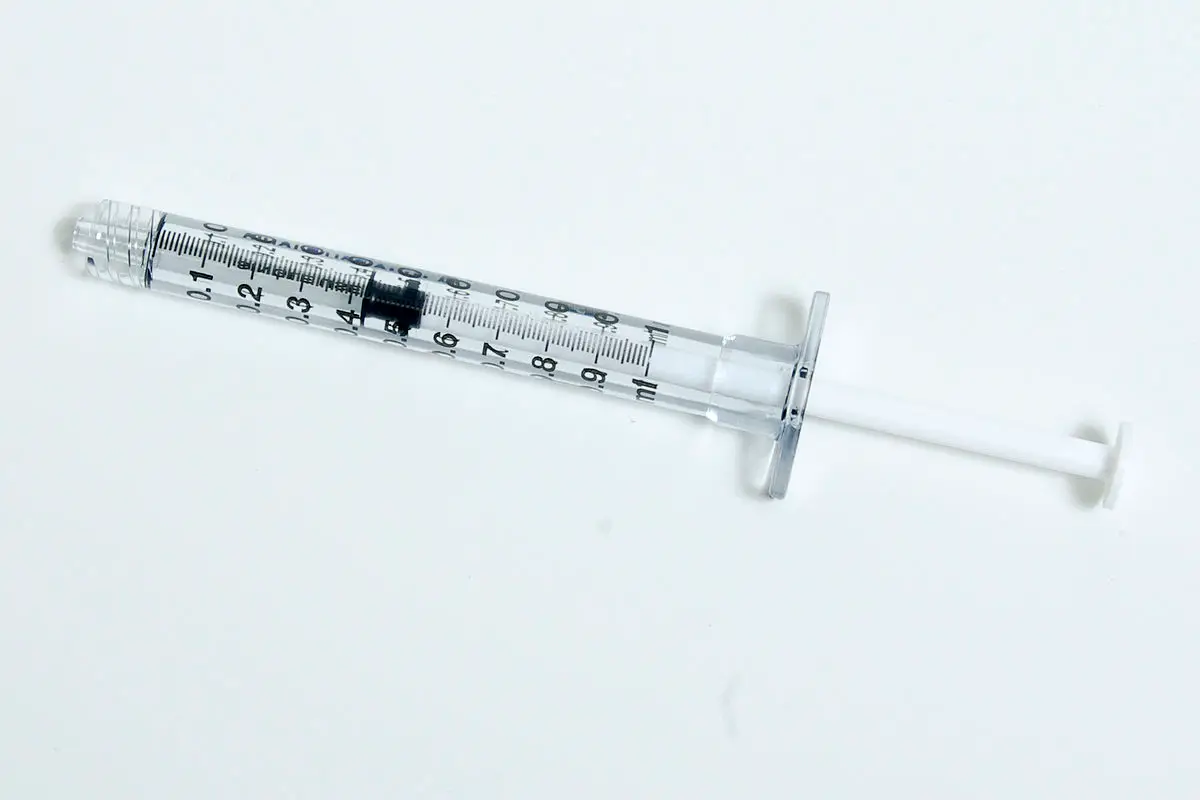
Reading a 1-mL syringe
The numbers on a 1-mL syringe are tenths (e.g., .1, .2). For this syringe, there are 10 lines per 0.1 mL, so each line equals 0.01 mL, and the syringe measures to the hundredth place (e.g., 0.08, 0.09, 0.15). The most common use of these syringes is for tuberculin (TB) skin tests.
If a medication order indicates that 0.14 mL is to be given, the medical assistant should find the calibration marking for 0.1. A trick is to think of 0.1 as 0.10. The next small line would be 0.11, then 0.12, and so on. If a medication order indicates that 0.04 mL is to be given, the medical assistant should find the large line at the top of the syringe. This would be 0, and the next little line would be considered 0.01, followed by 0.02, and so on.
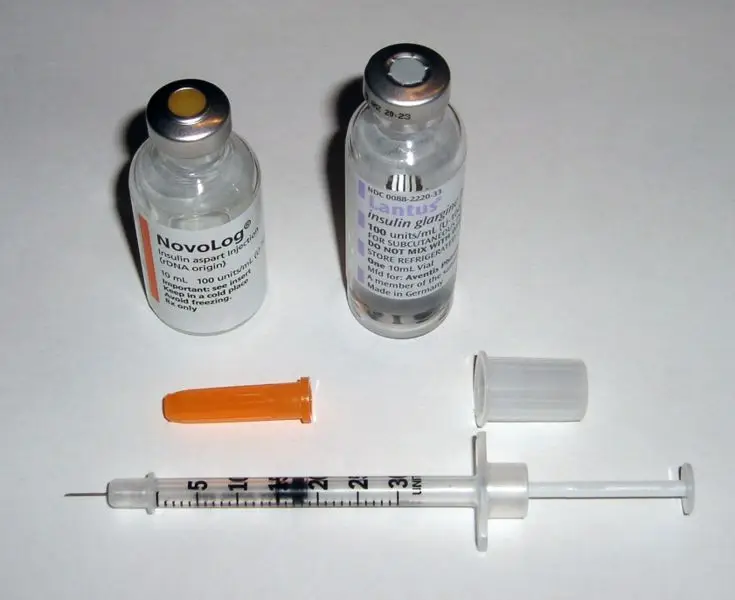
Reading an insulin syringe
With an insulin syringe, the insulin is measured in units. The calibration markings on this type of insulin syringe are similar to those of the 60-mL syringe. The numbers labeled are in increments of 5 (e.g., 5, 10, 15). On a single-unit-scale U-100 syringe, each line equals 1 unit; always confirm the scale printed on the barrel, since some U-100 syringes mark 2 units per line. Syringes with this type of calibration can only measure whole number amounts (e.g., 5, 9, 11). This type of syringe may be used in ambulatory care for U-100 insulin administration.
Patient coaching
In some cases, the medical assistant needs to teach patients and parents how to read oral medical syringes. These syringes are used to draw up and administer oral medications, usually to young children. When coaching a patient or a parent on using an oral syringe to measure medications, it is important for the medical assistant to refer to the provider’s order. If the order states 1 teaspoon, the medical assistant should coach the person that this is the same as 5 mL. Prior to finishing the coaching session, the medical assistant should have the patient or parent draw up (with air) the dose ordered to determine if the person understands the procedure.
Legal and ethical issues
Not all states allow medical assistants to calculate medication dosages. It is important for the medical assistant to review the state’s scope of practice laws. Some agencies may also have policies and procedures for calculating medication dosages. The medical assistant must follow both the state’s scope of practice laws and the agency’s policies and procedures.
Professional behaviors
If you have questions about how to calculate a medication dosage, talk with the provider for clarification before proceeding.