




Dietary guidance and food labels
Food guides and dietary guidelines
For over a century, the US Department of Agriculture (USDA) has provided food guides to the public. Some of the more recent guides include the following:
- 1992: Food Guide Pyramid, which showed the five basic food groups arranged in a pyramid. The lower part of the pyramid consisted of the food groups that made up the majority of the daily diet. People were to eat less of the food groups at the top of the pyramid.
- 2005: MyPyramid Food Guidance System, which continued with the pyramid design but added physical activity and oils.
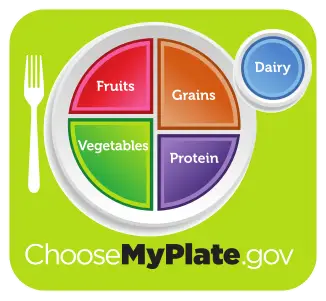
- 2011: MyPlate was introduced and later updated with the 2020 Dietary Guidelines for Americans.
MyPlate
MyPlate focuses on making healthy food choices because everything eaten matters. Some key messages are included with these dietary guidelines:
- Fill half the plate with fruits and vegetables. Focus on whole fruits and vary the types of vegetables.
- Make half of the grains eaten each day whole grains.
- Vary the types of proteins eaten.
- Move to low-fat or fat-free milk and yogurt.
- Choose foods and beverages with less added salt, sugars, and saturated fats.
MyPlate consists of five food groups, along with oil. Oil contains required nutrients, so the USDA addresses it. Oil is usually consumed in nuts, fish, cooking oil, and salad dressing. Most children need 3 to 6 teaspoons, and adults need 5 to 7 teaspoons daily, depending on sex and age.
The MyPlate website offers numerous online resources for individuals and professionals. Tip sheets, food plans, and other resources provide additional information. MyPlate is very flexible for cultural foods.
Dietary guidelines
The USDA publishes Dietary Guidelines every 5 years. These guidelines are for individuals 2 years or older. The focus is on disease prevention and health promotion. The current dietary guidelines focus on overall eating patterns, health, and the risk of chronic disease.
Key recommendations from the 2020-2025 Dietary Guidelines for Americans include those listed with MyPlate, in addition to the following:
- Added sugars: Limit to less than 10% of calories per day starting at age 2. Avoid for infants and toddlers
- Saturated fat: Limit to less than 10% of calories per day starting at age 2. Examples of saturated fats include butter, whole milk, fatty meats, coconut oil, and palm oil.
- Sodium: Limit to less than 2300 milligrams (mg) per day for those age 14 and older.
- Alcoholic beverages: Men should limit intake to two drinks or less per day. Women should limit intake to one drink or less per day.
- Pay attention to portion sizes.
- Food choices should be rich in nutrients.
Food labels
Knowing how to read a food label is important when making healthy food selections. The food label contains the nutritional information and the ingredient list. The government has required food manufacturers to include certain information on the food label. The amounts for “Trans Fat” and “Added Sugars” are some of the newer additions to the food label.
Reading a food label
Food labels provide nutritional facts. This information is presented in both the quantity (e.g., grams [g] or mg) and as a percentage. The percentage reflects the % Daily Value (DV). This is the percentage of the nutrient in a single serving in terms of the daily recommended amount based on a 2000-calorie diet. You will see this description at the bottom of the list of nutrition facts. Remember, if you are eating fewer than 2000 calories daily, these percentages will be different for you.
When reading the nutrition facts, start at the top and work down:
- Check the calories per serving. If you eat the entire container and it consists of two servings, you need to double the calories.
- Check the amount of fat. Limit the saturated fat intake and avoid trans fats.
- The amounts listed for cholesterol, sodium, total carbohydrates, and added sugars are also numbers to consider. Choose foods with low amounts of these nutrients.
- Examine the dietary fiber, protein, vitamin D, calcium, iron, and potassium. Make sure you are getting enough of these beneficial nutrients.
Ingredient lists
Ingredient lists on foods are also important to understand. The ingredients are listed in descending order, starting with the one that weighs the most and ending with the one that weighs the least. There are several reasons a person may look at the ingredient list:
- To look for trans fats: Even if the nutrition information indicates 0 grams of trans fats, the product may still contain less than 0.5 gram of trans fats per serving. Look for ingredients such as “hydrogenated” or “partially hydrogenated oil.” This indicates the presence of trans fats. So even if the nutrition information indicates 0 grams of trans fats, you may quickly reach your daily limit if you eat more than one serving.
- To avoid certain ingredients: Some people try to avoid ingredients such as high-fructose corn syrup and certain food colorings.
- To identify allergens: More than 160 foods have been found to be allergens. The government has identified nine allergens - milk, eggs, fish, crustacean shellfish, tree nuts, peanuts, wheat, soybeans, and sesame - that make up about 90% of all food allergy reactions. Sesame was added as the ninth major allergen by the FASTER Act, effective January 1, 2023. Laws regulating food labeling require manufacturers to indicate if any of the top allergens are in the food product. Advisory statements, such as “May contain peanuts” or “Made in a factory that also processes tree nuts,” are optional and not required by law.