



ICD-10-CM structure and format
Getting to know the ICD-10-CM
The ICD-10-CM is a fairly complex system for diagnostic coding. It allows for a great deal of specificity for the diagnosis. It is important to understand the structure and format of the ICD-10-CM codes, as well as how to use the Alphabetic Index and the Tabular List. The next sections will help you to better understand ICD-10-CM.
Structure and format of the ICD-10-CM
The ICD-10-CM has two sections:
- Alphabetic Index (the ICD-10-CM Index to Diseases and Injuries)
- Tabular List (officially, the ICD-10-CM Tabular List of Diseases and Injuries)
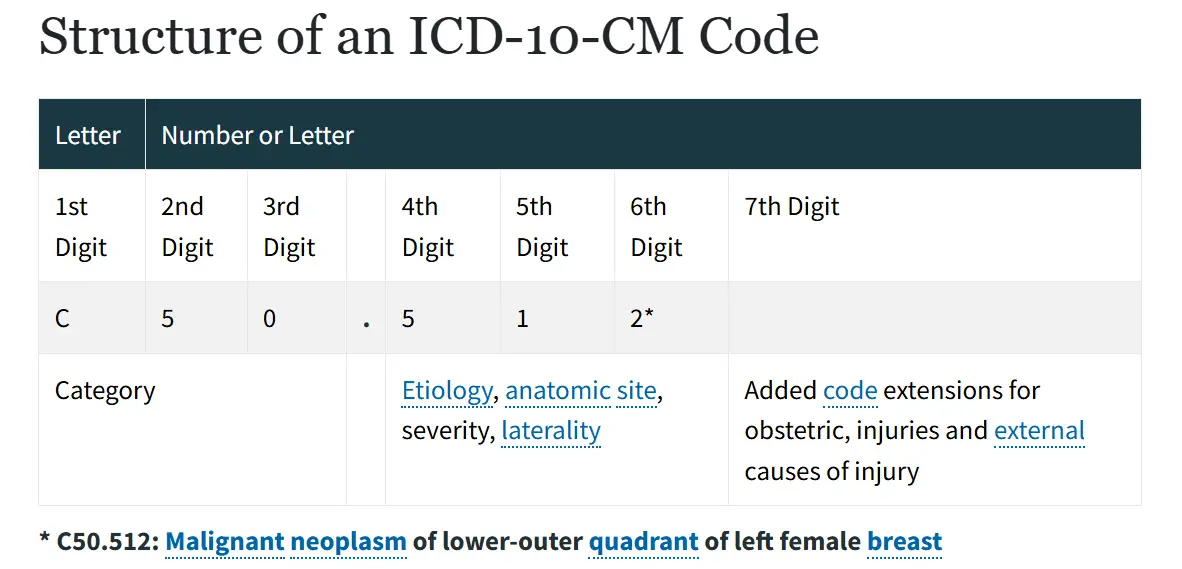
Determining an ICD-10-CM code starts in the Alphabetic Index and is confirmed in the Tabular List. These codes have three to seven characters. Every ICD-10-CM code begins with an alphabetic letter that indicates the chapter in the Tabular List from which the code originates. All the letters of the English alphabet are used except U, which the WHO has reserved to assign to new diseases of uncertain etiology. Some conditions use more than one alphabetic letter in their code ranges. For example, the codes in Chapter 1, Certain Infectious and Parasitic Diseases (A00-B99), begin with the letter A or B. The second character is always numeric. The remaining characters can be a combination of letters and numbers. Only certain codes require the seventh character. The following box describes the seventh character requirements in more detail.
CMS and the National Center for Health Statistics (NCHS) prepare the Official Guidelines for Coding and Reporting to be used with the ICD-10-CM codes, in addition to instructions on how to report the codes on insurance claim forms. The guidelines are a set of rules that have been developed to accompany and complement the official conventions and instructions provided in the ICD-10-CM proper.
The alphabetic index
The Alphabetic index consists of an alphabetic list of diagnostic terms and related codes. This index includes main terms, nonessential modifiers, essential modifiers, and subterms:
- Main terms: These terms appear in bold type.
- Nonessential modifiers: These terms follow the main term and are enclosed in parentheses. They are supplementary words or explanatory information. They do not need to be in the actual diagnostic statement.
- Essential modifiers: These terms are indented under the main term. They can modify the main term by describing different sites or etiology. They must be included in the diagnostic statement.
Let’s use the example of chronic ischemic colitis. You would start with the main term: Colitis. You can see that the main term is followed by the nonessential modifiers (acute, catarrhal, chronic, noninfective, hemorrhagic) that do not affect the code assignment. Follow the list to the modifying term: Ischemic. Indented under ischemic, you will find “chronic” with the code K55.1. You will look up K55.1 in the Tabular List.
You may also see the terms see or see also following the main term. See indicates another term should be referenced (e.g., Bronchopleuropneumonia; see Pneumonia). See also follows a main term and instructs that there is another main term, which may also be referenced and may provide additional Alphabetic Index entries that may be useful.
Supplementary sections of the alphabetic index
The Alphabetic Index section includes two important tables:
- Table of neoplasms: This table lists neoplasms by anatomic location. For coding purposes, neoplasms are further classified into six categories:
- Malignant primary
- Malignant secondary
- Ca (cancer) in situ
- Benign
- Uncertain behavior
- Unspecified behavior
- Table of drugs and chemicals: This table presents a classification of drugs and other chemical substances; it is used to identify poisonings and external causes of adverse effects. There are six coding classifications:
- Poisoning, accidental (unintentional)
- Poisoning, intentional self-harm
- Poisoning, assault
- Poisoning, undetermined
- Adverse effect
- Underdosing
The tabular list
The tabular list is divided into 21 chapters. Most chapter titles specify a particular group of diseases and injuries, and all titles are followed by a code range in parentheses. Some chapters use a body part or an organ system to group the codes:
- Chapter 7, Diseases of the Eye and Adnexa (H00-H59)
- Chapter 9, Diseases of the Circulatory System (I00-I99)
Other chapters group conditions by etiology or the nature of the disease process:
- Chapter 2, Neoplasms (C00-D49)
- Chapter 15, Pregnancy, Childbirth, and the Puerperium (O00-O9A) - groups codes related to the prenatal and postnatal periods
- Chapter 20, External Causes of Morbidity (V00-Y99) - also groups codes related to external causes of injury and poisoning
- Chapter 21, Factors Influencing Health Status and Contact with Health Services (Z00-Z99)
Each chapter is divided into subchapters or blocks, and each subchapter has a designated three-character code. These subchapter codes and code ranges form the foundation of the ICD-10-CM code set.
In each chapter, all the three-character block codes begin with the alphabetic letter assigned to that chapter. For example, in Chapter 6, Diseases of the Nervous System (G00-G99), all the block codes (and their versions) begin with G. If a chapter’s code range includes two letters, each three-character block code begins with one of those two letters, followed by a two-character number. A summary of the blocks at the beginning of each chapter provides an overview of the chapter.
It is important to note that some codes do not need to be extended beyond the three-character code, and these are considered valid codes as is - for example, code I10 Essential (primary) hypertension.
If a code has only three characters, do not add a decimal after the third character. If a code has more than three characters, add a decimal point after the third character - for example, K11.7 Disturbances of salivary secretion. Most ICD-10-CM codes have four to seven characters.
Reporting NEC and NOS codes
In some cases, because of limited documentation in the patient’s health record, the medical assistant coder can find it difficult to assign an ICD-10-CM code with a higher specificity. The ICD-10-CM code set accommodates these coding circumstances by establishing “not elsewhere classified” (NEC) and “not otherwise specified” (NOS) guidelines.
- NEC means that the diagnostic statement contains specific wording, but no specific classification exists to match the wording. For example, an NEC code would be assigned if a patient seeks medical attention for chronic postoperative pain. The ICD-10-CM code would be G89.28 Other chronic postprocedural pain.
- NEC codes typically end in 8.
- NOS means that the diagnostic statement does not contain any more specific wording. For example, sinusitis with no documentation of the specific sinus site is assigned the NOS code J32.9 Chronic sinusitis, unspecified.
- The coder should keep in mind that the lack of documentation does not mean that all patients’ sinuses are inflamed. There must be no documentation of the exact site of the sinusitis for a non-NOS code to be assigned. As providers recognize that ICD-10-CM codes are more specific than ICD-9-CM codes, their documentation also is becoming more specific.
- NOS codes typically end in 9.
Conventions used in the tabular list
Conventions are abbreviations, punctuation, symbols, instructional notations, and related entities that help the coder select an accurate, specific code. Conventions are found in the Tabular List but not in the Alphabetic Index. Understanding their meaning and using them as guides are crucial to accurate coding. The conventions used most often are these:
Following these notes is not optional. A code found in the Alphabetic Index is never final until it has been verified in the Tabular List, because the Index cannot show whether the code may be used for this patient, whether another code has to accompany it, or in what order the two are reported.