


Achievable logoAchievable logo
CCMA
Sign in
Sign up
Purchase
Textbook
Practice exams
Support
How it works
Exam catalog
Mountain with a flag at the peak
Textbook
1. Medical assistant
2. Electronic records
3. Medical terminology and anatomy
4. The fundamentals of infection control
5. Introduction to vital signs
6. The patient interview and history
7. The physical examination
8. Appointment scheduling
9. Insurance billing
10. Diagnostic coding and the ICD-10-CM System
11. Procedural coding
12. Medical billing and reimbursement essentials
13. Assisting with medical specialties
14. Assisting with the musculoskeletal system
15. Assisting with the cardiovascular system
16. Assisting with the respiratory system
17. Assisting with the nervous system
18. Anatomy and physiology of the urinary system
19. Assisting in obstetrics and gynecology
20. Assisting in endocrinology
21. Assisting in ophthalmology & otolaryngology
22. Assisting in gastroenterology
23. Assisting in the immune & lymphatic systems
24. Assisting in pediatrics: the developmental stages and care
25. The medical assistant’s role in caring for the older patient
26. The role of the medical assistant in physical therapy examination and assessment
27. Preparing for minor surgery: room, solutions, and supplies
28. Introduction to the clinical laboratory
29. Urinalysis
30. Blood collection
31. Analysis of blood
32. Electrocardiography and heart structure
33. The principles of pharmacology
34. Essential calculations and measurement systems
34.1 Math basics for medications
34.2 Drug labels and core mathematical principles
35. Solid, liquid, & solutions medication doses
36. Administering medications
37. Metabolism and core nutrient roles
38. Medical emergencies in the healthcare setting
Achievable logoAchievable logo
34.2 Drug labels and core mathematical principles
Achievable CCMA
34. Essential calculations and measurement systems
Our CCMA course is currently in development and is a work-in-progress.

Drug labels and core mathematical principles

7 min read
Font
Discuss
Share
Feedback

Pharmacology math

Medical assistants are responsible for being absolutely certain that the medication they prepare and administer to a patient is exactly what the provider ordered. Although drugs often are delivered by the pharmacy or supplied by pharmaceutical representatives in unit-dose packaging, the dosage ordered may differ from the dosage on hand. In this case, the medical assistant must be prepared to calculate the correct dose accurately before dispensing and administering the medication. There is never a margin of error in drug calculations; even a minor mistake may result in serious complications for the patient. The medical assistant, therefore, must take meticulous care in calculating all drug dosages.

Drug labels

A drug label contains a lot of information. Some of the information is used when verifying the right medication and calculating the drug dose. Other information may be used when documenting medication. The following sections discuss the information found on drug labels.

Label information for drug administration

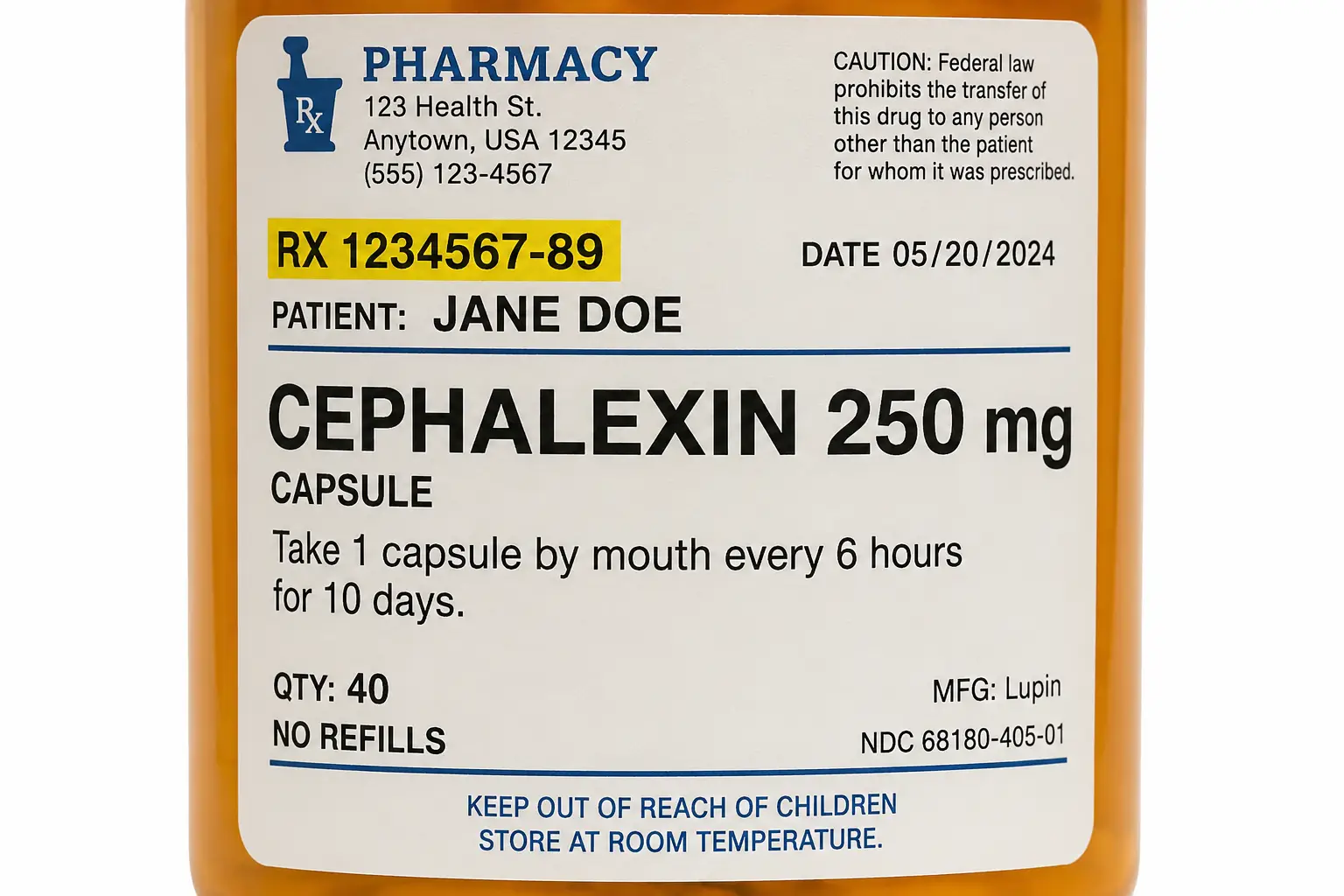
When the medical assistant prepares medications, it is important to compare the medication’s name and strength with the provider’s order. The first step in safely calculating a drug dosage is to accurately read the label of the drug on hand to determine whether the provider’s order and the packaged drug are in the same system of measurement. The label shows the following information:

  • Trade or brand name: The manufacturer’s name for the drug (e.g., Cardizem). The brand name is capitalized and typically in bold print. The brand name is copyright protected; therefore, it is followed by an ® symbol that indicates the US government has granted a Federal Registration Certificate for the drug.
  • Generic name: The drug name used by all manufacturers who make that specific medication (e.g., diltiazem HCl, cephalexin). The name is printed in lowercase letters and usually appears under the brand name in smaller print. If the patent and exclusivity have expired, only a generic name may be present on the label.
  • Strength: The amount of drug in the unit dose (e.g., 200 mg, 180 mg/5 mL). Each tablet of Cardizem is 120 mg. Cephalexin is a suspension (liquid), and the strength or unit dose is 250 mg (of powdered medication) per 5 mL (of liquid).
  • Total amount or total volume: Both liquid and solid medication labels indicate the amount of medication in the container.
Prescription bottle label showing cephalexin 250 mg dosage information.
Cephalexin 250 mg prescription label

Patents and exclusivity

A patent is granted on a drug for 20 years from the date of filing for the patent. Patents are granted at any point in time during the development of a drug.

Exclusivity is granted by the Food and Drug Administration (FDA) to give exclusive marketing rights to the manufacturers of the drug when it earns FDA approval. This exclusive marketing right can vary from 3 to 5 years. If a medication has been on the market longer than 20 years or after the exclusive rights to the drug have expired, the generic name may be the only one listed (e.g., meperidine instead of Demerol or diazepam rather than Valium).

Additional information on drug labels

Besides the information mentioned in the prior section, the drug label contains additional information that is useful to the medical assistant. Additional information found on the drug label includes the following:

  • Manufacturer: The name of the manufacturer of the medication.
  • Directions and storage: Instructions on how to take the medication and how to store the drug.
  • Expiration date: Indicates when the drug can no longer be used.
  • Lot number: Indicates the batch of drug the medication came from. The lot number is important to document when giving immunizations. Some agencies may require that lot numbers be documented for all medications administered.
  • National Drug Code (NDC): A unique 10-digit number indicating the product. The NDC is required by federal law to be on all prescription and nonprescription medication packages and inserts in the United States.

The medical assistant should also look at the expiration date.

Math basics

When working with math in healthcare, you need to thoroughly understand the addition, subtraction, multiplication, and division of fractions and decimals, the relationship between decimals and fractions, and how they are converted from one to the other.

Fractions

When you divide a whole unit into parts, you can create a fraction with a part. For instance, you cut a tablet into 2 parts; each part is . If you cut a pizza into 8 slices, each slice is . The top number in a fraction is the numerator, and the bottom number is the denominator.

Proper and improper fractions

In a proper fraction, the numerator is smaller than the denominator, such as . In improper fractions, the numerator is equal to or greater than the denominator, such as and . Improper fractions can be converted into whole numbers by dividing the numerator by the denominator. For example, if you had an improper fraction of , you would divide the numerator by the denominator, or 12 ÷ 3 = 4. Some improper fractions can be simplified. For example, would be 12 ÷ 5 = 2 , which is considered a mixed number. A mixed number is a whole number with a proper fraction.

Multiplying and dividing fractions

When multiplying fractions, you multiply the two numerators and the two denominators. Then you reduce the answer into the simplest form. Let us use this problem: . The two numerators are multiplied (1 × 2), and the two denominators are multiplied (6 × 4). The answer would be . Now we must reduce the fraction to its lowest terms. Two is the largest number that will divide equally into 2 and 24. Therefore, divide the numerator by 2 (2 ÷ 2 = 1) and the denominator by 2 (24 ÷ 2 = 12). Thus, the final answer would be.

To divide fractions, you must invert the divisor (the second fraction) and then multiply the numerators and denominators. Let us use this problem: . The divisor is , which needs to be inverted ( ). Next, we rewrite the problem and multiply the numerators and the denominators: . Multiplying the numerators (3 × 2) would be 6, and multiplying the denominators (5 × 3) would be 15. The answer would be , but it needs to be written in the simplest form. Three is the largest number that will divide equally into the 6 and 15. Therefore, divide the numerator by 3 (6 ÷ 3 = 2) and the denominator by 3 (15 ÷ 3 = 5). Thus, the final answer would be .

Decimals

A decimal is similar to a fraction, but it is expressed in units of tenths (0.1), hundredths (0.01), and thousandths (0.001). To perform drug calculations, fractions first must be converted into decimals. To convert a fraction into a decimal, simply divide the numerator by the denominator.

For example, if a dose of medication is mL, the provider’s order would be written in the decimal equivalent. To perform this math, you may need to add zeroes after the decimal point at the end of the numerator. The problem would be written: 2 ÷ 5. The answer would be 0.4 mL.

Percentage

A percentage is a number expressed as part of 100.

To convert a decimal to a percent, multiply the decimal by 100. Then add a percent sign (%). Another way to convert the decimal is to move the decimal point two spaces to the right and add a percent sign (%).

To convert a fraction to a percent, divide the numerator by the denominator. Multiply the answer by 100 and add a percent sign.

Examples

To convert a decimal to a percent, multiply by 100 and add the percent sign (%).

0.25=10025​=25%

0.5=10050​=50%

0.75=10075​=75%

0.055=1005.5​=5.5%

Pharmacology math

  • Absolute accuracy required in drug dosage calculations
  • Dosage ordered may differ from dosage on hand
  • No margin of error; mistakes can cause serious harm

Drug labels

  • Must verify medication name and strength with provider’s order
  • Label indicates measurement system (e.g., mg, mL)
  • Key info: trade/brand name, generic name, strength, total amount/volume

Patents and exclusivity

  • Patent: 20 years from filing date
  • FDA exclusivity: exclusive marketing rights (3–5 years)
  • After expiration, only generic name may be listed

Additional information on drug labels

  • Manufacturer’s name
  • Directions for use and storage instructions
  • Expiration date and lot number (important for documentation)
  • National Drug Code (NDC): unique 10-digit identifier

Math basics

  • Proficiency in basic operations with fractions and decimals required
  • Must understand conversion between decimals and fractions

Fractions

  • Numerator (top), denominator (bottom)
  • Represents part of a whole (e.g., 1/2, 1/8)

Proper and improper fractions

  • Proper: numerator < denominator (e.g., 3/5)
  • Improper: numerator ≥ denominator (e.g., 12/3)
    • Can be converted to mixed numbers (e.g., 12/5 = 2 2/5)

Multiplying and dividing fractions

  • Multiply: numerators × numerators, denominators × denominators, then simplify
  • Divide: invert divisor, then multiply as above, simplify result

Decimals

  • Expressed as tenths, hundredths, thousandths (e.g., 0.1, 0.01, 0.001)
  • Convert fraction to decimal: divide numerator by denominator

Percentage

  • Percent = part per 100
  • Decimal to percent: multiply by 100, add %
  • Fraction to percent: numerator ÷ denominator × 100, add %

Sign up for free to take 15 quiz questions on this topic

Previous
Next  | 35.1 Calculating tablet doses
All rights reserved ©2016 - 2026 Achievable, Inc.

Drug labels and core mathematical principles

Pharmacology math

Medical assistants are responsible for being absolutely certain that the medication they prepare and administer to a patient is exactly what the provider ordered. Although drugs often are delivered by the pharmacy or supplied by pharmaceutical representatives in unit-dose packaging, the dosage ordered may differ from the dosage on hand. In this case, the medical assistant must be prepared to calculate the correct dose accurately before dispensing and administering the medication. There is never a margin of error in drug calculations; even a minor mistake may result in serious complications for the patient. The medical assistant, therefore, must take meticulous care in calculating all drug dosages.

Drug labels

A drug label contains a lot of information. Some of the information is used when verifying the right medication and calculating the drug dose. Other information may be used when documenting medication. The following sections discuss the information found on drug labels.

Label information for drug administration

When the medical assistant prepares medications, it is important to compare the medication’s name and strength with the provider’s order. The first step in safely calculating a drug dosage is to accurately read the label of the drug on hand to determine whether the provider’s order and the packaged drug are in the same system of measurement. The label shows the following information:

  • Trade or brand name: The manufacturer’s name for the drug (e.g., Cardizem). The brand name is capitalized and typically in bold print. The brand name is copyright protected; therefore, it is followed by an ® symbol that indicates the US government has granted a Federal Registration Certificate for the drug.
  • Generic name: The drug name used by all manufacturers who make that specific medication (e.g., diltiazem HCl, cephalexin). The name is printed in lowercase letters and usually appears under the brand name in smaller print. If the patent and exclusivity have expired, only a generic name may be present on the label.
  • Strength: The amount of drug in the unit dose (e.g., 200 mg, 180 mg/5 mL). Each tablet of Cardizem is 120 mg. Cephalexin is a suspension (liquid), and the strength or unit dose is 250 mg (of powdered medication) per 5 mL (of liquid).
  • Total amount or total volume: Both liquid and solid medication labels indicate the amount of medication in the container.

Patents and exclusivity

A patent is granted on a drug for 20 years from the date of filing for the patent. Patents are granted at any point in time during the development of a drug.

Exclusivity is granted by the Food and Drug Administration (FDA) to give exclusive marketing rights to the manufacturers of the drug when it earns FDA approval. This exclusive marketing right can vary from 3 to 5 years. If a medication has been on the market longer than 20 years or after the exclusive rights to the drug have expired, the generic name may be the only one listed (e.g., meperidine instead of Demerol or diazepam rather than Valium).

Additional information on drug labels

Besides the information mentioned in the prior section, the drug label contains additional information that is useful to the medical assistant. Additional information found on the drug label includes the following:

  • Manufacturer: The name of the manufacturer of the medication.
  • Directions and storage: Instructions on how to take the medication and how to store the drug.
  • Expiration date: Indicates when the drug can no longer be used.
  • Lot number: Indicates the batch of drug the medication came from. The lot number is important to document when giving immunizations. Some agencies may require that lot numbers be documented for all medications administered.
  • National Drug Code (NDC): A unique 10-digit number indicating the product. The NDC is required by federal law to be on all prescription and nonprescription medication packages and inserts in the United States.

The medical assistant should also look at the expiration date.

Math basics

When working with math in healthcare, you need to thoroughly understand the addition, subtraction, multiplication, and division of fractions and decimals, the relationship between decimals and fractions, and how they are converted from one to the other.

Fractions

When you divide a whole unit into parts, you can create a fraction with a part. For instance, you cut a tablet into 2 parts; each part is . If you cut a pizza into 8 slices, each slice is . The top number in a fraction is the numerator, and the bottom number is the denominator.

Proper and improper fractions

In a proper fraction, the numerator is smaller than the denominator, such as . In improper fractions, the numerator is equal to or greater than the denominator, such as and . Improper fractions can be converted into whole numbers by dividing the numerator by the denominator. For example, if you had an improper fraction of , you would divide the numerator by the denominator, or 12 ÷ 3 = 4. Some improper fractions can be simplified. For example, would be 12 ÷ 5 = 2 , which is considered a mixed number. A mixed number is a whole number with a proper fraction.

Multiplying and dividing fractions

When multiplying fractions, you multiply the two numerators and the two denominators. Then you reduce the answer into the simplest form. Let us use this problem: . The two numerators are multiplied (1 × 2), and the two denominators are multiplied (6 × 4). The answer would be . Now we must reduce the fraction to its lowest terms. Two is the largest number that will divide equally into 2 and 24. Therefore, divide the numerator by 2 (2 ÷ 2 = 1) and the denominator by 2 (24 ÷ 2 = 12). Thus, the final answer would be.

To divide fractions, you must invert the divisor (the second fraction) and then multiply the numerators and denominators. Let us use this problem: . The divisor is , which needs to be inverted ( ). Next, we rewrite the problem and multiply the numerators and the denominators: . Multiplying the numerators (3 × 2) would be 6, and multiplying the denominators (5 × 3) would be 15. The answer would be , but it needs to be written in the simplest form. Three is the largest number that will divide equally into the 6 and 15. Therefore, divide the numerator by 3 (6 ÷ 3 = 2) and the denominator by 3 (15 ÷ 3 = 5). Thus, the final answer would be .

Decimals

A decimal is similar to a fraction, but it is expressed in units of tenths (0.1), hundredths (0.01), and thousandths (0.001). To perform drug calculations, fractions first must be converted into decimals. To convert a fraction into a decimal, simply divide the numerator by the denominator.

For example, if a dose of medication is mL, the provider’s order would be written in the decimal equivalent. To perform this math, you may need to add zeroes after the decimal point at the end of the numerator. The problem would be written: 2 ÷ 5. The answer would be 0.4 mL.

Percentage

A percentage is a number expressed as part of 100.

To convert a decimal to a percent, multiply the decimal by 100. Then add a percent sign (%). Another way to convert the decimal is to move the decimal point two spaces to the right and add a percent sign (%).

To convert a fraction to a percent, divide the numerator by the denominator. Multiply the answer by 100 and add a percent sign.

Examples

To convert a decimal to a percent, multiply by 100 and add the percent sign (%).

0.25=10025​=25%

0.5=10050​=50%

0.75=10075​=75%

0.055=1005.5​=5.5%

Key points

Pharmacology math

  • Absolute accuracy required in drug dosage calculations
  • Dosage ordered may differ from dosage on hand
  • No margin of error; mistakes can cause serious harm

Drug labels

  • Must verify medication name and strength with provider’s order
  • Label indicates measurement system (e.g., mg, mL)
  • Key info: trade/brand name, generic name, strength, total amount/volume

Patents and exclusivity

  • Patent: 20 years from filing date
  • FDA exclusivity: exclusive marketing rights (3–5 years)
  • After expiration, only generic name may be listed

Additional information on drug labels

  • Manufacturer’s name
  • Directions for use and storage instructions
  • Expiration date and lot number (important for documentation)
  • National Drug Code (NDC): unique 10-digit identifier

Math basics

  • Proficiency in basic operations with fractions and decimals required
  • Must understand conversion between decimals and fractions

Fractions

  • Numerator (top), denominator (bottom)
  • Represents part of a whole (e.g., 1/2, 1/8)

Proper and improper fractions

  • Proper: numerator < denominator (e.g., 3/5)
  • Improper: numerator ≥ denominator (e.g., 12/3)
    • Can be converted to mixed numbers (e.g., 12/5 = 2 2/5)

Multiplying and dividing fractions

  • Multiply: numerators × numerators, denominators × denominators, then simplify
  • Divide: invert divisor, then multiply as above, simplify result

Decimals

  • Expressed as tenths, hundredths, thousandths (e.g., 0.1, 0.01, 0.001)
  • Convert fraction to decimal: divide numerator by denominator

Percentage

  • Percent = part per 100
  • Decimal to percent: multiply by 100, add %
  • Fraction to percent: numerator ÷ denominator × 100, add %

More from Essential calculations and measurement systems

  • Math basics for medications