



Ethics, data interpretation, argumentation
Ethical procedures
Protecting participants from physical or psychological harm is essential. Researchers use several safeguards to make sure studies are conducted ethically.
Institutional reviews, such as reviews by Institutional Review Boards (IRBs), help protect human and animal participants. These systematic procedures evaluate research proposals to confirm that they are safe, follow regulations, and treat participants ethically.
Researchers must obtain informed consent (a participant’s voluntary agreement to participate after fully understanding the study’s purpose, procedures, and risks). When minors or others who are not legally able to give informed consent participate, informed assent is required. Assent shows the person’s willingness to participate, but it isn’t legally sufficient consent. When assent is given, informed consent must also be obtained from the participant’s parent or legal guardian.
Confidentiality is maintained by securely handling identifying data and reporting results in aggregate or anonymized form. Sometimes deception (misleading participants) is used to preserve the integrity of an experiment, but it must be ethically justified and followed by thorough debriefing. Debriefing explains the true nature of the study and addresses concerns after participation ends. One example of deception is the use of research confederates (researchers who pretend to be a bystander or fellow participant).
Data interpretation
Psychological research produces many kinds of data, from numerical scores to detailed narratives. Interpreting these data accurately is necessary for drawing meaningful conclusions.
There are two main types of research: quantitative and qualitative research.
- Quantitative research involves collecting and analyzing numerical data.
- Qualitative research involves identifying themes, patterns, or contradictions in observational data that can’t be quantified.
Using both quantitative and qualitative approaches can provide a fuller understanding of psychological phenomena.
What is the key difference between quantitative and qualitative research?
Quantitative research uses numerical data, while qualitative research analyzes patterns and themes in non-numerical data.
Quantitative research relies on the following data:
- Mean: The average value of a set of numbers. To calculate it, add all numbers together, then divide by the total number of values.
- Median: The middle value in an ordered list of numbers. To find it, sort the numbers from smallest to largest (or largest to smallest), then identify the value in the middle.
- Mode: The most frequent number in the data set.
- Range: The difference between the smallest and largest values in the data set. To calculate it, subtract the smallest number from the largest number.
- Standard deviation: The average distance of each data point from the mean (a measure of variability, or how spread out the data are).
- Percentile rank: The percentage of scores at or below a given score. For example, a score at the 80th percentile means 80% of scores in the data set fall at or below it.
- Statistical significance: An assessment of whether results are likely due to chance or reflect a real effect. A common measure is a p-value (often using <0.05 as a threshold for significance). A p-value of <0.05 means that if the null hypothesis were true, results this extreme or more extreme would occur less than 5% of the time.
- Effect size: The magnitude of the relationship between variables or the size of differences between groups. This helps interpret practical importance. Statistical significance suggests whether an effect exists; effect size indicates how meaningful that effect is.
How is statistical significance different from effect size?
Statistical significance shows whether an effect exists, while effect size indicates the magnitude or practical importance of that effect.
Based on the following table, what is the median and mode numbers of average hours per night of sleep amongst the participants?
| Participant number | Average number of hours/night of sleep |
|---|---|
| 1 | 5 |
| 2 | 7 |
| 3 | 6 |
| 4 | 5 |
| 5 | 8 |
| 6 | 6 |
| 7 | 6 |
| 8 | 5 |
| 9 | 6 |
| 10 | 7 |
| 11 | 6 |
Median is 6. Mode is 6. Median is the middle value (when numbers are ordered). When ordered, the list will look like this: 5, 5, 5, 6, 6, 6, 6, 6, 7, 7, 8. Then choose the value that is in the middle of those ranked values, which is the 6th number (the halfway point in a list of 11 numbers). The 6th number is 6, so the median is 6. Mode is the number that appears most frequently. The value 6 appears 5 times, which is the highest frequency, so 6 is the mode.
When interpreting research data, you must also consider regression towards the mean. When more data are collected, extreme values on a scale are often followed by values closer to the mean due to random variation. This matters in research design because accounting for it helps prevent incorrect conclusions.
To interpret relationships between variables, researchers examine correlation coefficients ( r ). This value ranges from -1 to +1 and describes both the strength and direction of the relationship between variables.
A scatterplot is a graph that visually displays these relationships. However, correlation does not imply causation. A correlation may occur because of confounding variables or because it’s unclear which variable influences the other. When you plot data, the distribution may appear as a normal distribution, right skew (positive skew), left skew (negative skew), or a bimodal distribution.
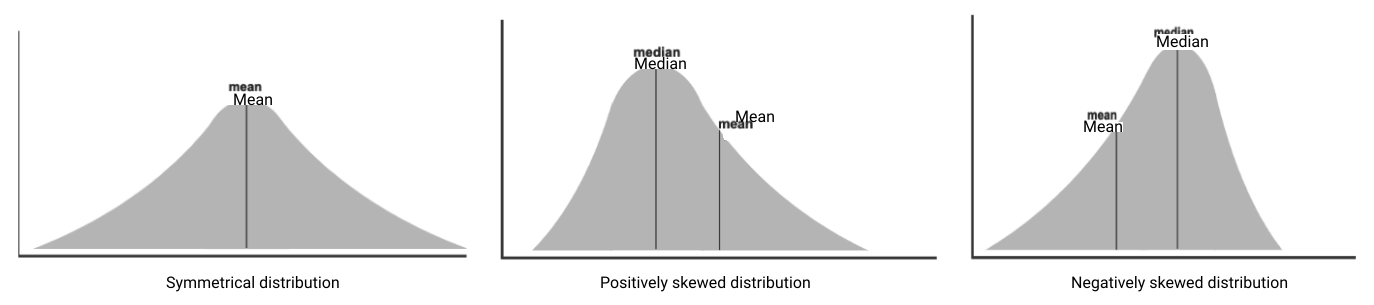
When data from a normal distribution are graphed, they form a bell curve with symmetry around the mean. Skewed distributions are asymmetrical. Because skew pulls the mean toward the tail, the median is typically a better measure of center than the mean for skewed data.
- Right skew (positive skew): Most data points cluster on the left side of the graph, with a long tail extending to the right (typically with the mean greater than the median).
- Left skew (negative skew): Most data points cluster on the right side of the graph, with a long tail extending to the left (typically with the mean less than the median).
- Bimodal distributions: The graph has two peaks, suggesting two distinct subgroups.
Argumentation
Effective psychological argumentation requires grounding claims in empirical evidence rather than opinion. When you support or critique policies, therapies, or theories, you should evaluate the quality of the research behind the claim. For example, the claim that mindfulness programs reduce stress needs support from peer-reviewed studies showing measurable outcomes.
Strong argumentation also addresses limitations, such as sample size, methodological constraints, ethical issues, and reproducibility. Critiquing a claim may involve identifying weaknesses in the research, sources of bias, or contradictory evidence. For example, if a study claims that a new therapy reduces anxiety, you might note that the sample included only 12 participants, there was no control group, and the results have not been replicated - each of which limits how confidently we can accept the conclusion. This kind of balanced evaluation reflects scientific thinking and critical scrutiny.